
How to Get More Monthly Listeners on Spotify: What Works
Learn how to get more monthly listeners on Spotify: the 28-day count, Release Radar pitching, Discover Weekly signals and a pre-release timeline.
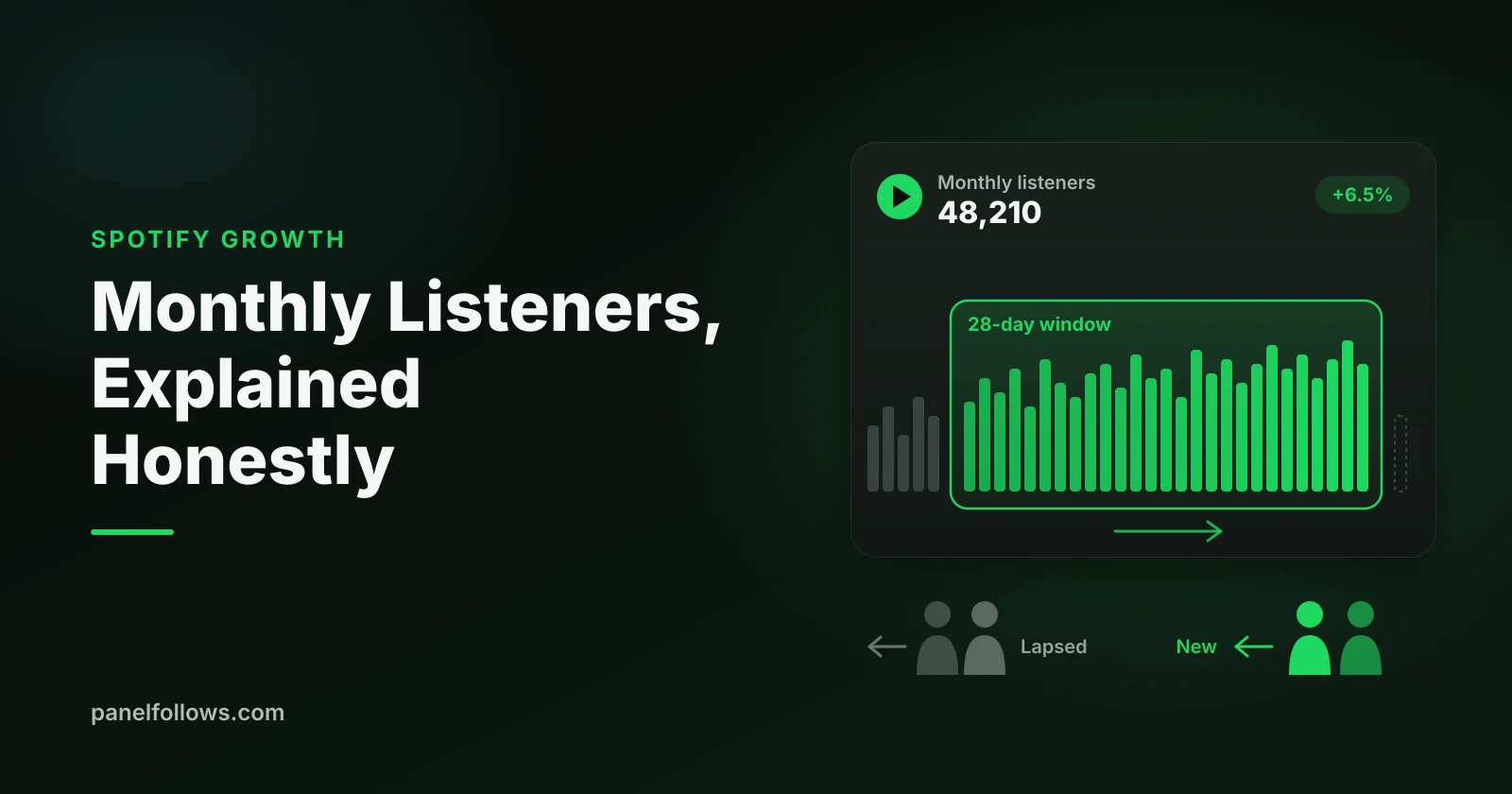
To get more monthly listeners on Spotify, you need more unique people playing your music within a rolling 28-day window. The durable way to get them: release on a steady schedule, pitch every release in Spotify for Artists at least seven days early so it reaches your followers' Release Radar, and bring in listeners who save and replay the song. Bought streams can be removed and can cost you royalties.
Most pages ranking for this question are lists of promotion services. This one starts with what the number actually counts, then covers how Release Radar, Discover Weekly and editorial pitching work, which listener behaviors seem to drive algorithmic playlists, a pre-release timeline you can copy, and what Spotify's artificial streaming rules mean for anyone thinking about buying plays. Organic methods come first because for this platform they are the better answer.
Facts in this guide were checked in October 2026. Spotify's definitions of monthly listeners and audience segments were confirmed against its support documentation. The pitching windows and policy consequences described here follow Spotify for Artists guidance as published, but Spotify changes its tools often, so check the current wording in your own dashboard before you plan around a date. Anything Spotify has not said itself is labeled as observation.
What does Spotify count as a monthly listener?
A monthly listener is one unique person who played your music on Spotify during the most recent 28 days. Someone who plays your single fifty times counts once. Someone who hears one song on a playlist also counts once. The number measures reach, not depth, and it is not a lifetime fan count.
Two details matter. First, the window rolls: every day the oldest day drops out and a new day is added, so the number can move even when you have done nothing. Second, a play generally has to pass the 30-second mark to count as a stream, as Musosoup's explainer on the calculation notes. A listener who skips your intro after ten seconds does not add a stream. Spotify has not documented exactly how very short plays are treated in the listener count, so assume a ten-second skip does nothing useful for you.
Why 28 days and not a calendar month? Spotify has not published an official rationale, but explainers such as Best Friends Club's streams vs listeners breakdown point out that a 28-day window always contains exactly four of each weekday. People listen differently on a Friday than on a Tuesday, so a window with the same mix of weekdays keeps day-to-day comparisons fair.
Spotify for Artists also splits your audience into segments, and this is where the headline number starts to become useful. According to Spotify's support page on audience segments:
| Segment | What Spotify says it means | Why you care |
|---|---|---|
| Monthly active listeners | People who intentionally streamed you in the past 28 days from active sources: your artist profile, your release pages, or their own library and playlists | These people chose you. This is the core you are building |
| Previously active listeners | Former active listeners who have not intentionally streamed you in at least 28 days, though they may still hear you through programmed sources | Lapsed fans. A new release is your best chance to bring them back |
| Programmed listeners | People who have only heard you through programmed sources: editorial playlists, other listeners' playlists, AI DJ, and personalized playlists such as Discover Weekly, Radio and Autoplay | Reach you did not earn directly. Some will convert, most will not |
The public monthly listener count on your profile includes all of these together. Two artists with 5,000 monthly listeners can have very different careers: one with 3,000 active listeners, one with 200 active listeners and a single lucky playlist slot. Orphiq's analytics guide makes the same point: monthly listeners and monthly active listeners are separate numbers, and the gap between them shows how much of your reach is an actual fan base.
| Metric | What it counts | Window | What it tells you |
|---|---|---|---|
| Monthly listeners | Unique people who played you | Rolling 28 days | Current reach |
| Streams | Plays past roughly 30 seconds | Any period you pick | Listening volume |
| Followers | People who followed your profile | Cumulative | Who gets your new releases in Release Radar |
| Saves and playlist adds | People who kept a song | Any period you pick | Intent, the best early signal of a song that lasts |
| Monthly active listeners | Intentional listeners from active sources | Rolling 28 days | The real size of your fan base right now |
Why do monthly listeners rise and fall when nothing changed?
Monthly listeners drop when the days on which people found you slide out of the 28-day window and those people have not come back. Nothing is broken and nobody is penalizing you. The window is just moving.
Here is a hypothetical example. Say you are an indie folk artist with 600 monthly listeners. A mid-sized user playlist adds your song for one week, and 2,400 new people hear it. Your count jumps to around 3,000. Four weeks after the first day of that placement, those listening days start dropping out. Unless a meaningful share of those people saved the song, followed you or came back on their own, you slide toward 600 again over the following week. That drop is the 28-day cliff, and every short promotion has one.
The cliff tells you something useful. If you land at 900 instead of 600, roughly 300 people stuck. That is the real result of the campaign, and it is a much better number to track than the peak. De Novo Agency's explainer recommends checking the number before, during and after a release push for exactly this reason.
Two things follow for planning. A single release every eight months gives you one spike and a long slide, while a release every four to eight weeks keeps fresh listening days in the window. And growth that matters shows up as a rising floor between releases, not as a higher peak.
How does the Spotify algorithm decide who hears your song?
Spotify does not publish the weights its recommendation systems use, so nobody outside the company can give you a formula. What you can know is which placements Spotify has documented, which ones you can influence directly, and which popular claims are guesses.
| Claim in circulation | Status |
|---|---|
| Release Radar includes new releases from artists a listener follows | Documented by Spotify |
| Pitching an unreleased song at least 7 days before release puts it on your followers' Release Radar | Documented in Spotify for Artists pitching guidance |
| You cannot pitch to Discover Weekly, Radio or Autoplay; they are personalized | Documented by Spotify; only editorial playlists accept pitches |
| Streams from bots, paid stream farms or "guaranteed streams" services break Spotify's rules | Documented policy |
| Discovery Mode trades a lower royalty rate for more exposure in personalized contexts | Documented Spotify product |
| Saves, playlist adds and repeat listens help a song get recommended | Widely observed and consistent with how recommendation systems work, but Spotify has not published weights |
| Early skips hurt a song | Plausible: a play under 30 seconds does not count as a stream. The exact weight is unknown |
| A song needs a specific number of streams or saves (often quoted as 20,000 streams or a 20% save rate) to reach Discover Weekly | Not confirmed by Spotify. Treat as folklore |
| Using Spotify for Artists or uploading on a certain weekday triggers a boost | Not confirmed |
The useful model looks like this. Personalized playlists try to match songs to listeners who will probably like them. When a song reaches a group of people and they save it, add it to their own playlists, replay it or move on to your profile, the system has evidence that it was a good match for that kind of listener. When they skip in the first seconds, it has evidence that it was not.
That is why who hears a song matters as much as how many people hear it. Five hundred well-matched listeners who save the track tell the system more than 5,000 random listeners who skip it. It is also why streams from people who are not your audience (bots, click farms, mismatched paid campaigns) are worse than useless: they teach the recommendation system the wrong things about who your music is for.
You will not see a skip rate in Spotify for Artists. What you can track per song is streams, listeners, saves and playlist adds, plus where streams came from. Two proxies cover most of what you need: streams per listener (a higher ratio means more people come back) and saves per listener (the share of people who kept the song). Neither has an official target. Compare your own songs against each other.
How does Spotify Release Radar work, and how do you get on it?
Release Radar is a personalized playlist updated every Friday with new music from artists a listener follows, plus some new releases the system expects them to like. For your followers you can make sure you are included: pitch an unreleased song from the release in Spotify for Artists at least seven days before the release date.
This is one of the most underrated growth levers on Spotify, because it is the one personalized placement you control. When you pitch on time, every follower gets your song in a playlist built for them, which many listeners check each week. Miss the seven-day window and you lose that guarantee. Surprise drops uploaded the night before are the most common way artists lose it.
What this means in practice:
- Followers are worth more than they look. A follower is someone who will be shown your next release. Ask for follows directly (in videos, at shows, in your bio links), not just plays.
- Every release gets a pitch. Even if you have no hope of an editorial playlist, the pitch is how you secure Release Radar.
- Schedule ahead with your distributor. You can only pitch music that your distributor has delivered and that appears as upcoming in Spotify for Artists. Distributors often recommend uploading several weeks ahead, and delivery can be slower than you expect.
- Credits matter. Collaborations with properly credited artists can reach both artists' followers. Get the artist credits right at upload, because fixing them later is slow.
Release Radar placement does not guarantee a listen. People scroll past songs. But for a small artist with an engaged following it can be one of the bigger sources of first-week streams (check the source breakdown for your own past releases), and it costs nothing but planning.
See live pricing in the panel
Unit prices for follower, like, view and engagement services are listed live. Registration is free and you can browse the list before adding any balance.
How do you pitch to Spotify editorial playlists?
You pitch through the Music section of Spotify for Artists by picking one unreleased song from an upcoming release and filling in a form about genre, mood, instrumentation, culture and the story behind the track. Editors read pitches but place only a small share of them. The pitch is still worth doing for every release, because it also secures Release Radar.
- Get the release delivered early. Upload to your distributor with the final master, artwork and correct credits, ideally four or more weeks ahead of the release date.
- Confirm access. Make sure you have artist-level access to your profile in Spotify for Artists, and that the upcoming release shows in the Music tab.
- Choose the right song. You pitch one song per release. Pick the track with the strongest first 30 seconds, not the one you are proudest of.
- Fill in metadata honestly. Genre and mood tags help editors route your pitch. Tagging a lo-fi bedroom track as "pop, dance, party" sends it to the wrong desk.
- Write a specific description. Two or three concrete sentences: what the song is, who it sounds next to, why it exists, and what you are doing to promote it (a tour date, a video, press, a sync). "This is my best song yet" tells an editor nothing.
- Submit well before the seven-day cutoff. Editors need time. Pitching at the last moment technically counts for Release Radar but gives editors less time to listen.
- Do not count on the result. Plan the release as if no editorial placement will happen. If one does, you have a bonus.
Editorial placement brings programmed listeners, and many of them leave when the playlist rotates you out. That is not a reason to skip the pitch. It is a reason to judge the placement by how many people saved or followed afterward, not by the spike.
How do Discover Weekly, Radio and Autoplay pick up a song?
Discover Weekly, Radio and Autoplay are personalized and cannot be pitched. Discover Weekly refreshes each Monday with songs Spotify thinks a listener has not heard but will like. A song gets into these surfaces when enough real listeners respond well to it, so your job is to put it in front of the right people and give them reasons to keep it.
Things that help the signals you can influence:
- Get to the point fast. If the hook arrives at 0:45, many first-time listeners leave before the 30-second stream mark. Consider an edit that starts closer to the hook.
- Target the right audience off-platform. A short video that reaches fans of similar artists brings listeners who are more likely to save. A viral clip that reaches the wrong audience brings skips.
- Ask for the save, not just the play. "Save it if you like it" is a reasonable ask in a caption or a live set. Saves and playlist adds are how people keep a song.
- Fill out your profile. An updated bio, Artist Pick, and Canvas (the short looping visual) give a curious listener something to land on, which helps turn a programmed listener into an active one.
- Release often enough to stay in rotation. A catalog that grows gives the system more of your songs to recommend to people who liked one.
Discovery Mode is Spotify's paid option here, and it deserves a straight description. Through your distributor or label, you can opt selected tracks into Discovery Mode, which gives them more exposure in certain personalized contexts such as Radio and Autoplay in exchange for a lower royalty rate on streams from those contexts. It is a real trade: more exposure for lower pay per stream. Eligibility and terms come from your distributor, so read their current terms before you opt in.
A pre-release timeline that gives each song its best shot
The fixed point in every Spotify release is the seven-day pitch deadline. Everything else is planned backward from the release date so the song reaches followers, editors and the right new listeners at once. Here is a timeline for a single, which you can stretch for an EP.
| When | What to do | Why |
|---|---|---|
| 4 to 6 weeks before | Finish master and artwork, upload to distributor, set release date, double-check credits | Delivery delays are the top reason artists miss the pitch window |
| 3 to 4 weeks before | Pitch the song in Spotify for Artists; set up a pre-save or countdown link if available to you | Gives editors time, locks in Release Radar |
| 2 to 3 weeks before | Post short video teasers built around the hook; update bio and profile images | Builds a group of people ready to listen on day one |
| 7 days before | Final deadline for the pitch | After this, followers' Release Radar is not guaranteed |
| Release day and week | Post the song with a direct link; message your mailing list and close fans; ask for saves and playlist adds | Concentrated early response from people who actually like you |
| Weeks 2 to 4 | Keep posting new angles on the same song; reach out to independent curators who do not charge for placement | Feeds new listening days into the 28-day window |
| Day 28 and after | Read the cliff: compare active vs programmed listeners and saves per listener to your last release | Tells you what actually grew |
The pattern to avoid is a release with all the effort on day one and nothing in weeks two to four. A song that keeps finding the right people for a month gives the personalized surfaces more evidence than one loud day followed by silence.
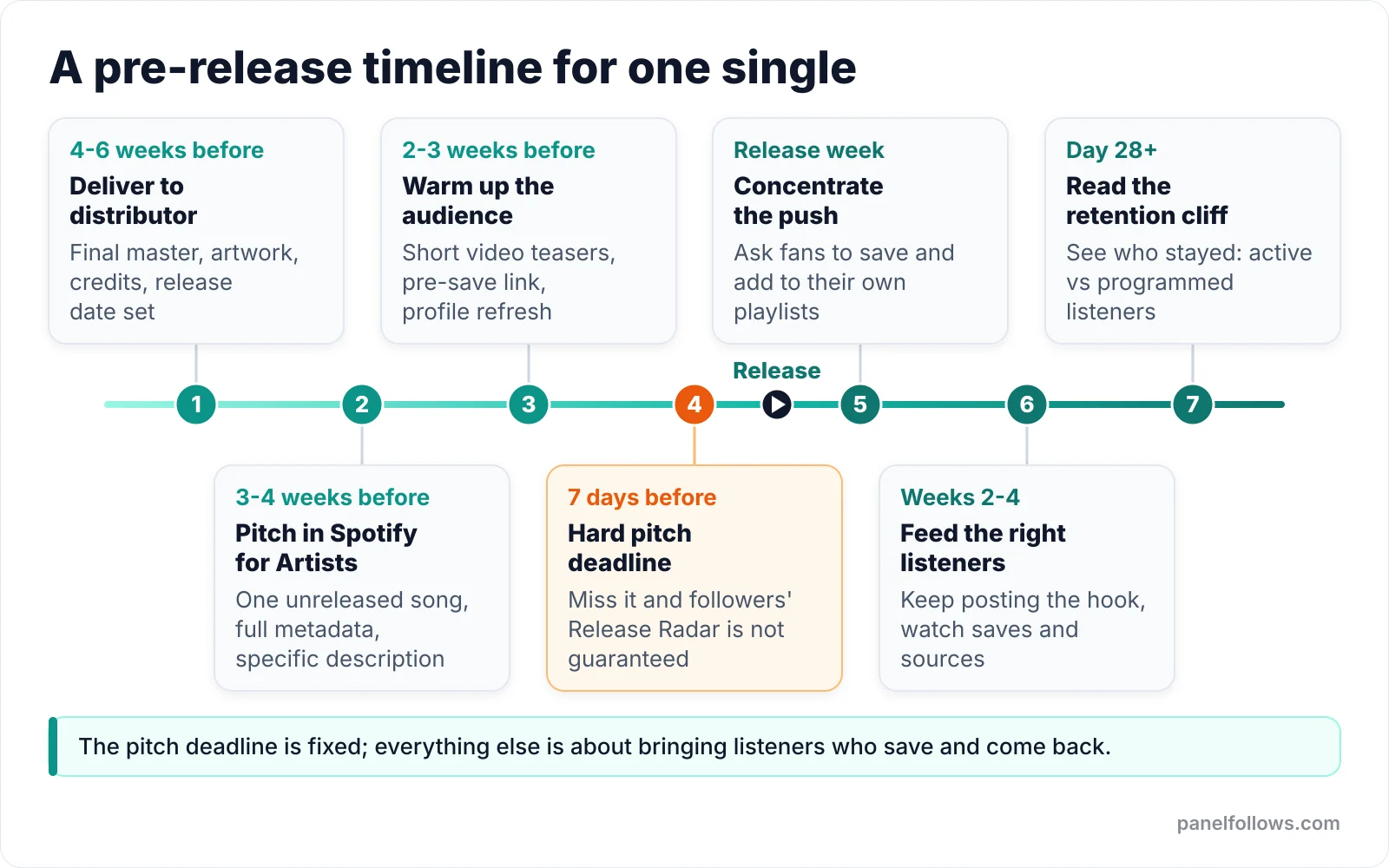
Plan backward from the release date so the pitch lands well before the seven-day Release Radar cutoff.
How to get more monthly listeners on Spotify for free
Free growth on Spotify comes from things you control: release consistency, followers who receive your Release Radar slot, and off-platform content that sends well-matched listeners to your profile. None of it is instant, but all of it builds the floor between releases instead of a temporary peak.
Short video is often the strongest free channel for independent artists. One clip of a song rarely works. Ten different clips of the same hook (a performance, the story behind a lyric, a before-and-after of the production) give it ten chances. The same viewing mechanics we describe for why TikTok videos stall and how to fix them apply here: retention beats posting volume. If you also post on Instagram, our Reels and Explore guide covers how those surfaces choose what to show non-followers.
Turn listeners into followers. Everyone who follows you gets your next release in Release Radar. Put a follow ask on your link page, in your video captions and on a slide at shows. A QR code at the merch table that opens your Spotify profile costs nothing.
Collaborate with artists at your level. A properly credited collaboration can reach both artists' followers and helps link your audiences, which is part of how a listener of one artist starts seeing the other recommended. Choose collaborators whose fans would plausibly like you. A mismatch brings skips.
Use honest independent playlists. Many genre curators accept submissions without charging for placement. Look at a playlist's follower count against its real engagement. A playlist with 80,000 followers that sends almost no streams is a red flag (more on this below).
Play live and capture people. A show is one of the few places where strangers hear your whole song with no skip button. Give them one clear next step, follow on Spotify, rather than five links.
Release more often. You do not need an album every year. A single every four to eight weeks, or a song from a recorded batch released in sequence, keeps the 28-day window full.
How to get your first 1,000 monthly listeners on Spotify
Getting to 1,000 monthly listeners means about 1,000 different people playing you within the same 28 days. For a new artist that is rarely one source. It is a stack of small, repeatable ones lined up around a release.
Here is a hypothetical stack for an artist starting from about 150 monthly listeners, mostly friends and family. The numbers are illustrations, not benchmarks:
- Own network and mailing list: perhaps 150 to 250 people if you ask directly and personally on release day.
- Release Radar for followers: with 300 followers, maybe a third to a half press play in release week.
- Short video: two or three clips that reach fans of similar artists might send a few hundred new listeners over four weeks.
- One or two independent curator playlists that accept free submissions: a few dozen to a few hundred listeners, depending on the playlist.
- A local show or open mic with a QR code: dozens, but often your highest-saving listeners.
- Personalized surfaces: if the earlier listeners save and replay, Radio and Autoplay may start adding listeners you never reached directly.
Add those up and 1,000 in a 28-day window is realistic for a focused release, even if you fall back below it after the cliff. The goal of the next release is to fall back to a higher floor than the last time. Two or three releases in a row that each end higher is how 1,000 becomes the starting point instead of a peak. If short video is your main channel, the habits in our guide to your first 1,000 TikTok followers carry over directly.
Can you buy monthly listeners on Spotify?
You can buy plays and followers. Many sellers offer them, including the Spotify plays and Spotify followers listings in our own catalog. But buying artificial streams violates Spotify's rules, and for an artist who distributes music to earn royalties the downside is real. We do not claim it is safe, and we do not recommend it for a catalog you want to earn from.
What Spotify's artificial streaming guidance says it may do when it detects artificial streams: remove the affected streams, withhold the related royalties, correct stream and listener counts, and in serious cases remove the release from Spotify. Spotify also tells artists to avoid third-party services that guarantee streams or playlist placements. Since 2024, Spotify has charged labels and distributors a per-track fee when it detects flagrant artificial streaming on their releases. Many distributors respond by taking down the affected music or closing the account, and some pass charges to the artist. Read your distributor's terms on this before anything else.
Also since 2024, a track needs at least 1,000 streams in the previous 12 months to generate recorded royalties. Buying streams to get a track over that threshold is still artificial streaming, so it carries the same risks described above.
Then there are the practical costs:
- Bought plays do not save, follow or come back. They add nothing to the signals that drive personalized playlists, and can dilute the real ones.
- They corrupt your data. Cities, ages and listener sources in Spotify for Artists stop reflecting your real audience, which breaks ad targeting and tour routing.
- Bot playlists are the hidden version. Some pay-for-placement playlists have big follower counts that are themselves fake, and their streams can be flagged against your track. You may not know until streams disappear.
- The cliff is worse. Bought listeners vanish from the 28-day window and leave nothing behind.
If you want to spend money on Spotify itself, there are better places to start: Spotify's own campaign tools in Spotify for Artists (such as Marquee and Showcase, where eligible), Discovery Mode with its royalty trade-off, or paid ads on social platforms aimed at fans of similar artists, sending people to your Spotify link. These bring real listeners, even if they are more expensive per listener than a bot.
If you do buy anything from any seller, keep in mind that platform terms prohibit it, check each listing's details, and understand that drops and removals are possible. Our explainer on why counts drop and how refill guarantees work describes what a refill does and does not cover, and the full catalog with each service's terms is on the services page.
A 28-day protocol to measure what is working
The only reliable way to learn what grows your monthly listeners is to measure your own releases against each other across a full 28-day window. Here is a simple protocol you can run on your next single.
- Record a baseline the day before release. Note monthly listeners, monthly active listeners, followers, and the source breakdown for the past 28 days.
- Log every push with a date. Each video posted, each playlist add, each show, each newsletter. One line each in a spreadsheet.
- Check daily for the first week, then weekly. Watch streams, listeners and saves for the new song, and which sources are growing.
- Calculate two ratios at day 7 and day 28: streams per listener and saves per listener for the new song. Compare them with your previous release, not with numbers from the internet.
- Match spikes to your log. If a spike follows a specific video or playlist add, note it. That channel gets more effort next time.
- Read the cliff at day 35. Compare monthly active listeners and followers with the baseline. This is your real gain.
- Change one thing for the next release. A different hook in the first 15 seconds, a different video format, an earlier pitch. Change one variable so you can tell what worked.
If you want a sense of how this kind of ratio thinking works across platforms, our guide to calculating engagement rate uses the same idea: pick a denominator and compare like with like.
Open your account and order in minutes
Signing up is free and takes two steps. Top up with card, bank transfer or crypto, place your order and track delivery from the dashboard.
Frequently asked questions
How can I get more monthly listeners on Spotify for free?
Pitch every release in Spotify for Artists at least seven days before release so your followers get it in Release Radar. Grow followers on purpose, post several short videos built around each song's hook, collaborate with artists at your level, and submit to independent curators who do not charge. Release every four to eight weeks so new listening days keep entering the rolling 28-day window. None of these cost money, and all of them build the floor between releases.
What does Reddit say about getting more monthly listeners?
Music subreddits mostly agree on the basics: release consistently, use short video, pitch every release, and avoid paid playlists that guarantee streams, because many are bot-driven and can get streams removed. Where threads often go wrong is repeating specific thresholds, such as a set number of streams for Discover Weekly, as if they were rules. Spotify has not published thresholds like that, so treat them as one person's experience and test against your own data.
How do I see who has the most monthly listeners on Spotify?
Monthly listeners appear on every artist's profile in the Spotify app, under the artist name. Spotify does not publish an official leaderboard ranked by monthly listeners, so ranked lists come from third-party chart trackers that collect profile numbers. For your own account, Spotify for Artists shows listeners over time, the audience segments and where your streams came from, which is far more useful than the public number.
How many monthly listeners do you need to get paid on Spotify?
There is no monthly listener threshold for payment. Royalties are paid on streams through your distributor or label. Since 2024, Spotify has required a track to reach at least 1,000 streams in the previous 12 months before it generates recorded royalties. Monthly listeners matter indirectly: more unique listeners usually means more streams, and a larger active audience gives each new release a stronger start.
Does playing my own song on repeat increase monthly listeners?
No. You count as one monthly listener no matter how many times you play your own music. Looping your own tracks to inflate streams, especially across multiple accounts or devices, is the kind of behavior Spotify's artificial streaming rules address, and it can lead to streams being removed. Listening to your own release a few times like a normal fan is fine. Running playback overnight to boost numbers is not.
Does pitching to Spotify editors guarantee a playlist placement?
No. Editors place only a small share of the songs pitched to them, and you get no detailed feedback when a pitch is not chosen. What pitching does guarantee is that your release appears in your followers' Release Radar, as long as you pitch at least seven days before release. That alone makes it worth doing for every release, even if you never expect an editorial slot.
Why did my monthly listeners drop after a playlist placement ended?
Monthly listeners count unique people over a rolling 28 days, so when a playlist rotates your song out, the people who heard it there drop out of the window about four weeks later unless they come back. That fall is normal. The useful question is how far it falls: if you land higher than your baseline, some playlist listeners became real fans. Check monthly active listeners and new followers to see how many stayed.
Can buying Spotify streams get my music removed?
It can. Spotify says it may remove artificial streams, withhold royalties and, in serious cases, take releases down. It also charges labels and distributors a per-track fee for flagrant artificial streaming, and many distributors respond by removing the music or closing the account. No seller can promise this will not happen. If you earn royalties from your catalog, the risk falls on the work you most want to protect.
Are Spotify followers more important than monthly listeners?
For long-term growth, followers often matter more. Monthly listeners show reach over the past 28 days and swing with every release and playlist. Followers stay until they unfollow, and each one receives your new music in Release Radar when you pitch on time. A rising follower count with a steady listener floor usually means a healthier career than a spiky listener count with few followers.
Sources and further reading
- Spotify: Audience segments on Spotify: Spotify's official definitions of monthly active, previously active and programmed listeners.
- Musosoup: Spotify monthly listeners, how they are calculated: plain-language explainer of the rolling 28-day window and the 30-second stream mark.
- Best Friends Club: Streams vs monthly listeners on Spotify: why Spotify uses a 28-day window with equal weekdays.
- Orphiq: Spotify for Artists analytics: how monthly listeners differ from monthly active listeners and how each analytics view uses its time window.
- De Novo Agency: Spotify monthly listeners explained: using the metric across a release cycle and reading listener sources.