
How Much to Charge for a Sponsored Post: A Rate Card Method
How much to charge for a sponsored post, built from your real views, deliverables, usage rights, exclusivity and whitelisting. Example rate card included.
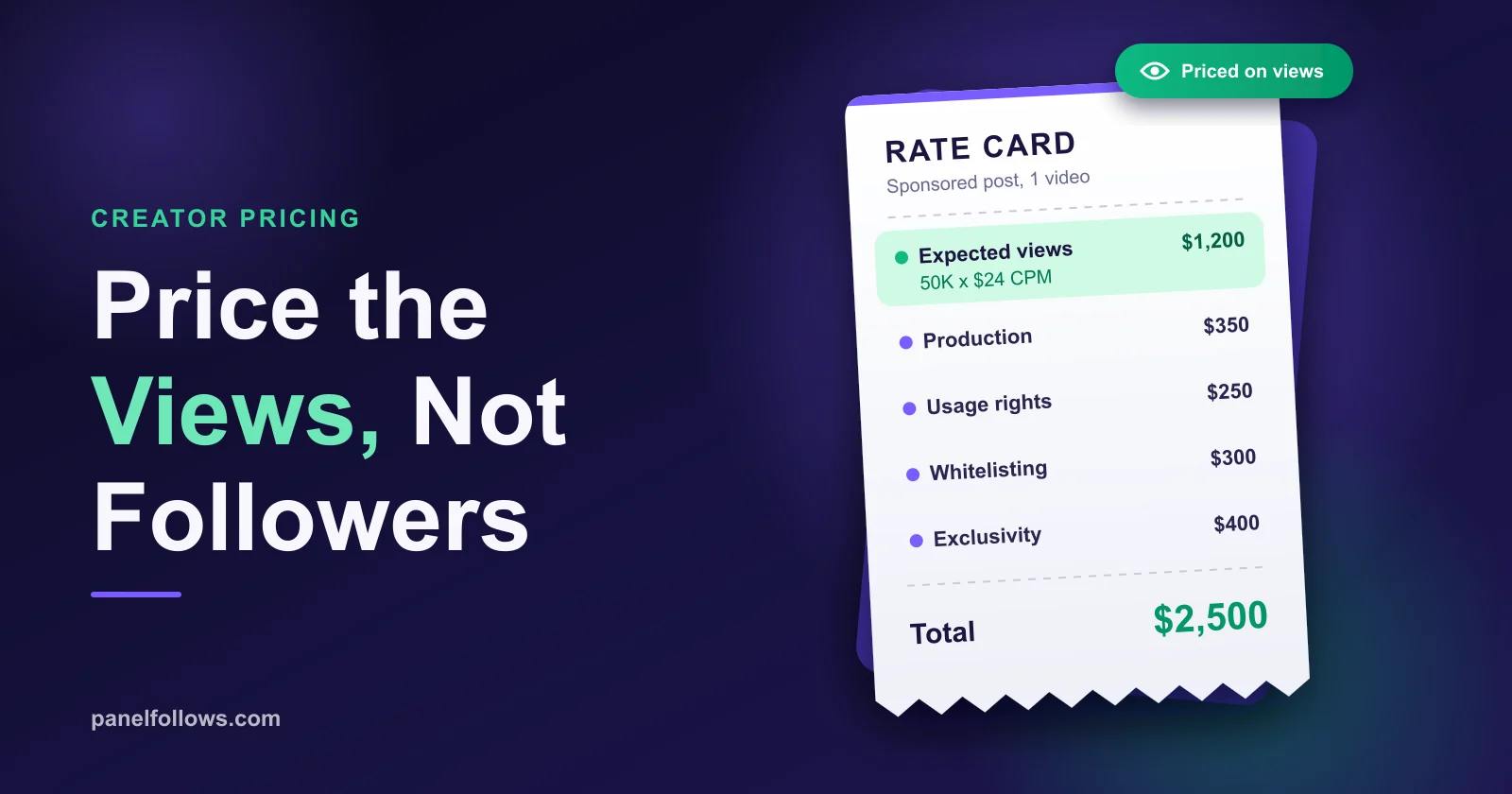
Charge for a sponsored post based on the views you can realistically deliver, not your follower count. Take the median views of your last 10 to 15 comparable posts, take a little off because sponsored posts usually underperform, multiply by a per-thousand-views rate that fits your niche, and add your production cost. Then price usage rights, whitelisting and exclusivity as separate line items, because each one is a separate product.
The rest of this guide shows how to run the numbers on Instagram and TikTok (with notes for YouTube), what published benchmarks can and cannot tell you, how to price the add-ons brands slip into contracts, a clearly labeled example rate card, and word-for-word negotiation scripts. Facts in this guide were checked in October 2026.
One honesty note: every "going rate" online comes from agencies, marketplaces and software vendors, not from the platforms, which do not publish creator rates. Use benchmarks as a sanity check, not as the number.
Why is follower count the wrong place to start?
Follower count is the wrong place to start because brands are not buying your followers. They are buying the attention a specific post gets, and on recommendation-driven feeds that is only loosely tied to follower count. The familiar rule of thumb (around $100 per 10,000 followers) survives because it is easy to remember, not because anyone buys media that way.
Take two hypothetical accounts with 40,000 followers each. One gets 4,000 views on a typical Reel because its audience followed years ago for content it no longer posts. The other gets 35,000 views because its videos travel to non-followers. A per-follower rule charges them the same, yet a brand paying both would see a cost per view almost nine times higher on the first.
Brands that run creator programs at any scale think in cost per thousand views (CPM), the unit they use for paid ads. They divide your fee by the views the post got and compare the result with what Meta or TikTok ads would have cost. If you beat that, or delivered something ads can't (trust, a reusable creative asset), you get rebooked.
A sponsored post also bundles four different things, and most underpricing happens because creators quote for the first and give away the rest:
| Component | What the brand gets | How to price it |
|---|---|---|
| Distribution | Views from your audience and from recommendations | Expected views x your per-thousand rate |
| Production | A finished video or image: concept, script, shoot, edit, revision | Your time, which sets a floor even when views are low |
| Rights | Permission to reuse the content on their channels or in ads | A percentage of the base fee per 30 days, by type of use |
| Restrictions | You avoiding competitors, or ads running from your handle | A percentage of the base fee per 30 days, by scope |
Distribution and production make up your base fee. Rights and restrictions are add-ons that scale with time. A brand that wants to run your Reel as an ad for three months while you avoid competitors pays the base fee plus three months of two add-ons. That can easily double the deal, and it should.
How do you calculate your base rate from average views?
To calculate your base rate, turn your recent performance into an expected view count, multiply it by a per-thousand rate, and check the result against a production floor. This is the procedure I use with creators.
- Pull comparable posts. List the views of your last 10 to 15 posts in the format the brand wants (Reels for a Reel deal, Stories for a Story deal). Skip anything older than about 90 days, because your reach back then may not match your reach today.
- Use the median, not the average. One viral post can double an average. The median is what a typical post does, and a typical post is what you are promising.
- Apply a sponsored haircut. Sponsored content usually lands below a creator's organic median, because viewers skip ads and you have less creative freedom. I take 10 to 20 percent off. If you have past sponsored posts, use your own gap instead.
- Multiply by your per-thousand rate. Divide expected views by 1,000 and multiply by your CPM. The next section covers how to choose it.
- Add production. Estimate the hours for concept, script, shoot, edit and one revision round, multiply by a fair hourly rate, and add hard costs such as props or a location.
- Check your floor. Because production is added on top of distribution, the quote can never fall below the time the work takes. On a small account the distribution part may be tiny, so production will be most of the fee, and that is correct: smaller accounts should never price below the time the work takes. If a brand pushes you under that line, reduce the deliverables rather than your hourly value.
- Round it and date it. Record the price on your rate card with the date and the median it came from, so you can update it next quarter.
As a formula: base fee = (median views x (1 minus haircut) / 1,000 x CPM) + production cost, and production cost is the minimum you accept.
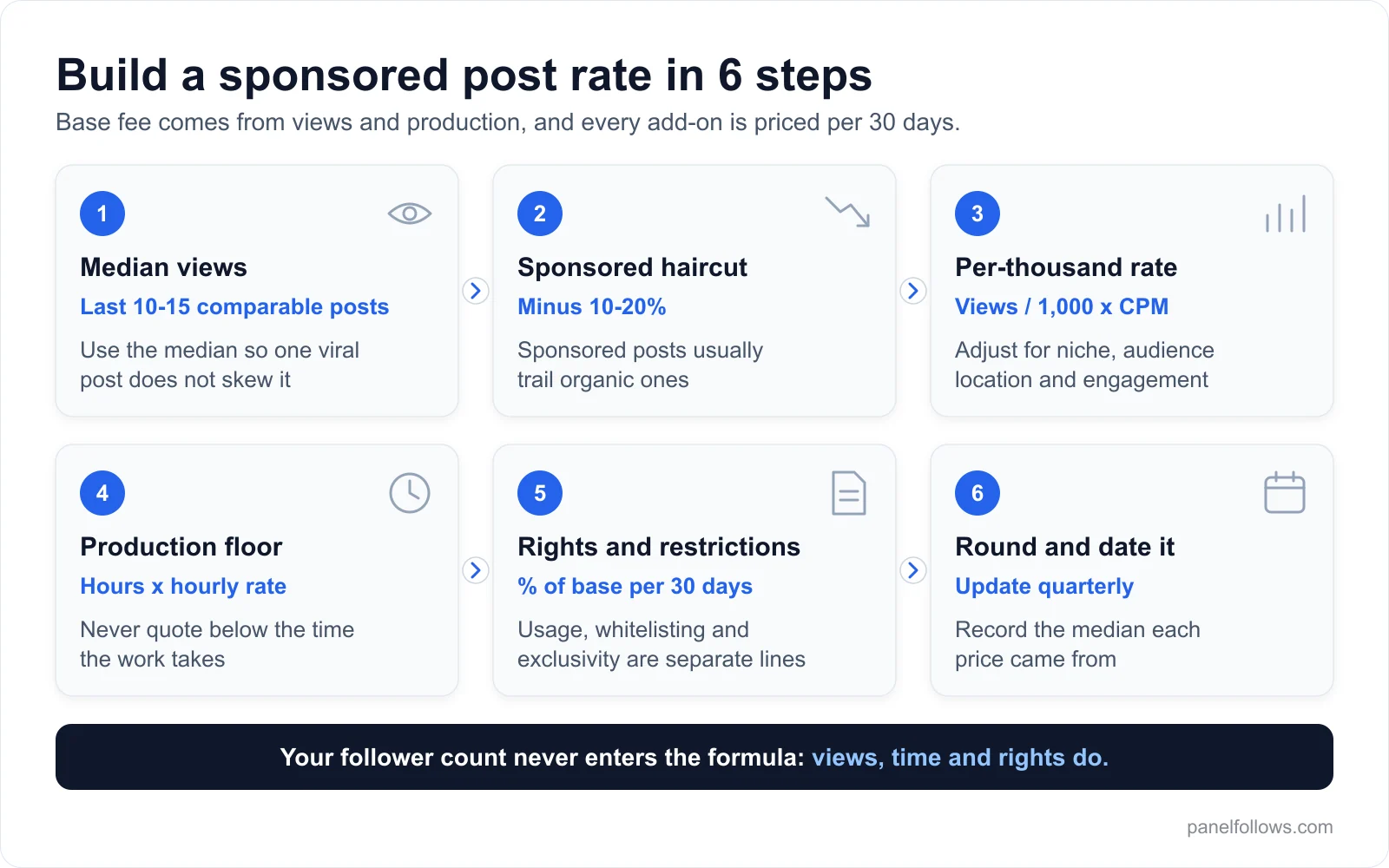
Base fee comes from views and production, and every add-on is priced per 30 days.
Say you run a hypothetical skincare account. Your last 12 Reels have a median of 18,000 views. A 15 percent haircut leaves 15,300 expected views. At a $20 CPM the distribution part is about $306. A sponsored Reel takes you about five hours, valued at $40 an hour, so production is $200. The base fee comes to about $506, rounded to $500. Your follower count never entered the calculation.
One warning belongs here, not in a footnote. If the views in step 1 are bought, the method works against you: your quote looks higher, the brand's own CPM math after the campaign looks terrible, and you lose the client. FTC staff guidance says fake likes are deceptive and that both the purchaser and the seller of the fake "likes" could face enforcement action. Platform terms prohibit bought engagement too. Build your rate card from organic numbers only.
What per-thousand-views rate is realistic?
There is no official per-thousand rate, and published estimates disagree so much that the sensible move is to pick a starting CPM and let rebookings tell you whether it is right. Modash, for example, compiles three third-party estimates for YouTube: $2 to $12, $5 to $15 and $10 to $30 per 1,000 views. Other vendors publish bands that run much higher. The spread reflects niche, audience geography and how each source collected its data.
Instead of trusting one figure, start mid-range and adjust using factors you can observe:
| Factor | Pushes your CPM up | Pushes your CPM down |
|---|---|---|
| Niche and buyer value | Finance, software, B2B, high-ticket products | Broad entertainment, cheap impulse products |
| Audience location | Viewers where the brand sells and ads cost more | Viewers outside the brand's shipping area |
| Engagement quality | Saves, shares, real questions in comments | Views with almost no interaction |
| Format | Dedicated video, spoken integration, tutorial | Brief mention, static image, single Story frame |
| Proof | Past sponsored posts with shareable results | No sponsored history yet |
| Turnaround and scope | Rush timeline, several revision rounds | Flexible dates, a clear brief |
On engagement, comparing yourself with a generic "good" percentage tells you less than comparing with accounts in your niche and size range. Our guide to calculating engagement rate explains why the denominator matters, and the Instagram engagement benchmarks article shows how "average" moves with account size. Many brands also ask about saves and shares, because they suggest intent rather than a passing double tap.
To test your CPM, quote it to the next three brands. If all three accept instantly, you are probably too low. If none reply after seeing the number, check whether the problem is the price or the pitch before you cut.
A plain disclosure, since Panel Follows sells social media services: those services have no place in this calculation. Bought views inflate the median you quote and then make the brand's post-campaign CPM look worse. Platform terms on Instagram, TikTok and YouTube also prohibit buying engagement. If you manage client accounts or run an agency and use paid reach for other purposes, apply the same discipline you would to ads: know what each view costs and what it does afterward. The Panel Follows services catalog lists start time, speed, refill period (if any) and cancellation terms for every service, so you can see what you are buying. Bought numbers should never be the views you sell to a brand.
See live pricing in the panel
Unit prices for follower, like, view and engagement services are listed live. Registration is free and you can browse the list before adding any balance.
Instagram sponsored post rates: what should each format cost?
On Instagram, price each format from its own view data, because Reels, Stories and feed posts reach very different audiences on the same account. A single "Instagram post" price usually undercharges for Reels and overcharges for Stories.
- Reels are your main unit. Use your median Reel views and the full method above.
- Stories are priced per frame or per set of three. Story views come mostly from existing followers and fall off across frames, so base the expected count on first-frame views. Use a lower CPM than for Reels to reflect the drop-off on later frames, and report link-sticker taps if the brand wants clicks. Our Story engagement guide explains forward taps and exits, which are worth showing a brand.
- Carousels and single-image posts get less distribution on most accounts but suit product showcases. Price them from their own median.
- Link in bio, pinned comments and Live mentions are small flat-fee add-ons.
Instagram also adds a commercial layer. Its help center notes that branded content ads are now called partnership ads, and that brands can create ads from your branded content when the Allow brand partner to boost toggle is on, or from any post once you share a partnership ad code. Turning that toggle on is a usage decision that belongs on your invoice, not a default you tap without thinking.
If you are unsure which insights number counts as views and which counts as reach, our explainer on views, reach and impressions shows where each lives.
TikTok sponsored post price: how do you handle volatile views?
On TikTok, price from a longer median and a bigger haircut, because views swing more from video to video than on most platforms. One video at 300,000 views in a run of 15,000-view posts is a lottery ticket, not a forecast.
I make three adjustments for TikTok:
- Widen the sample to your last 15 to 20 videos and use the median. Note the spread too, so you can tell the brand honestly how much results vary.
- Shift weight to the asset. Many TikTok deals are really about the video the brand will run as a Spark Ad, so production and usage should carry more of the fee.
- Never guarantee views. Offer a make-good instead (wording below).
Spark Ads are TikTok's version of whitelisting: the brand boosts your actual post. You turn on ad authorization and generate a code, and TikTok's ads help center says you choose an authorization duration of 7, 30, 60 or 365 days. Those durations map neatly onto a rate card: price 30 days, scale for 60, and treat 365 days as a premium package.
TikTok also requires you to turn on the commercial content disclosure setting when promoting a brand, product or service, and says posts without proper disclosure may be removed or restricted. A removed sponsored post is a failed deliverable.
On YouTube, quote from views at 30 days rather than lifetime, and tick the paid promotion box so YouTube shows its disclosure label. Brand rates are also unrelated to platform payouts such as TikTok's Creator Rewards Program or YouTube's Partner Program thresholds; brands care about views, not enrollment.
How should you price usage rights?
Price usage rights as a percentage of your base fee per 30 days, with different percentages for different kinds of use, and never include paid usage for free. This is where creators leave the most money on the table, because a brand running your video as an ad for three months gets far more value than one organic post.
There are three levels of use. Organic reposting means the brand shares your post on its own accounts, and many creators include 30 days of it. Paid usage means the brand runs your content as an ad from its own account or uses it on its website and emails. Whitelisting means ads run from your handle, which the next section covers.
Industry guides publish ranges, and they vary. A 2026 roundup from Gigapay, compiling figures from several agencies and marketplaces, puts standard paid usage at 15 to 30 percent of the base fee per 30 days and whitelisting at 25 to 50 percent, with 12-month terms and perpetual buyouts priced much higher. These are agency-reported figures, not rules, but they are a reasonable start.
| Use requested | Common structure | Example starting quote |
|---|---|---|
| Organic repost, first 30 days | Included or a small fee | Included in base |
| Organic repost beyond 30 days | Per extra 30 days | 10% of base per 30 days |
| Paid ads from the brand's account | Per 30 days | 25% of base per 30 days |
| Website, email, product pages | Per 12 months | 25% of base per 12 months |
| Whitelisting, partnership ads or Spark Ads | Per 30 days | 40% of base per 30 days |
| Perpetual use in all media | One-time buyout | 2x to 3x base, or decline |
The third column is an example structure, not a market rate. What matters is the shape: every type of use has a duration, and every duration has a price. Watch for "in perpetuity, in all media" in brand templates. It isn't standard just because it's in their template.
Why does whitelisting cost more than usage rights?
Whitelisting costs more because the brand is renting your identity, not just your video. The ad shows your name and photo, borrows your audience's trust, and can be targeted at strangers who will associate the message with you. You carry the reputational risk if the copy or targeting is bad.
On Instagram, know which permission level a brand wants. Content-level permission covers individual posts. Account-level permission, managed through Meta's Creator Marketing Hub, is much broader: Instagram says advertisers with it can create partnership ads from a partner's handle without pre-existing content, as well as from your existing posts. That is open access to your name for ads, and it should be priced that way.
Before agreeing to whitelisting, settle these points in writing:
- Duration: 30, 60 or 90 days, with a fee per period and a renewal price.
- Approval: you sign off on ad copy, headlines and edits before they run.
- Scope: specific posts (content-level) or full account access (priced higher).
- Reporting: basic ad performance data. Larger creators sometimes charge a share of ad spend instead of a flat fee.
- Removal: Instagram lets partners revoke permissions at any time, so agree on the date you will remove access.
How much should you charge for exclusivity?
Charge for exclusivity as a percentage of your base fee per 30 days, scaled by how wide the restricted category is, because exclusivity pays you for income you agree not to earn. A clause blocking "any competitor in beauty" for six months can cost more in lost deals than the sponsorship paid.
| Exclusivity scope | Example | Suggested structure |
|---|---|---|
| Named competitors | "No posts for Brand B or Brand C" | Included for 14 to 30 days, or a small fee |
| Product category | "No other protein powders" | 15 to 30% of base per 30 days |
| Broad vertical | "No other supplements or fitness brands" | 30 to 50% of base per 30 days, or decline |
Ask the brand to name the competitors it actually worries about, since a short list usually satisfies them. Start the clock on the posting date, not the contract date, and end it on a fixed calendar date.
Example influencer rate card (hypothetical)
The rate card below is a worked example for a fictional creator, built with this guide's method. It is not a market rate, and your numbers will differ. Assume a home-cooking creator with these 90-day medians: Instagram Reels 18,000 views, Stories 2,400 first-frame views, TikTok 25,000 views. The chosen CPM is $20 for Reels and TikTok and $15 for Stories, with a 15 percent haircut on Instagram, 20 percent on TikTok, and production valued at $40 an hour.
| Deliverable | How it was built | Example price |
|---|---|---|
| 1 Instagram Reel (30 to 60 sec) | 15,300 expected views x $20 CPM = $306, plus 5 hours ($200) | $500 |
| 1 TikTok video | 20,000 expected views x $20 CPM = $400, plus 5 hours ($200) | $600 |
| 3-frame Story set with link | 2,040 expected first-frame views x 3 frames = about 6,100, x $15 CPM (lower to reflect drop-off) = $92, plus 1.5 hours ($60) | $150 |
| Bundle: Reel, TikTok cut of the same shoot, 3 Stories | Shared production saves about $140, small bundle discount | $1,050 |
| Add-on | Example price |
|---|---|
| Organic repost by the brand, first 30 days | Included |
| Paid usage from the brand's account | 25% of the deliverable's base per 30 days |
| Partnership ads or Spark Ads authorization | 40% of the deliverable's base per 30 days |
| Category exclusivity | 20% of base per 30 days, from posting date |
| Extra revision round (one included) | $75 |
| Raw footage | 30% of base |
| Rush turnaround (under 5 business days) | +25% |
| Link in bio, 7 days | $50 |
Terms on the card: 50 percent on signing and 50 percent on posting, one revision round included, posts stay live at least 90 days, and rates valid until a stated date. A brand asking for one Reel plus 60 days of partnership ads plus 30 days of category exclusivity gets a quote of $500 + $400 + $100 = $1,000, and every dollar maps to a line item. Agencies can use the same structure to compare creators; our agency scaling playbook covers standardizing quotes.
What should you say when a brand pushes back on your rate?
When a brand pushes back, trade scope instead of cutting price, and anchor every number to the data behind it. These scripts use the example card above, so swap in your own figures.
"What are your rates?" "Thanks for reaching out. My rates are built from recent view data, so they depend on deliverables. A single Reel with 30 days of organic reposting starts at $500, based on a median of 18,000 views across my last 12 Reels. Send the brief, timeline and planned use of the content, and I'll quote exactly within a day."
The budget is lower than your rate. "Thanks for sharing the $300 budget. I keep my Reel rate consistent because it reflects what the Reel delivers, but a three-frame Story set with a link sticker fits $300. If the Reel is the priority, we could get closer by removing usage rights from the brief."
The contract asks for perpetual usage. "The agreement includes usage in perpetuity across all media. My base rate covers organic posting and 30 days of reposting. Paid usage is 25 percent of base per 30 days, or I can quote a 12-month license. What use do you actually have planned?"
They want guaranteed views. "I can't guarantee views, because no creator controls distribution. What I can offer: if the Reel gets less than half my quoted expected views after seven days, I'll add a free three-frame Story set."
They offer product instead of payment. "Thank you, I'd be happy to try it. For product-only collaborations I can do an unscripted Story mention if I genuinely like it, disclosed as a gift. Scripted posts with briefs, deadlines or approvals are paid work, and my rate card is attached."
They ask for a Spark code after posting. "Happy to set that up. Ad authorization wasn't in our agreement, so it's 40 percent of base per 30 days. I can generate a 30-day or 60-day code as soon as you confirm."
What disclosure rules and contract terms protect your rate?
Disclosure rules and clear contract terms protect your rate by keeping sponsored posts live, your audience's trust intact and your add-ons enforceable. In the US, the FTC's Disclosures 101 for Social Media Influencers says to disclose any financial, employment, personal or family relationship with a brand, and that free products count as something of value.
That guidance shapes how you produce a deliverable:
- Place the disclosure with the endorsement, not only in your bio, at the end, or among hashtags.
- In a video, put the disclosure in the video itself, not just the description. Saying it aloud and showing it on screen is better than either alone.
- Use plain words like "ad" or "sponsored", not shorthand like "sp", "spon" or "collab".
- Use platform labels (Instagram's paid partnership label, TikTok's commercial content toggle, YouTube's paid promotion box), but the FTC advises not to assume a platform tool is enough on its own.
Then put these items in every agreement before you film:
| Contract item | What to specify |
|---|---|
| Deliverables | Format, length, number of posts, platforms |
| Timeline | Draft due date, approval window, posting window |
| Revisions | Rounds included, price per extra round |
| Usage | Type of use, duration, territories |
| Whitelisting | Content-level or account-level, duration, copy approval |
| Exclusivity | Named brands or category, start and end dates |
| Payment | Amount, deposit, due dates, currency, late fee |
| Kill fee | What you're paid if the brand cancels after production starts |
| Reporting | Which insights screenshots, and when (for example at 7 and 30 days) |
This week's work is short. Pull your medians for each format, pick a starting CPM, calculate your production floor, and write a one-page rate card with base fees and add-ons. Send it to the next brand that asks and note the response. After three or four quotes you will know more about your market rate than any benchmark can tell you.
Open your account and order in minutes
Signing up is free and takes two steps. Top up with card, bank transfer or crypto, place your order and track delivery from the dashboard.
Frequently asked questions
How much should I charge for a sponsored post with 10k followers?
There is no single right price for 10,000 followers, because two accounts that size can get very different views. Work from your median views instead. Take an account with a median of 5,000 views per Reel. After a 15 percent sponsored haircut and at a $20 CPM, distribution comes to about $85. If the work takes four hours at $40 an hour, production adds $160, so the quote lands around $250. Small accounts should price from their time, not a per-follower formula.
Is it better to charge per follower or per view?
Charging per view is better because it matches how brands judge results. After a campaign, brands divide your fee by the views the post received and compare that with paid ads. A per-follower price makes you look expensive if your views are low and leaves money on the table if your posts reach far beyond your followers. Views also come straight from your insights, which makes the quote easy to justify.
What is a fair price for usage rights?
A common structure is a percentage of your base fee for each 30 days of use, with higher percentages for more valuable use. Industry roundups often cite around 15 to 30 percent per 30 days for paid ads from the brand's account, and more for whitelisting. These are agency-reported ranges, not rules, so pick a starting point, put it on your rate card and adjust after you see how brands respond.
Should I accept free products instead of payment?
A free product can be a fair trade for a brand you already like, as long as the work is light and unscripted. Once a brand sends a brief, sets deadlines or wants approval rounds, it is paid work. Either way, the FTC treats free products as something of value, so a gifted mention still needs a clear disclosure in the post itself, not just in your bio.
Can a brand ask me to guarantee a number of views?
A brand can ask, but you should not guarantee views, because no creator controls how a platform distributes a post, and guarantees invite payment disputes. Offer a make-good instead: if a post falls well below your quoted expected views after a set number of days, you add an extra Story set or a repost. That shares the risk fairly without promising something you can't deliver.
Should I share my rate card publicly or only on request?
Most working creators send rate cards on request rather than posting them, because every brief differs in usage, exclusivity and timeline. A media kit can say "rates from" for your main deliverable to filter out brands with no budget. Sending the full card after seeing the brief lets you add the right line items and stops brands from treating your base fee as the full price.
How often should I update my rate card?
Update your rate card at least every quarter, or whenever your median views shift noticeably for more than a month. Because the method is tied to views, updating is mostly arithmetic: pull fresh medians, rerun the formula and change the date on the card. Existing clients usually accept increases backed by data, especially when you give notice before the new rates apply to their next booking.
Do I charge more for TikTok than for Instagram?
You charge whatever each platform's views justify, so the answer depends on your numbers. If your TikTok median is higher, a TikTok post may cost more even at the same CPM. Because TikTok views swing more, many creators use a bigger sponsored haircut there and price Spark Ads authorization as a separate add-on. Build each platform's rate from its own data rather than copying one into the other.
Sources and further reading
- Disclosures 101 for Social Media Influencers (FTC): the FTC staff brochure on when and how to disclose brand relationships, including free products.
- FTC's Endorsement Guides: What People Are Asking: detailed staff Q&A, including the statement that buyers and sellers of fake likes could face enforcement.
- Manage content-level permissions for partnership ads (Instagram Help): how the boost toggle and partnership ad codes let brands run ads from your posts.
- Manage account-level permissions in Creator Marketing Hub (Instagram Help): the broader permission that lets advertisers create ads from your handle without existing content.
- How to create Spark Ads (TikTok Ads Help): the creator authorization flow and the 7, 30, 60 and 365-day durations.
- How to turn on the Commercial Content Disclosure setting (TikTok Ads Help): TikTok's disclosure requirement and what happens to undisclosed posts.
- Influencer Pricing (Modash): a vendor compilation of third-party per-1,000-view estimates that shows how much published figures disagree.
- Influencer Usage Rights and Whitelisting Fees in 2026 (Gigapay): a roundup of agency-reported percentage ranges for usage, whitelisting and buyouts.