
How to Check Fake Followers on Any Account: Manual Audit
Learn how to check fake followers by hand: growth spikes, engagement ratio, comment quality, follower samples, country mix, and what checker tools miss.
To check fake followers, look at how an account behaves, not how big it is. Check the growth history for sudden jumps that no post explains, compare typical engagement with similar accounts, read the comments for generic or repeated text, review a random sample of 50 to 100 followers by hand, and see whether the audience's countries and languages fit the content. Free checker tools estimate the same things, but from less data.
This guide walks through that manual audit as six checks you can run on any public Instagram, TikTok or YouTube account in under an hour. You need a spreadsheet and a logged-in account, and nothing else. It explains what each signal means, which innocent explanations can produce the same pattern, what free fake follower checkers can't see, and how to ask a creator for the private data that settles the question. Facts in this guide were checked in October 2026.
A note on who is writing this. Panel Follows is an SMM panel: we sell followers, likes and views. That is exactly why we know what purchased followers look like when someone audits an account, and we will be plain about it below. This article is not about buying anything. It is about auditing an account, whether that is a creator you might pay or your own profile.
What counts as a fake follower?
A fake follower is any follower that does not stand for a person who might see, care about or act on the account's content. That covers more than bots. When brands say "fake," they usually mean several different things, and keeping them apart matters because each one leaves different traces and not all of them mean the owner did anything wrong.
| Type | What it is | How it shows up in an audit | Did the owner cause it? |
|---|---|---|---|
| Bot or automated account | Run by software, often with stock or AI photos | Empty or copied profiles, odd usernames, no real activity | Sometimes, sometimes not |
| Purchased follower | Delivered by a paid service | Arrives in blocks, rarely engages, may drop off later | Yes |
| Spam follower | Follows unprompted to promote something | Bios with links, crypto or adult offers, mass following | No |
| Inactive real account | A real person who stopped using the app | Old last post, normal-looking profile | No |
| Giveaway or follow-for-follow follower | A real person who followed for a prize or a follow back | Real profile, no interest in the niche | Yes, but through a promotion, not a purchase |
| Engagement pod member | A real creator trading likes and comments in a group | The same small set of commenters on every post | Yes |
The audit measures audience quality. It does not prove guilt. Spam accounts follow small and large profiles without being asked, and every account that has existed for a few years collects people who quit the app. What separates a concern from a normal account is the size of the problem compared with similar accounts, and whether the pattern matches buying.
Why checking fake followers matters for brands and agencies
Fake followers matter because you pay for reach, and fake followers have none. Say a creator charges by audience size and quotes a fee based on 50,000 followers. If a fifth of those followers are purchased or bot accounts, part of what you pay for is an audience that cannot see your product. The fee looks the same on the invoice, while the effective cost per real person reached goes up.
There is also a legal side in the United States. The Federal Trade Commission's rule on consumer reviews and testimonials, announced on August 14, 2024 and in force since October 21, 2024, covers fake indicators of social media influence. As Morgan Lewis summarizes it, it prohibits selling or buying fake followers, views, likes, comments and similar indicators where the person knew or should have known they were fake, and the indicators can be used to materially misrepresent influence for a commercial purpose. This is not legal advice, but it is a good reason for brands to write down how they vetted a partner.
The third reason is practical: inflated numbers can disappear in the middle of a campaign. Every major platform bans bought engagement and removes it when it finds it.
- Instagram started removing inauthentic likes, follows and comments linked to third-party growth apps in 2018, and said the practice breaks its community guidelines and terms of use.
- TikTok's policy on deceptive behavior bans fake engagement, including selling followers or likes. Its December 2024 newsroom post reported that in the first half of 2024 it blocked over 15 billion fake follow requests and removed over 207 million fake followers.
- YouTube's fake engagement policy says terminated accounts and subscribers identified as spam are not counted in subscriber or view totals.
At that scale, a creator's follower count is never final. Sudden drops are one of the signals you will look for below.
The six checks at a glance
A manual audit is six checks in a fixed order, running from the cheapest data to the most revealing. You start with what anyone can see in two minutes, then move to the slower checks that need a sample and a spreadsheet, and end with data only the account owner can show you.
- Account history: join date, username changes and the growth curve.
- Engagement ratio: the median engagement per post compared with similar accounts.
- Comment quality: whether comments come from people who actually watched or read the post.
- Follower sample: a hand review of 50 to 100 followers, sorted into buckets.
- Country and language mix: whether the audience could plausibly buy from you.
- Owner data: a screen recording of native analytics, requested only when you are close to signing.
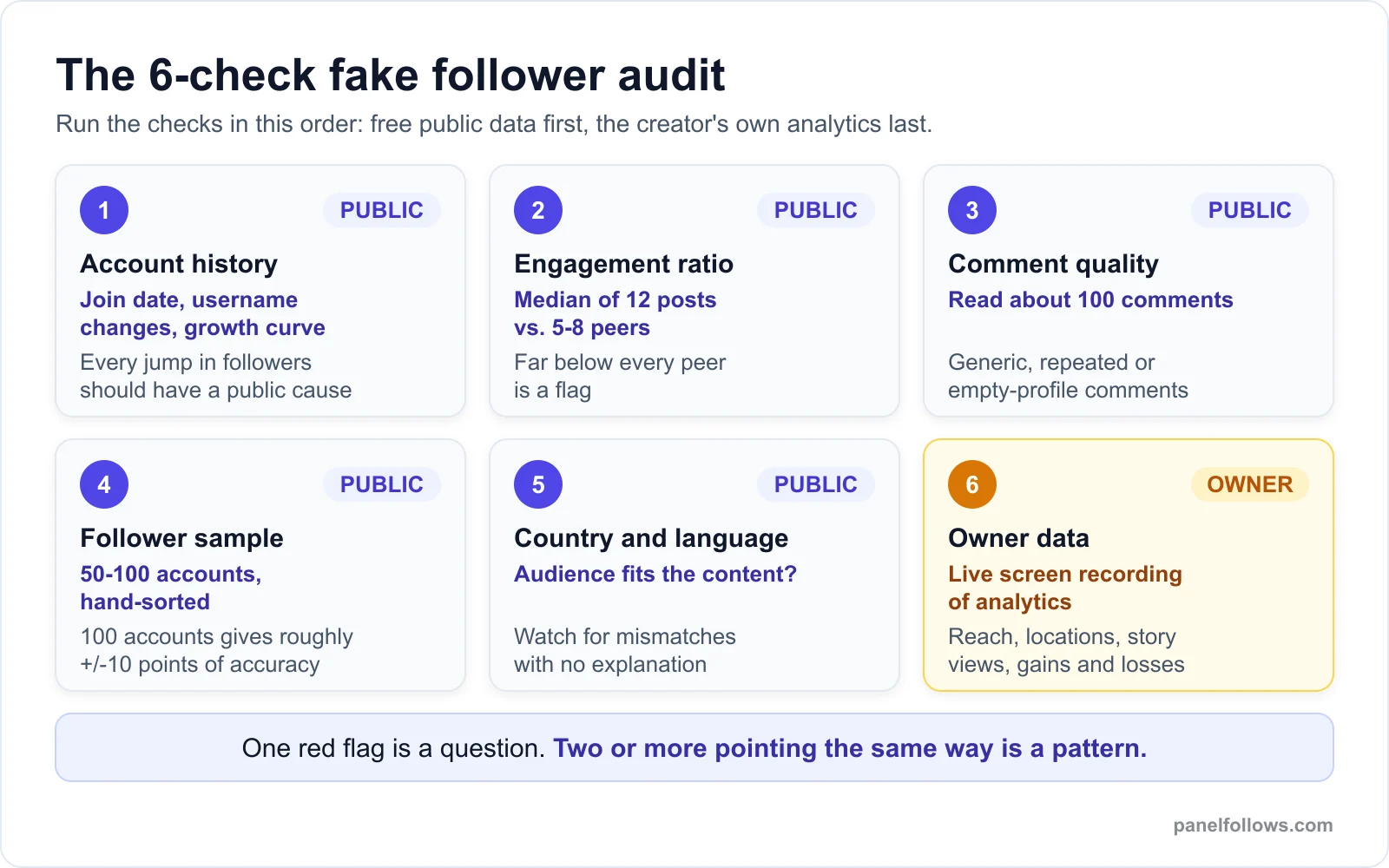
Run the checks in this order: free public data first, the creator's own analytics last.
Budget about 45 minutes per account for checks 1 to 5. Do them for every shortlisted creator, not only the ones that feel off. Your gut reaction to a polished feed is not a signal, and the comparison between candidates is often what makes the numbers mean something.
Check 1: How do you read an account's growth history?
Read growth history by asking whether each jump in followers has a public cause, such as a viral post, press mention, collaboration or giveaway. Real growth is uneven, but it is explainable. Purchased growth tends to arrive as a block with nothing visible behind it.
Start with the facts the owner cannot edit. On Instagram and Threads, tap the three dots on a profile and open About this account. Instagram's help page for the feature lists the date the account joined and how many times the username has changed. Some accounts also show the country they are based in, and third-party guides note that what appears varies from account to account.
Two things in that panel deserve attention. A join date that doesn't fit the story ("we have been posting since 2019" on an account created this year) is worth a question. Several username changes can mean the account was something else before, and accounts with existing followers are sometimes bought, renamed and repurposed. Neither is proof, since people rebrand all the time.
Next, the curve itself. Free public stats trackers keep follower history for many public accounts, though coverage is patchy for smaller profiles. If you have no tracker data, scroll the post history: an account with three years of posts that collected a few dozen likes each, and that now shows 40,000 followers with similar likes, grew its follower count without growing its audience.
| Pattern in the curve | Common legitimate cause | Pattern that suggests buying | What to check next |
|---|---|---|---|
| Steep jump over one to three days | A viral post or a mention by a larger account | No post or mention around that date | Find the post from that week and compare its views with the others |
| Clean staircase steps of similar size | Rare; maybe recurring giveaways | Repeated identical blocks, often round numbers | Look for giveaway posts on those dates |
| Jump, then a slow decline | Followers from a giveaway losing interest | Drop-off after delivery, or platform removal of fake accounts | Compare engagement before and after the jump |
| Smooth, steady rise | Consistent posting in a niche | Drip-fed purchases can look similar | Check that engagement grows along with followers |
| Sudden large drop | Platform purge of spam accounts that followed everyone | A purge of purchased accounts | Ask the creator; many accounts lost followers in the same purge |
That fourth row is the honest limit of this check. Drip-feed delivery, where purchased followers arrive a few at a time over weeks, is designed to look like a smooth curve. That is why growth history alone never settles the question and why the next checks exist.
Check 2: Is the engagement rate realistic for the follower count?
Engagement is realistic when it lands in the same range as similar accounts of similar size. Fake followers rarely engage, so a large share of them pushes the engagement rate below that peer range. There is no universal "good" number, because rates differ by platform, niche, format and account size, so the benchmark you trust most is one you build yourself.
Use this method:
- Take the 12 most recent regular posts. Skip pinned posts, paid partnerships, giveaways and anything clearly boosted.
- For each post, add likes and comments (and saves or shares if the platform shows them publicly), then divide by the follower count.
- Use the median, not the average, so one viral post doesn't hide eleven weak ones.
- Repeat for five to eight accounts in the same niche and size band that you have no reason to doubt.
- Compare. Being somewhat below the middle of the group is normal. Being far below every peer is a flag.
Here is a hypothetical example. Say a skincare brand is vetting a creator with 48,000 followers and builds this peer set:
| Account (hypothetical) | Followers | Median likes + comments | Median engagement rate |
|---|---|---|---|
| Peer A | 39,000 | 1,050 | 2.7% |
| Peer B | 52,000 | 1,190 | 2.3% |
| Peer C | 61,000 | 1,280 | 2.1% |
| Peer D | 44,000 | 1,150 | 2.6% |
| Candidate | 48,000 | 392 | 0.8% |
The candidate sits at about a third of the peer range. That doesn't prove anything on its own (the creator could be in a slump, or the account could have grown from an old viral moment), but it moves the account from "fine" to "needs checks 3 to 5." Our guide to Instagram engagement rate benchmarks explains why the follower denominator causes trouble, and engagement rate explained covers the other formulas you will see in media kits.
Engagement that is too high or too even is also a signal. Bought likes create a different fingerprint: counts that are oddly similar from post to post whatever the content, likes way out of line with comments, or a post with thousands of likes and three generic comments. Real audiences are lumpy.
On short-video platforms, use views as well. On TikTok, Reels and Shorts, a lot of views come from people who don't follow the account, so followers and views are loosely linked. Still, an account with 200,000 followers whose last 15 videos have a median of 1,500 views, with likes in proportion to those views, has a follower count that its audience doesn't support. If you want to know why views stall for honest reasons, our article on why TikTok videos stall covers the organic side.
Test this on one post before you scale
The cheapest way to check the logic above is a small order on a single post, then compare the outcome against your own Insights data.
Check 3: How do you spot fake followers through comments?
You spot them by reading the comments for proof that someone actually watched or read the post. A real comment usually mentions something specific in the content, asks a question, or starts a reply thread with the creator. Fake and pod comments are interchangeable: they would fit under any post on any account.
Read around 100 comments across five recent posts, and sort what you see.
| Signal | Points to a real audience | Points to fake or coordinated engagement |
|---|---|---|
| Content | Mentions details, asks questions, disagrees | Generic praise, emoji only, "nice pic" style lines |
| Repetition | Different wording from different people | The same phrases repeated across posts or commenters |
| Commenter profiles | Varied accounts with their own history | Empty profiles, no posts, recently created |
| Who comments | A mix of regulars and new names | The same 15 to 30 accounts on every post, often creators in one niche |
| Timing | Spread out, with a peak after posting | A burst of near-identical comments within minutes |
| Language | Matches the content and the stated audience | A language the creator never uses, with no connection to the post |
| Replies | The creator replies, and threads develop | Nobody replies to anybody |
The "same small group on every post" pattern usually means an engagement pod rather than purchased followers. Pods are made of real accounts, and they don't hurt you as much as bots do, but they make engagement look stronger than it is. Leave pod commenters out when you work out the engagement rate. For more on how comments relate to reach, see our Instagram comments strategy guide.
Check 4: How do you sample a follower list by hand?
You sample a follower list by opening it, picking accounts from several points in the list, and sorting each one into a bucket using fixed rules. This is the closest you can get to what paid checker tools do, and doing it yourself shows you the reasoning behind the result.
- Open the follower list of a public account while logged in.
- Take accounts from several depths: the top, after a few scrolls, and further down. The platforms don't document how the list is ordered, so don't rely on any single stretch of it.
- Pick at least 50 accounts. 100 is better.
- Open each profile and sort it using the rubric below. Don't stop to think hard about any one account: your first impression, applied the same way each time, is enough.
- Count each bucket and turn it into a percentage.
| Signal | Likely real | Unclear | Likely fake |
|---|---|---|---|
| Profile photo | Personal, varied | None, but other signs normal | Stock photo, AI face, or the same style as many other followers |
| Username | Readable name or handle | Name with a few digits | Random letters plus long digit strings |
| Posts | Some posts over time | None, but follows a sensible mix | None, or a few posted on one day |
| Following vs. followers | Balanced or modest | Follows a few hundred | Follows thousands, has almost no followers |
| Bio | Personal or blank | Blank | Promo link, crypto, adult or "DM to collab" spam |
| Last activity | Recent posts or stories | Old posts, normal profile | No signs of activity at all |
Sample size decides how much you can trust the result. With 50 accounts, the percentage you get is only accurate to about plus or minus 14 percentage points (at 95% confidence, in the worst case). With 100 accounts, it is about plus or minus 10. So a 50-account sample showing 30% likely fake actually tells you "somewhere between about 16% and 44%." That is enough to separate a clean account from a badly inflated one, but not to argue over five points.
Be fair to real people. Many genuine users never post, use a cartoon avatar and follow a few hundred accounts. That is why the rubric has an "unclear" bucket, and why you should only count the "likely fake" bucket in the verdict. The useful comparison, again, is against peers: run the same 50-account sample on two of the peer accounts from check 2 and see whether the candidate stands out.
Check 5: Does the audience's country and language mix fit the content?
The country and language mix fits when the audience could plausibly watch, understand and buy from the content. A mismatch is one of the strongest signs of purchased followers, because cheap follower sources are rarely spread across countries the way a real niche audience is.
From the outside, you estimate the mix. Look at the languages in your follower sample's bios and posts, the names, and the languages of the comments. Say you are auditing a local Chicago bakery account with 9,000 followers: if your sample is mostly accounts posting in languages the bakery never uses, from countries it can't deliver to, those followers are not customers, whatever their origin.
Leave room for honest exceptions. Diaspora creators, travel accounts, language teachers and global niches like gaming or music have international audiences by nature. The question is never "is the audience foreign?" but "does this audience match what this account says it is?"
Only the owner can see the real mix. Native analytics on Instagram, TikTok and YouTube show audience locations, which leads to the most reliable part of the audit.
What free fake follower checkers can't see
Free fake follower checkers can only see public data and usually only a sample of it, so they can't see reach, audience location as the platform records it, story views, or why a follower arrived. They are useful for sorting a long list of creators quickly. They are not a verdict, and their scores are not comparable from one tool to another.
| What a free checker sees | What it can't see | Why it matters |
|---|---|---|
| Public follower count and some history | Followers gained and lost per day inside the app | It can miss purchases followed by drops between its snapshots |
| A sample of follower profiles | The full follower list, private accounts | Its percentage carries the same sampling error as yours, usually without telling you |
| Public likes and comments | Reach, impressions, saves, shares, non-follower reach | It can't tell a low-reach account from a fake-follower account |
| Bios, names, language guesses | Audience location as the platform records it | Its country estimate is a guess based on text |
| Patterns that look suspicious | Intent: purchase, giveaway, spam follows or a purge | It can flag an innocent account that was spammed |
| Its own proprietary score | How other tools weight the same signals | Two tools can give the same account very different scores |
Platforms also limit how much follower data outside tools can collect, which is why most checkers model results from a sample rather than reading every account. Treat a free score like a smoke alarm. If it goes off, run checks 1 to 5 yourself. If it stays quiet on an account whose engagement looks wrong, trust your own audit.
Free tools also can't tell you what you most need to know as a buyer of influence: how many real people saw the creator's last sponsored post. Only the creator can show that.
How to run an influencer audit with the creator's own data
An influencer audit with the creator's data means asking for a live screen recording of their native analytics, not screenshots or a media kit PDF. Screenshots and PDFs are easy to edit. A recording in which the creator scrolls from the profile into Insights or Studio is far harder to fake, and any serious creator has been asked for one before.
Ask for this, on a short call or as a recording:
- Accounts reached over the last 30 days, with the split between followers and non-followers.
- Audience top locations and age ranges from the native analytics screen.
- Story views on the last five stories (Instagram), which are watched mostly by people who already follow the account and so show how much of the follower base is really active.
- Views and reach for the last three sponsored posts, if they have done any.
- Followers gained and lost by day over the last 90 days, to compare with the public curve from check 1.
- On YouTube, the Studio audience tab, traffic sources and subscribers gained and lost. YouTube removes subscribers it identifies as spam, and Analytics can lag behind the public count, so small differences between the two numbers are normal.
Story views compared with followers is the most revealing number in that list, because stories mostly reach existing followers. If 100,000 followers produce a few hundred story views, those followers aren't watching. Our guide to Instagram views, reach and impressions explains how to read each metric so you don't confuse one with another.
If you vet creators for several clients, put these requests into a standard brief so every candidate is judged the same way. Our playbook for scaling a social media agency covers that kind of repeatable process.
How to score the audit: a decision matrix
Score the audit by giving each check green, yellow or red, then looking at how many reds there are and whether they agree. One red is a question to ask. Two or more reds pointing the same way are a pattern, and a pattern is what should change your decision.
| Check | Green | Yellow | Red |
|---|---|---|---|
| Account history | Join date and story agree, growth matches posts | Unexplained jump with a possible cause | Repeated unexplained blocks, or many username changes |
| Engagement ratio | Inside the peer range | Below the peer range, but close | Far below every peer, or oddly flat |
| Comments | Specific, varied, with replies | Pod-heavy but real | Generic, repeated, empty profiles |
| Follower sample | "Likely fake" share similar to peers | Somewhat above peers | Far above peers, even allowing for sampling error |
| Country and language | Fits the content and market | Broader than expected, but explainable | Mostly countries and languages unrelated to the content |
| Owner data | Provided, consistent with public data | Partly provided | Refused, or contradicts the public numbers |
The last row carries the most weight. A creator who sends a clean recording and has a yellow follower sample is usually a better bet than one with a perfect public profile who won't share analytics. When the public checks and the owner data disagree, believe the owner data only if it came as a live recording.
Write the result down, with the date and the sample you used. Follower counts change, and a record of how you vetted a partner is useful if the account changes later.
How to check fake followers on your own account
You check your own account the same way, then decide whether the fake share is worth acting on. Common causes are spam accounts that follow everyone, old giveaways, follow-for-follow phases, and past purchases. Spam followers show up on almost every growing account and don't mean you did anything wrong.
Run checks 1, 3 and 4 on yourself, and use your own analytics for the rest. If the likely-fake share is small, leave it alone: removing a handful of followers changes nothing that matters. If it is large, removing the obvious bot and spam accounts over time brings your ratios closer to the truth, which matters when brands audit you. We don't have evidence that removing them raises reach, and Instagram hasn't said so. What is certain is that your engagement rate goes up when the denominator stops counting accounts that never engage. If you suspect a visibility problem as well, our guide to Instagram shadowbans covers how to tell.
Now the honest part about purchased followers, including ours. Followers bought from any panel can fill a count, help with social proof on a brand-new profile, or test how a page looks at a given size. But they don't behave like an interested audience, and they show up in the checks above: little engagement, sample profiles that land in the "unclear" or "likely fake" buckets, and possible drops when platforms remove accounts. Buying them also breaks the terms of Instagram, TikTok and YouTube. In the United States, using them to misrepresent influence for a commercial purpose can fall under the FTC rule described earlier. Our buyer's guide to follower quality describes the tiers honestly, and our explainer on why followers drop and how refills work covers what happens after delivery. If you just want to see what panel-delivered engagement looks like on a test account before forming a view, the free services page has small no-password samples. They are a sample, not a growth method.
Open your account and order in minutes
Signing up is free and takes two steps. Top up with card, bank transfer or crypto, place your order and track delivery from the dashboard.
Frequently asked questions
Is there an accurate free fake follower checker?
No free checker is accurate enough to judge an account on its own. Free tools see only public data, usually analyze a sample of followers, and can't see reach, story views or audience location as the platform records it. Their scores come from proprietary models, so two tools can rate one account very differently. Use them to sort a long list of creators, then run a manual audit on anyone you might pay.
What percentage of fake followers is normal?
No platform publishes an official "normal" percentage, and figures quoted online usually come from tools with their own definitions. Every account older than a couple of years has some inactive followers and spam follows. The useful test is comparison: run the same follower sample on several similar accounts and see whether the one you are auditing stands out, allowing for the sampling error of your sample size.
Can you tell if someone bought followers?
You can find strong evidence, but rarely proof. Purchases usually leave several matching traces: unexplained jumps in follower history, engagement far below similar accounts, follower samples full of empty profiles, and an audience from countries unrelated to the content. Any one of these can have an innocent cause, such as a giveaway or a spam wave. Several together, plus a refusal to share native analytics, is about as close to certain as an outside audit can get.
Does Instagram remove fake followers?
Yes, Instagram removes inauthentic activity when it detects it. In 2018 it announced it would remove inauthentic likes, follows and comments generated by third-party growth apps, and said the practice violates its community guidelines and terms of use. Removal is not instant or complete, so fake followers can stay for a long time and then disappear in bulk, which is why sudden drops in follower history are worth asking about.
How do I spot fake followers on TikTok?
On TikTok, compare follower count with the median views on the last 15 videos, and check that likes and comments are in proportion to those views. Then sample followers the same way you would on Instagram, looking for empty profiles, random usernames and accounts following thousands. TikTok bans fake engagement and reported removing over 207 million fake followers in the first half of 2024, so counts can drop.
How do I check if a YouTube channel has fake subscribers?
Compare subscriber count with typical views per video and with comment quality, then look for unexplained jumps or drops in subscriber history. YouTube says subscribers identified as spam and terminated accounts are not counted in totals, so purchased subscribers often disappear later. For a channel you might pay, ask for a screen recording of YouTube Studio showing subscribers gained and lost, traffic sources and audience geography.
Do fake followers hurt engagement rate?
Yes, by simple math. Engagement rate divides interactions by followers, and fake followers add to the follower count without adding interactions, so every fake follower lowers the rate. Whether they also reduce reach is less clear, since platforms have not published that as a direct factor. For brands, the lower rate is what counts, because it is one of the first numbers they look at when auditing you.
Is it illegal to buy fake followers?
In the United States, the FTC rule that took effect on October 21, 2024 prohibits buying or selling fake indicators of social media influence, such as followers, views or likes, where the buyer knew or should have known they were fake and they are used to misrepresent influence for a commercial purpose. Rules differ by country. Separately, every major platform's terms prohibit buying engagement, whatever local law says.
How many followers should I sample in a manual audit?
Sample at least 50 followers, and 100 if the decision involves real money. With 50, your estimate of the fake share is accurate to roughly plus or minus 14 percentage points; with 100, roughly plus or minus 10. Take accounts from several depths of the list, sort each into likely real, unclear or likely fake using fixed rules, and run the same sample on a few peer accounts for comparison.
Sources and further reading
- What is "About this account" on Instagram and Threads (Instagram Help Center): official list of account details, including join date and username change count.
- Countering deceptive behavior (TikTok Safety Center): TikTok's policy banning fake engagement and the sale of followers or likes.
- How TikTok counters deceptive behaviour (TikTok Newsroom, December 2024): enforcement figures for fake accounts, likes and followers in the first half of 2024.
- Fake engagement policy (YouTube Help): how YouTube treats artificial traffic and why spam subscribers are removed from counts.
- FTC Issues Final Rule on Consumer Reviews and Testimonials (Morgan Lewis): legal summary of the FTC rule, including the fake social media indicators provision and its October 21, 2024 effective date.
- Instagram strips out fake likes tied to third-party apps (MarTech): coverage of Instagram's 2018 move to remove inauthentic likes, follows and comments.