
How to Grow a Facebook Page When Organic Reach Is Low
How to grow a Facebook page when organic reach is low: why followers beat likes, which formats still travel, groups, invites and when ads win.
To grow a Facebook Page when organic reach is low, stop chasing Page likes and grow followers, because followers are the people who can actually receive your posts. Then publish formats Facebook still recommends to non-followers (Reels and photos people send to friends), run a group linked to the Page, invite your existing network, and post on a fixed weekly routine. If you need local customers on a deadline, ads usually beat organic.
This guide explains why the number on your Page header changed meaning, what Meta has published about Feed ranking, which formats still travel, how groups and invites fit in, what gets a Page demoted, and a weekly routine a small business can run in about two hours of posting work, plus a short daily reply window. It ends with an honest comparison of organic, ads and paid followers.
Facts in this guide were checked in October 2026.
Why is organic reach on Facebook Pages so low?
Organic reach is low because every Page post competes with posts from friends, groups and recommended content for a limited number of slots in each person's Feed, and Facebook ranks them all by predicted interest. Following your Page only puts your post into the pool of candidates. It does not reserve a place for it.
Meta's own explanation in its Facebook Feed ranking overview describes the first step as gathering an "inventory": every new post from people you are friends with, Pages you follow and groups you have joined. Each candidate then gets a relevance score built from thousands of signals, and posts are shown in order of that score. Most people have far more candidates than they will scroll through in one session, so the bottom of the list simply never appears.
There is a second pool: recommended content, including posts from Pages and groups the viewer does not follow. A stranger can see your Reel today while a follower of five years misses your Tuesday update. Reach is a property of each post, not of your follower count.
Meta does not publish an average organic reach figure for Pages. The percentages quoted online come from tool vendors measuring their own customers, so measure your Page against itself instead.
Facebook page likes vs followers: what is the difference?
A follower is someone who can receive your Page's posts in their Feed, while a Page like was an older public endorsement that Meta has been phasing out. When Facebook (now Meta) announced the new Pages experience in January 2021, ahead of a gradual rollout, its announcement said it was removing Likes and focusing on Followers, explaining that followers represent the people who can receive updates from a Page.
Under the classic design, liking a Page also followed it by default, but the two could be separated, so the numbers drifted apart. Someone could like your Page as a favor and then unfollow it, or follow without liking so their name was not publicly attached to your brand. The gap between the two was a rough measure of polite but uninterested fans.
| Page likes (classic Pages) | Page followers (current Pages) | |
|---|---|---|
| What it means | Public endorsement of the Page | Opted in to receive the Page's posts |
| Puts your posts in their Feed candidates | Only while they also follow (liking followed by default) | Yes |
| Shown on new Pages experience | Phased out | Yes, the headline count |
| Can exist without the other | Yes (liked, then unfollowed) | Yes (followed without liking) |
| Useful for | Historical social proof | Reach planning, reporting, ads audiences |
| What to track today | Ignore for growth decisions | Net new followers per week |
Two consequences follow. Anyone still selling you "Page likes" as the growth metric is measuring the wrong thing. And people can react to posts without following the Page, so a well-liked post does not automatically grow your audience; converting reactors is covered in the invites section.
If you are trying to understand engagement numbers in general (and which denominator to divide by), our explainer on how engagement rate is calculated walks through the math with worked examples.
How does Facebook decide who sees a Page post?
Facebook shows a Page post to the people its ranking system predicts are most likely to find it valuable, based on what they have liked, commented on, shared, watched and scrolled past before. Mostly, the system is not judging your Page as a whole. It is predicting how each viewer will react to each post.
Meta's Facebook Feed AI system card lists concrete examples of its inputs, including average time spent on each post, how many times the viewer has seen the same content type in the past hour, and how often the viewer quickly scrolled past the same friend's posts in the past seven days. The ranking overview adds predictions such as how likely you are to send the post in a message, where privacy law permits.
Read those signals as a Page owner and three lessons fall out:
- Scroll-past behavior counts against you. Followers who keep swiping past your posts teach the system to start future posts lower.
- Format variety helps. Someone who watched five videos in the last hour may be shown a photo next, so mixing formats gives you more slots.
- Sends are strong signals. A post messaged to a friend says more than a passive like.
The newest change came on October 13, 2026, when Meta announced Your algorithm, a set of tools that let people tell Facebook in their own words which topics they want more or less of in Feed and Reels. After tapping Interested or Not interested, users may be asked follow-up questions, and Meta says recommendations update in real time. Meta has not said how this affects Pages specifically. Our reading is that a Page with a clear, recognizable topic is easier for these systems to match to people who ask for that topic, and a Page that posts a bit of everything is easier to filter out.
Which Facebook post formats still get distribution?
Short vertical video posted as Reels, original photos that people want to send to someone, and posts that start real conversations are the formats most likely to reach people beyond your existing followers. Plain announcements and link posts can still do their job with current followers, but they rarely travel further.
| Format | Main job | Reaches non-followers? | Effort | Best for |
|---|---|---|---|---|
| Reels (all video) | Discovery | Often, through Reels and recommendations | Medium | New audience, showing your work |
| Original photos and carousels | Saves, sends, recognition | Sometimes, when people share them | Low to medium | Products, before/after, local scenes |
| Text question posts | Conversation with existing fans | Rarely | Low | Feedback, community feel |
| Link posts | Traffic to your site | Rarely | Low | Followers who already trust you |
| Live video | Real-time connection | Some, via notifications and Feed | High | Launches, Q&A, events |
| Posts in your linked group | Depth and loyalty | Within the group | Medium | Repeat customers, niche communities |
A shareable photo is not a stock image with a caption. It is something specific enough that a viewer thinks of a person: a chart of local trail closures, a tidy before-and-after of a repaired bike, a printable checklist, a photo of the new menu with prices visible. Those get sent in Messenger, and a send is one of the predictions Meta lists in its ranking overview.
Originality is now a distribution factor in its own right. In July 2025, Meta announced a crackdown on accounts that repeatedly reuse other people's text, photos or videos, as TechCrunch reported, including reduced distribution for offenders. Reposting viral memes from other Pages was always weak; it is now risky.
See live pricing in the panel
Unit prices for follower, like, view and engagement services are listed live. Registration is free and you can browse the list before adding any balance.
How should Pages use Facebook Reels?
Use Reels as your discovery channel: short, vertical, original videos that make sense to someone who has never heard of your business. Since Meta's 2025 change (rolled out over several months), videos you post to Facebook are published as reels anyway, so the real question is how to make videos that work for strangers.
Meta announced the change on its creators blog in June 2025: over the following months all videos on Facebook would be shared as reels, and Reels would no longer have length or format restrictions. A two-minute walkthrough and a 12-second clip now live in the same system and compete for the same viewers.
What changes when you design for strangers:
- Open with the payoff, not the logo. The first two seconds show the result, the problem or the person.
- Make it work with the sound off. Add captions or on-screen text.
- One idea per video. "How we fix a slipping chain" beats "A day at the shop" for a stranger.
- Keep it original. Trending audio is fine; re-uploading someone else's clip is not.
- End with a reason to follow. "One repair fix every Tuesday" beats "Like and share," which drifts into engagement bait.
Say you run a bike repair shop Page with 1,800 followers. A weekly 30-second Reel showing one common fix (a squeaky brake, a slipping chain) gives local riders a reason to watch to the end and a reason to follow for the next one.
If you also post on Instagram, our guide to Reels and the Explore tab covers the hook and retention side in more depth. The same video often works on both, but test captions and pacing separately.
Do Facebook groups help grow a Page?
Yes, a group linked to your Page is one of the most reliable organic channels left, because posts from groups people have joined are part of their Feed inventory, and in our experience group members interact more than casual followers. A group works when it gives members something the Page cannot: conversation with each other.
The mechanics are straightforward, though menu names move around. You need to be an admin of both the Page and the group. You join the group as your Page, make the Page a group admin, and then add the group to your Page (for example through a "Visit group" action button or the Page's groups section). Once linked, you can post and comment in the group as the Page, which keeps your brand name visible in every thread.
Groups that grow Pages usually share three traits:
- A narrower topic than the Page. A hardware store Page can run "Weekend DIY Fixes, [Town]" instead of a group about the store itself.
- A reason to come back. A weekly thread (show your project, ask a question, swap tools) gives members a habit.
- Light selling. If every post is a promotion, members mute it. Let the Page earn trust in the group and do the selling on the Page.
Be honest about the workload. A group needs moderation, member approval and replies within a day. If nobody can give it 15 minutes a day, put that time into Reels instead; a dead group hurts credibility more than no group.
How to get more followers on a Facebook Page with invites and owned channels
The fastest free source of followers is people who already know you, so start by inviting your own network, then put the Page in front of customers everywhere you already reach them. These followers are slower to collect than an ad audience, but they are real people who recognize your name.
Facebook documents the invite flow in its help center under inviting friends to follow a Page. The steps, as published when we checked (menu labels shift between desktop, mobile and Page versions, so look for the equivalent option):
- Go to the Page you want to share.
- Click Options below the Page's cover photo and select Invite Friends.
- In the pop-up, switch to your personal profile if prompted (invites go out from you, not from the Page).
- Select the friends you want to invite.
- Click Send Invites.
Invite selectively: friends in your area or interested in your topic are worth more than your whole contact list, because uninterested followers become the scroll-past signal described earlier. Ask staff and co-owners to invite their relevant friends too. Some Pages also see an option to invite people who reacted to a post; it is not in the help page we checked, so use it if you see it, but do not plan around it.
Then work the channels you own:
- Receipts, packaging and counter signs: a QR code to the Page with one line on what you post.
- Email and website: a follow link in the footer and in order confirmations.
- Your personal profile: if you are the face of the business, share Page posts occasionally with your own context.
- Partners: swap shares with a nearby business that has a complementary audience.
Small, boring and repeatable beats clever.
What gets a Facebook Page demoted?
Facebook demotes Pages that use engagement bait, repost other people's content, or show signs of fake engagement, and the effect compounds when the behavior is repeated. Many small business Pages that "suddenly lost reach" are not banned. They are posting in ways the system has learned people dislike.
Meta's business help page on avoiding engagement bait describes the patterns its model is trained to detect, including asking people to react or "vote" with reactions, asking people to comment with specific answers, asking people to share with friends, and asking people to tag friends. It also says Pages that repeatedly and systematically use these tactics are demoted more than individual posts.
| Pattern | Example | Why it hurts | Better version |
|---|---|---|---|
| React bait | "Like if you love pizza!" | Named in Meta's engagement bait guidelines | Post a photo good enough to react to on its own |
| Comment bait | "Type YES if you want the recipe" | Same | "What would you add to this?" with a real question |
| Share/tag bait | "Tag a friend who needs this" | Same | Make content specific enough that people send it unprompted |
| Unoriginal reposts | Re-uploading viral clips from other Pages | Targeted by the July 2025 originality crackdown | Film your own version with your own angle |
| Fake engagement | Pods, giveaway loops, low-quality bought likes | Meta acts against fake engagement accounts | Real customers, slower but durable |
The TechCrunch report on the July 2025 crackdown also noted action against roughly 500,000 accounts for spammy behavior or fake engagement, including reduced distribution. Keep that in mind for the paid section below.
A weekly routine to grow a Facebook Page
A sustainable routine for a small business Page is three to four posts a week across different formats, a daily 15-minute reply window, one group prompt and a short Friday review of what worked. Consistency matters more than volume, because the system learns from how your audience responds over many posts.
Here is a routine for a one-person business. Schedule posts in Meta Business Suite so it survives a busy week. The posting tasks add up to just under two hours. The daily reply window adds roughly another hour and three-quarters across the week, so budget about three and a half hours in total.
| Day | Task | Time |
|---|---|---|
| Monday | Plan the week: pick one Reel idea, one photo, one question; check last week's comments for ideas | 20 min |
| Tuesday | Publish a Reel built for strangers (one idea, payoff first, captions on) | 30 min to film and edit |
| Wednesday | Publish an original photo or carousel designed to be sent to someone | 15 min |
| Thursday | Post a discussion prompt in your linked group, answer every reply | 15 min |
| Friday | Second Reel, a Live, or a behind-the-scenes photo; then the weekly review | 30 min |
| Every day | Reply to comments and messages within a day | 15 min |
The Friday review is where you actually manage growth. Look at four numbers for each post: viewers or reach (whichever your Insights shows), the share of viewers who were not followers, shares and sends, and for Reels, average watch time. Then write one sentence: what will you repeat next week, and what will you drop. After four weeks you have an honest data set about your own audience.
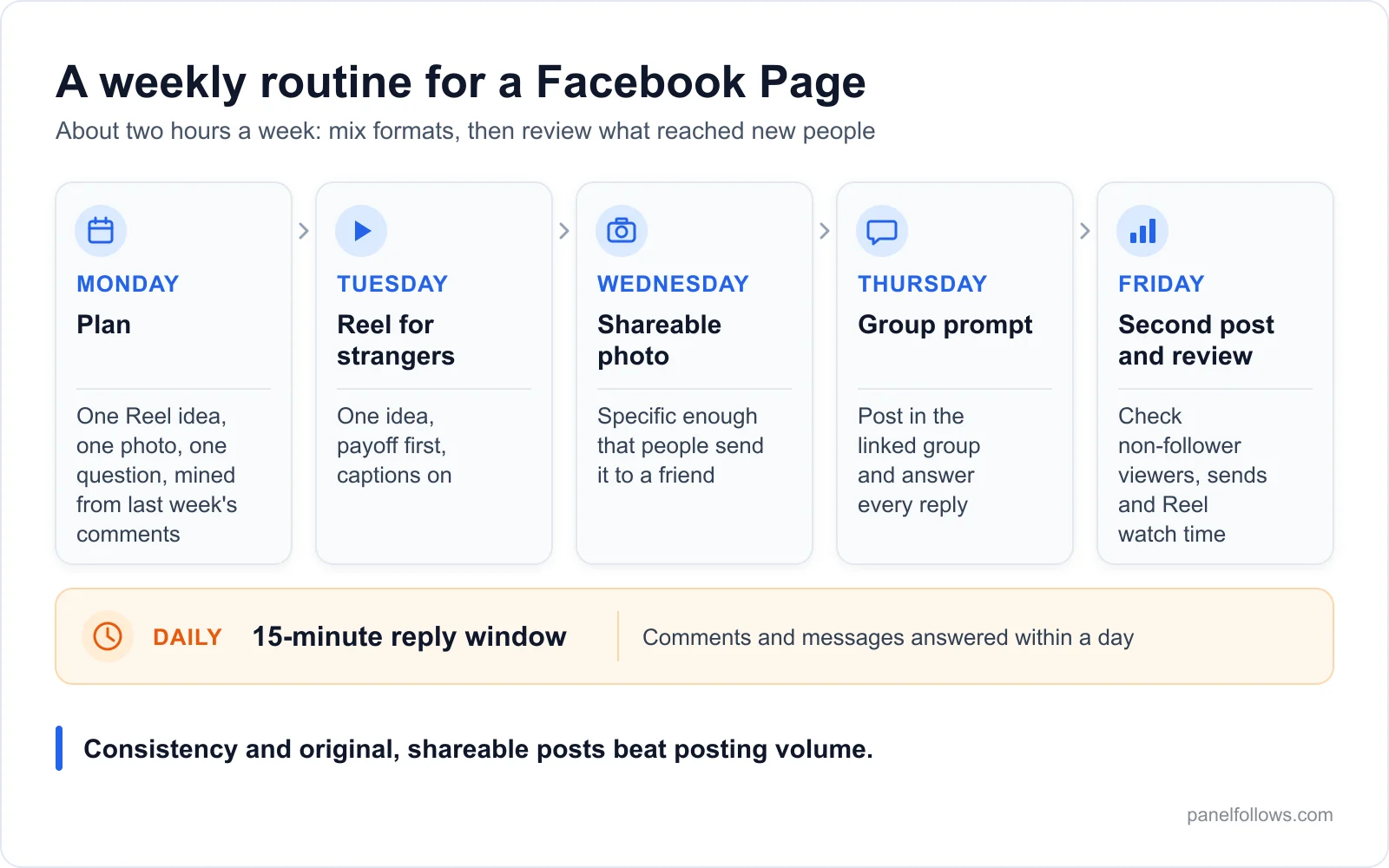
A two-hour weekly routine that mixes formats and ends with a short review of what actually reached new people.
Do not judge a format on one post; compare the last four Reels with the four before them. And track net new followers per week, since a spike followed by unfollows (common after giveaways) looks great in the total and terrible in the net. If your follower count drops for no visible reason, our article on why followers drop explains the usual causes, including platform cleanups.
When do Facebook ads beat organic growth?
Ads beat organic when you need a specific audience to see a specific offer by a specific date, such as a local business promoting an event, a seasonal sale or a new location. Organic builds trust and community over months; ads buy guaranteed reach now. Most small businesses need a bit of both.
| Situation | Better choice | Why |
|---|---|---|
| Opening a new location next month | Ads | You need local reach on a deadline |
| Brand-new Page with no audience | Ads plus invites | Organic has nothing to start from |
| Event with a fixed date and ticket link | Ads | Timing matters more than community |
| Building a loyal customer base over a year | Organic | Trust comes from repeated real interaction |
| Testing which content resonates | Organic first | Free data before you spend on boosting |
| A post already performing well organically | Small boost | Paying to extend a proven post is cheaper than boosting a weak one |
| Retargeting website visitors | Ads | Organic cannot target past visitors |
A practical rule we use: let organic tell you what works, then spend on it. Say your bike shop's chain-fix Reel outperforms everything else that month. Boosting that Reel to riders within 15 miles for a week is a far better use of a small budget than boosting your holiday hours post. Meta's minimum budgets and costs vary by country, currency and audience, so check the numbers in Ads Manager rather than trusting a figure from a blog.
Ads rent attention: when the budget stops, the reach stops. Earned followers and a linked group keep working without a budget, which is why the routine still matters if you run ads.
Agencies managing many client Pages can find budget and reporting splits in our multi-client operations playbook.
Where does buying Facebook followers fit?
Buying followers does not grow a Facebook Page in the sense that matters, because purchased followers do not watch, send or comment on your posts, and Meta's rules prohibit fake engagement. At best it changes the number on the header; at worst it adds an audience that scrolls past everything, which is exactly the signal you do not want.
We sell Facebook services on our Facebook SMM panel, so here is the honest version. The narrow case where some businesses choose it is a brand-new Page that looks empty at launch, where a small, slow order of Facebook followers is used purely as cosmetic social proof alongside real content, invites and ads. Even then, it carries the platform risk described above, it does not improve reach, and some of those followers may be removed in cleanups. If you go that way, choose a service with a stated refill period, order small amounts, and never let it replace the routine.
It will not fix low reach or turn into customers; for sales, a targeted ad to real local people is a better use of money. You can browse the full catalog, with each service's start time, speed and refill terms listed, on the services page, and the small no-password samples on the free services page show how delivery works without paying, but neither is a growth plan.
Open your account and order in minutes
Signing up is free and takes two steps. Top up with card, bank transfer or crypto, place your order and track delivery from the dashboard.
Frequently asked questions
How do I grow my Facebook page fast for free?
The fastest free growth comes from inviting relevant friends to follow the Page, adding the Page link to receipts, emails and your website, and posting original Reels built for people who have never heard of you. Add a linked group if you can moderate it daily. "Fast" on Facebook means weeks rather than days, so measure net new followers weekly and keep what works instead of switching tactics every few days.
Why can't I see likes on my Facebook page anymore?
Meta moved Pages to the new Pages experience, which removed Page likes and shows followers instead. Meta announced this in January 2021, explaining that followers represent the people who can receive a Page's updates. People can still react to individual posts, but the headline number on a Page is now the follower count, and that is the figure to use for reporting and planning.
How often should a Facebook page post?
For most small business Pages, three to four posts a week across different formats is enough to give the ranking system regular signals without overwhelming your followers. Quality and consistency matter more than volume: a weekly Reel, a shareable photo and a group prompt done well will outperform daily filler. Meta does not publish an ideal posting frequency, so test a schedule for a month and compare.
Are Facebook Reels worth it for a business page?
Yes, for discovery. Since 2025, every video posted to Facebook is shared as a reel, and Reels are the format most likely to reach people who do not follow you. They work best when they are original, show the payoff in the first seconds and make sense without sound. Keep photos and text posts for your existing followers, and use Reels to find new ones.
Can I invite people who liked a post to follow my Page?
Facebook's help center documents inviting your friends to follow a Page through the Options menu below the cover photo. Some Pages also see an option to invite people who reacted to a post, but it is not described in the help page we checked and availability appears to vary. If you see it, inviting recent reactors is a sensible way to convert them, since they already showed interest.
Is it better to boost posts or post organically?
Do both, in order. Post organically first to learn which content your audience responds to, then put a small budget behind posts that already perform well. Boosting a weak post rarely fixes it. If you have a deadline, such as an event or a new location opening, ads are usually the better tool because organic reach cannot be scheduled or guaranteed.
Is buying Facebook page followers against the rules?
Yes. Meta's rules prohibit fake engagement, and in 2025 Meta reported taking action against hundreds of thousands of accounts for spammy behavior or fake engagement, including reduced distribution. Bought followers also do not watch or share your posts, so they do not improve reach. If you consider it for cosmetic social proof on a new Page, understand the risk and never treat it as a growth strategy.
Why did my Facebook page reach drop suddenly?
Common causes are posting engagement bait, reposting content from other Pages, a run of posts that followers scrolled past, or a change in posting frequency. Seasonal swings and platform-wide ranking updates also move reach. Check your last month of posts against Meta's engagement bait patterns, compare four recent posts with four older ones, and look at whether non-follower viewers fell more than follower viewers.
Sources and further reading
- Introducing the New Pages Experience (Meta Newsroom): Meta's January 2021 announcement removing Page likes and focusing on followers.
- Our Approach to Facebook Feed Ranking (Meta Transparency Center): the inventory, signals, predictions and relevance score steps behind Feed.
- Facebook Feed AI system card (Meta Transparency Center): examples of the specific signals used to rank posts, including scroll-past behavior and time spent.
- Your Algorithm, Your Words (Meta Newsroom): the October 2026 tools that let people tell Facebook which topics they want in Feed and Reels.
- Making it easier to create videos on Facebook (Facebook Creators blog): the June 2025 change that shares all videos as reels.
- How to Avoid Posting Engagement Bait on Facebook (Meta Business Help): the engagement bait patterns Meta detects and how repeat offenders are demoted.
- Invite friends to follow a Page or profile (Meta Help Center): the official steps for inviting friends to follow a Page.
- Meta announces crackdown on unoriginal Facebook content (TechCrunch): July 2025 report on reduced distribution for reposted content and fake engagement.