
SMM Panel Chargeback Prevention: The Fraud Playbook
SMM panel chargeback fraud explained: stolen-card top-ups, refill abuse and order-then-dispute, plus the limits, terms and logs that stop them.
An SMM panel chargeback happens when a customer's bank or card network forcibly reverses a payment that funded their panel balance, usually weeks after the services were delivered and the upstream provider was paid. You cannot take the followers back, so you lose twice. Prevention comes from three things: payment methods that cannot be pulled back, limits on new accounts, and logs good enough to prove what happened.
This guide is for panel owners and resellers. It covers the fraud patterns operators actually see (stolen-card top-ups, order-then-dispute, refill abuse and smaller leaks), the card network rules that turn a few disputes into a processor problem, and the controls that cut exposure: push-only payments, new-account deposit limits, terms and refund wording, and order logs you can hand to a bank. Facts in this guide were checked in October 2026.
Nothing here is legal advice. Consumer protection law differs by country, and your terms of service cannot override it. Treat the sample wording below as a starting point to review with someone qualified where you operate.
What is an SMM panel chargeback, and why does it hurt more than a refund?
A chargeback is a reversal started by the payer's bank, not by you, and on an SMM panel it almost always arrives after delivery. A refund is your decision and costs you the sale. A chargeback costs you the sale, a fee, time spent responding and a mark on your dispute ratio, and you don't get to choose whether it happens.
Stripe's dispute documentation describes the mechanics plainly: the issuer opens a formal dispute on the card network, which immediately reverses the payment, and the processor then debits your balance for the amount plus a dispute fee. You get your say afterward, through evidence, and the issuer decides.
On an SMM panel the money was never really sitting with you. The usual chain:
- A customer tops up their panel balance.
- They place orders, and your panel forwards those orders to an upstream provider through the standard reseller API, paid from your provider balance.
- The provider delivers followers, views or likes within hours or days.
- Weeks later, the payment that started the chain is reversed.
At step 4 there is nothing to recover. The provider has been paid and the service has been used up. The service is consumed instantly but the payment can be reversed slowly, and that gap is why panels attract fraud that a store shipping physical goods would barely notice.
There's also an uncomfortable fact. Instagram, TikTok and YouTube ban buying engagement in their terms, and many mainstream processors restrict businesses that sell it. If you process cards for SMM services, read your processor's restricted business list first. Losing your merchant account because of your business category is a bigger risk than any single chargeback.
How does stolen-card balance top-up fraud work on a panel?
Stolen-card top-up fraud is when someone funds a panel balance with card details that aren't theirs, spends the balance on services quickly, and leaves you holding the reversal when the real cardholder notices. It's the most expensive pattern because the fraudster has no reason to hold back: every dollar of balance is free to them.
Panels are attractive targets for three reasons. The balance turns into a deliverable within minutes. The fraudster can resell that deliverable to their own clients. And the top-up form usually accepts any amount, which makes it useful for testing cards too.
Stripe's guide to card testing defines card testing as checking whether stolen card details are valid before using them for purchases. Its overview of common fraud types notes that sites with free text amount fields are frequent targets, and an "add funds, any amount" box on a panel is exactly that kind of field. The defenses Stripe recommends are familiar: CAPTCHA, rate limits and access controls on the endpoints testers hit.
The typical sequence has recognizable fingerprints:
- A new account, often with a disposable email, deposits within minutes of registering.
- The first deposit is small, then a second or third much larger one follows on the same day, sometimes with different cards.
- Declined attempts cluster before the successful one.
- The balance is spent almost entirely within an hour, frequently on high-volume, low-margin services or many different links.
- Nobody opens a support ticket, ever.
Stripe's guidance on identifying fraud lists a red flag that maps directly to panels: someone pays by card, then asks for a refund through another channel such as a wire transfer. On a panel it sounds like "I deposited too much, please send the rest to my crypto wallet." If you do it, you've laundered a stolen card for someone, and you still eat the chargeback.
The delay is what makes this dangerous. Cardholders typically have up to 120 days to dispute, and some reason codes tied to expected delivery dates stretch to 540 days from the transaction, per Chargebacks911's summary of Visa time limits. Your window to respond is usually 20 to 45 days, depending on the network and processor.
Here's the timeline. The deposit and orders happen on day zero, and your upstream balance is spent the same day. Delivery completes within days, and the dispute lands weeks or months later. By then the fraudster has usually done the same thing on other accounts.
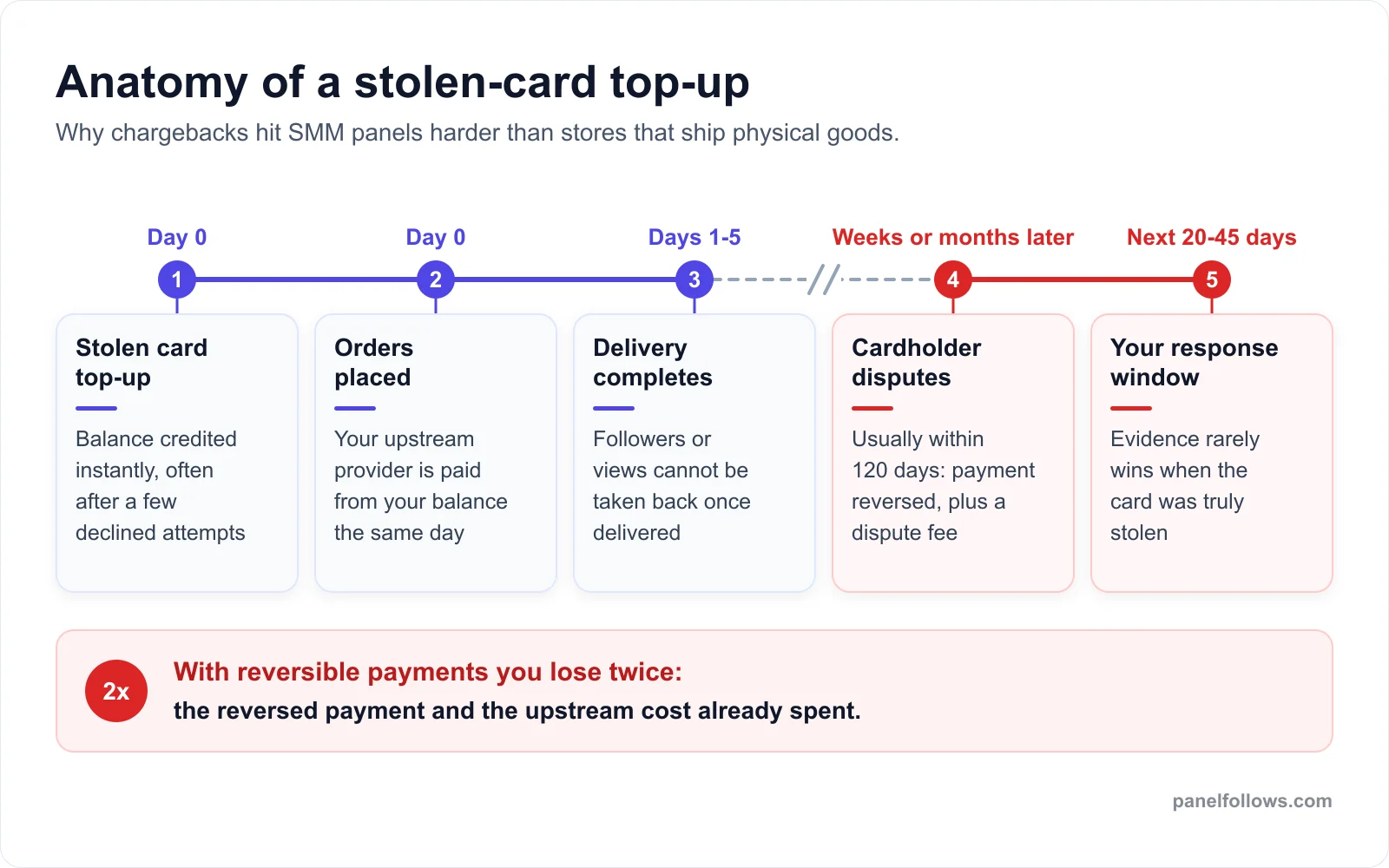
Why chargebacks hit SMM panels harder than stores that ship physical goods.
What does order-then-dispute (friendly fraud) look like?
Order-then-dispute is when a real customer, using their own payment method, receives the service and then files a dispute anyway, usually claiming the purchase was unauthorized or never delivered. The industry calls it friendly fraud or first-party misuse. It's less dramatic than stolen cards but harder to prevent, because the customer looks legitimate right up to the dispute.
Motives vary. Some customers regret the purchase after their followers drop. Some don't recognize the name on their statement. Some learned that disputing worked before. And some are freelancers whose own client never paid them.
Three triggers specific to panels come up again and again:
- Statement descriptor confusion. If the billing name on the card statement doesn't match your panel's brand, honest customers dispute charges they don't recognize.
- Drops without a clear refill path. A customer who sees numbers fall and can't get a quick answer from support often goes to the bank instead.
- Platform enforcement. When Instagram or TikTok removes inauthentic followers or restricts an account, some customers blame the panel and dispute, even though the service was delivered as described.
You'll lose some of these even with good evidence, because the cardholder is the one telling the bank they didn't authorize the purchase. The best tools stop the dispute from being filed at all, so fast support and a clear descriptor matter as much as logs.
How do customers abuse refill claims?
Refill abuse is when a customer uses a refill guarantee to get more than they paid for, either by causing drops themselves or by claiming drops that the provider can't verify. It doesn't trigger a chargeback directly, but it drains your provider balance. And a customer whose abusive refill claims are refused is a prime candidate for a dispute.
If refill mechanics are new to you, our guide on why followers drop and how refill guarantees work covers the legitimate side. The abusive patterns operators report look like this:
| Pattern | How it works | What stops it |
|---|---|---|
| Overlapping orders | Same link ordered on two panels at once, so neither can tell its own delivery from the other's, then both are asked for refills | Terms that void refill for links with simultaneous orders elsewhere, start count logging |
| Self-removal | Customer removes delivered followers, then requests a refill | Refill only up to the original start count plus quantity, logged at order time |
| Privacy toggling | Account set to private during delivery, "not delivered" claimed, then made public | Terms requiring a public account, status snapshots in logs |
| Username change | Handle changed after delivery so the link no longer works, refill or refund claimed | Terms that void refill after a username change, link snapshot at order time |
| Wrong service claim | Customer orders a no-refill service, then argues it should be refilled | Explicit no-refill warning that must be confirmed before ordering |
| Refill spam | Repeated refill requests on the same order in short intervals to put pressure on the provider | Rate limit on refill requests per order |
Two of those controls exist on Panel Follows: a refill can be requested once every 24 hours per order, and services without refill are clearly marked with a warning the customer must confirm before ordering. Whatever provider you use, the principle holds. Show the refill rule before purchase, log it at purchase, and let the system enforce it instead of arguing about it in tickets.
What other fraud patterns should a panel owner watch for?
Beyond chargebacks and refills, panels lose money through affiliate self-referrals, free sample farming, stolen API keys and account takeovers. None of these costs as much per incident as a stolen card, but they're common because they're cheap to attempt.
- Affiliate self-referral. A user refers their own second account, funds it with a stolen card, and collects commission before the chargeback lands. Pay only on completed orders, hold commissions past your dispute window if you accept cards, and void them on reversal. Our article on running an SMM panel affiliate program goes deeper on commission design.
- Free sample farming. Scripts create sign-ups that collect free samples across hundreds of accounts. Tie samples to a link and a time window instead of an account, and put a human check in front.
- API key theft. A reseller's key leaks from a public code repository or a compromised server, and someone drains the balance. Offer key rotation, show recent API activity, and keep keys on the server. Our SMM provider API integration guide covers key handling.
- Account takeover. Reused passwords let attackers into funded panel accounts. Login alerts and optional two-factor authentication solve most of it.
Resell the same services at your own price
Send orders from your own site through the reseller API and set your own margin. You can also run a child panel under your own brand.
When do chargebacks become a processor or card network problem?
Chargebacks become a structural problem when your dispute ratio crosses the thresholds your processor or the card networks monitor. At that point the real risk isn't the fees but losing the ability to accept cards. The network programs target larger merchants, but processors apply their own rules much earlier.
Here's what the public network thresholds looked like as of October 2026:
| Program | Threshold | Notes |
|---|---|---|
| Visa VAMP, merchant "Excessive" | 1.5% combined fraud and dispute ratio in North America, the EU and Asia Pacific since April 1, 2026 (previously 2.2%) | Per-transaction fees apply once enrolled; a monthly count floor keeps very small merchants outside formal enrollment |
| Visa VAMP, acquirer | 0.5% "Above Standard", 0.7% "Excessive" | Pressure on the acquirer gets passed down to its merchants |
| Mastercard ECM | At least 100 chargebacks and a 1.5% ratio in a month | Fines start in the second month above threshold |
| Mastercard HECM | At least 300 chargebacks and a 3% ratio in a month | Higher fines, longer path out |
The Visa figures come from the Merchant Risk Council's summary of the April 2026 VAMP change and the cside VAMP reference, which also lists the monthly count floor and the per-transaction fee. The Mastercard tiers match the J.P. Morgan merchant guide to the Excessive Chargeback Program, which also explains that the ratio is calculated against the previous month's transactions.
Two details change how you should think about this. First, the Visa ratio counts fraud reports as well as disputes, so a stolen-card top-up can count against you even if the cardholder never files a formal dispute. Second, a dispute you win still counts. These programs measure disputes received, not disputes lost, so winning a case later doesn't lower the count. Prevention is the only thing that reliably lowers the ratio.
The fees add up too. Stripe's dispute fees FAQ explains that a received dispute carries a fee, countering it adds a second fee, and the second fee comes back only if you win. Say a panel takes 400 card top-ups a month and six are disputed. That's a 1.5% ratio, six reversed top-ups and six fees, plus the upstream cost of the orders they funded. Visa wouldn't formally enroll a panel that small, but its processor would very likely notice.
Why do push-only payment methods reduce chargeback exposure?
Push payments reduce exposure because the payer sends the money themselves, and their bank has no card-style way to pull it back on request. Card payments are pull payments: you take the money using details the customer gave you, and the issuer can reverse that pull. Crypto transfers and bank transfers are pushed by the payer, so the chargeback pattern in this guide mostly disappears.
This is why many panels run on push methods. Panel Follows, for example, takes cryptocurrency (USDT and other coins through crypto gateways) and international bank transfer from international customers. The crypto SMM panel page shows that flow from the buyer's side.
Push-only doesn't mean risk-free. It changes the kind of fraud you see:
| Payment method | Chargeback possible? | Main remaining risks for the panel |
|---|---|---|
| Card (direct) | Yes, typically up to 120 days and sometimes longer | Stolen cards, friendly fraud, card testing, ratio monitoring, processor closure |
| Card through a third-party crypto on-ramp | The dispute goes to the on-ramp, not to you | The on-ramp may block or limit you if your customers generate fraud on their side |
| Stablecoins and other crypto | No chargeback at protocol level | Funds from hacks or scams that exchanges may freeze, wrong-network deposits, underpayments, some stablecoin issuers can freeze addresses |
| International bank transfer | No card-style chargeback; the sending bank can request a recall | Fake payment screenshots, recalls on fraud grounds, slow settlement, crediting before funds clear |
The rules for push payments are short:
- Credit the balance only once you've confirmed the money arrived, never on a screenshot or a transaction ID pasted into a ticket.
- Use a gateway that confirms on-chain payments automatically and checks that the amount and network match.
- Take a bank recall request seriously: freeze the balance and pause orders while you check.
- Never refund a push payment to a different wallet or account than the one it came from. That request is the push-payment version of "refund me by wire instead of to my card."
How should you set deposit limits for new accounts?
Deposit limits for new accounts cap how much a stranger can load and spend before you know anything about them. That caps your loss from any single stolen card or abusive user. Limits matter most with reversible payments, but push-only panels benefit too.
Customers should earn higher limits through time and a clean history, not through the size of their first deposit. The tiers below are only an illustration. Set real numbers from your own order values and dispute history.
| Example tier | How a user reaches it | Example limit |
|---|---|---|
| New | Just registered, email verified | One small top-up per 24 hours, low daily cap |
| Established | 7 days old and at least one completed order with no dispute | Higher daily cap, more top-ups per day |
| Trusted | 30 days old, several completed orders, no reversals | Normal limits, manual review only for unusual jumps |
| Reseller or API | Approved manually or by long clean history | Custom limits, monitored API activity |
To set this up:
- Pull your last 90 days of reversals and abuse cases and note the account age and first deposit size for each. That tells you where your fraud actually starts.
- Set the new-account cap just above what a normal first-time customer spends, so real buyers are rarely blocked.
- Add velocity rules: a maximum number of top-up attempts per hour, and a block after several declined attempts from one account or IP.
- Put a short hold on the first large deposit from a new account, so you can review it before it's spent with your provider.
- Flag mismatches for review: billing country different from IP country, many cards on one account, or one card used across several accounts.
- Tell users the limits exist and how to raise them, so honest customers stay patient.
What should your terms of service and refund policy say?
Your terms of service should state exactly what you deliver, what you refill, when refunds happen and what happens after a payment reversal, in words a bank reviewer can follow. Clear terms won't stop a determined fraudster, but they clear up honest confusion and support your evidence in a dispute.
The most useful refund policy decision for an SMM panel is to refund to the panel balance, not back to the payment method, unless the law requires otherwise. Combine that with balances that can't be withdrawn, and you remove the main way to cash out stolen funds. When a payment has to be returned, send it only to the original source.
Here are clause starting points to adapt with legal review. They were written for this guide, not taken from any panel's terms:
- Service description: "Services deliver the stated quantity of engagement to the public link you provide. We do not guarantee reach, sales, engagement beyond the stated quantity, or the platform's response to your account."
- Platform rules: "Social media platforms may restrict or prohibit purchased engagement. You are responsible for your use of the services under each platform's terms."
- Refills: "Refills apply only to services marked with a refill period, only within that period, only up to the start count plus the ordered quantity, and only if the link stays public and unchanged and has no simultaneous orders from other providers."
- Refunds: "Undelivered portions of an order are refunded to your panel balance. Balance cannot be withdrawn or transferred."
- Reversals: "If a payment is reversed, the related balance and any refills are suspended, and we may provide order records to the payment provider."
Record which version of the terms each user accepted and when. A clause in a dated, logged version counts as evidence. A clause you quietly added last month doesn't.
How do order logs work as evidence in a dispute?
Order logs prove that a specific account, from a specific device and network, placed specific orders that were delivered to a link the account supplied. In a chargeback response, that record is often the only thing between you and an automatic loss.
Log these fields for every deposit and order, and keep them at least as long as your longest possible dispute window:
| Event | What to record |
|---|---|
| Registration | Timestamp, email, IP, user agent, accepted terms version |
| Login | Timestamp, IP, device fingerprint or user agent, success or failure |
| Deposit | Amount, method, gateway reference, IP, billing country if available |
| Order | Service ID, link, quantity, start count, price, warnings confirmed (such as no-refill) |
| Delivery | Status changes with timestamps, remains, provider order ID |
| Refill | Request time, count at request, outcome |
| Support | Ticket thread, especially any message where the user acknowledges delivery |
You can build a dispute response from those logs the same way every time:
- Decide whether the dispute is worth contesting. You'll usually lose a genuine stolen-card case no matter what you send, so accepting it and banning the account can be the better use of your time.
- For friendly fraud, show continuity: the same IP and device that made the payment also logged in before and after, placed the orders and opened tickets.
- Show delivery: order IDs, the link the customer supplied, start and final counts, completion timestamps.
- Show agreement: the terms version accepted, plus the confirmed warning for no-refill services if relevant.
- Quote the customer's own support messages if they acknowledged the delivery.
- Submit before the deadline. Late evidence is the same as no evidence.
Once a formal dispute is open, you generally can't refund your way out. Stripe notes that you can't issue a refund outside the dispute process while a dispute is open. That's why responding fast to complaints before they become disputes matters so much.
Where does the risk sit for resellers and child panels?
If you're a reseller or child panel owner, your customers' payment risk is yours alone, because your provider only sees your balance. When a customer reverses a card payment to you, the orders it funded were already paid from your provider balance, and your provider has no reason or way to refund them.
So choosing a provider is part of fraud prevention. Clear refill periods, logged start counts and fast order statuses give you the data to answer disputes and refill claims. Our guide on how to find an SMM provider includes a test-and-score process, and wholesale SMM provider pricing explains why thin margins leave little room to absorb reversals. If you're just starting, starting an SMM reseller business from scratch covers the setup decisions that come before fraud controls.
If you run a child panel, the same logic applies with one more layer: your storefront takes the payment, so your payment methods, limits and terms decide your exposure. Resellers integrating through the SMM panel API should also copy provider order IDs and statuses into their own database. That way your delivery evidence for a dispute doesn't depend on looking it up later.
A 30-day plan for a small panel:
- Week 1: export every reversal and abuse case from the last 90 days and tag the pattern, account age and payment method.
- Week 2: add new-account deposit limits, velocity rules and CAPTCHA on the top-up form.
- Week 3: rewrite the refill and refund sections of your terms, version them, and log acceptance.
- Week 4: confirm your logs capture every field in the evidence table, and move as much volume as you can to push payments.
Open your account and order in minutes
Signing up is free and takes two steps. Top up with card, bank transfer or crypto, place your order and track delivery from the dashboard.
Frequently asked questions
Can a customer charge back a crypto payment to an SMM panel?
Not the way they can with a card. A crypto transfer is pushed by the sender, and no issuer can reverse it on request. The remaining risks are stolen funds that an exchange later freezes, wrong-network payments, underpayments and fake proof of payment. If the customer bought the crypto with a card through an on-ramp, any dispute goes to that on-ramp, not to your panel.
How long can a customer file a chargeback after buying SMM services?
For card payments the usual window is up to 120 days. Some dispute types tied to an expected delivery or service date can run up to 540 days from the transaction in certain Visa cases. Services delivered over time, such as drip-feed, can make it less clear when the clock starts. Your window to respond is much shorter, typically 20 to 45 days.
Do I win a chargeback if I can show the followers were delivered?
Sometimes against friendly fraud, rarely against true stolen-card fraud. If the real cardholder never made the purchase, proving delivery to someone else doesn't help. Delivery evidence works best alongside continuity evidence: the same IP and device paying, logging in, ordering and opening tickets, plus logged acceptance of your terms. A dispute you win can still count toward your dispute ratio.
Should an SMM panel refund to the card or to the balance?
Refund undelivered amounts to the panel balance by default and don't let balances be withdrawn, unless local consumer law requires otherwise. When money has to go back, send it only to the original source. Refunding to a different card, wallet or bank account is a classic way fraudsters turn stolen payments into clean money, and you still lose the chargeback afterward.
What should I do the day a chargeback arrives?
Freeze the account's balance, stop forwarding its orders, and pull its full log: registration, logins, deposits, orders, delivery statuses and tickets. Decide whether it looks like stolen-card fraud or friendly fraud. Accept clear stolen-card cases and ban the account. For friendly fraud, build an evidence packet and submit it well before your processor's deadline.
Does refunding a disputed payment stop the chargeback?
Usually not once the formal dispute is open. Processors such as Stripe don't let you refund outside the dispute process while it's active, and the fee is charged when the dispute arrives. The realistic way to avoid a dispute is to refund earlier, at the complaint or inquiry stage. That's why fast support on drops and unrecognized charges saves money.
What is card testing and why do SMM panels attract it?
Card testing means making small payments with stolen card details to see which ones still work. Panels attract it because the top-up form accepts any amount and confirms instantly. Signs include many declined attempts, several cards on one account and tiny deposits from new accounts. CAPTCHA, rate limits on payment attempts and blocks after repeated declines make testing impractical.
Are resellers liable when their own customer charges back?
In practice, yes. Your provider is paid from your balance when the order is placed, so a reversal between you and your customer doesn't change what you already paid your provider. The loss stays with you. That's why resellers need their own deposit limits, detailed order records, and payment methods that can't be reversed the way cards can.
Sources and further reading
- Stripe: Disputes: how a card dispute reverses a payment and debits the merchant's balance.
- Stripe: Dispute fees FAQ: the received and countered dispute fees and when the countered fee is returned.
- Stripe: Protect yourself from card testing: definition of card testing and recommended controls such as CAPTCHA and rate limits.
- Stripe: Identifying potential fraud: red flags including refunds requested outside the card network.
- Merchant Risk Council: Stricter VAMP ratio thresholds: the April 2026 change to Visa's merchant threshold.
- cside: VAMP thresholds 2026: reference table for VAMP tiers, fees and the monthly count floor.
- J.P. Morgan: Mastercard Excessive Chargeback Program guide: ECM and HECM thresholds and how the ratio is calculated.
- Chargebacks911: Visa chargeback time limits: the 120-day standard window and the 540-day cap for certain reason codes.