
Best Time to Post on TikTok: Does the Hour Really Matter?
The best time to post on TikTok depends on your followers, not a vendor heatmap. Compare the studies, read TikTok Analytics and test your own window.
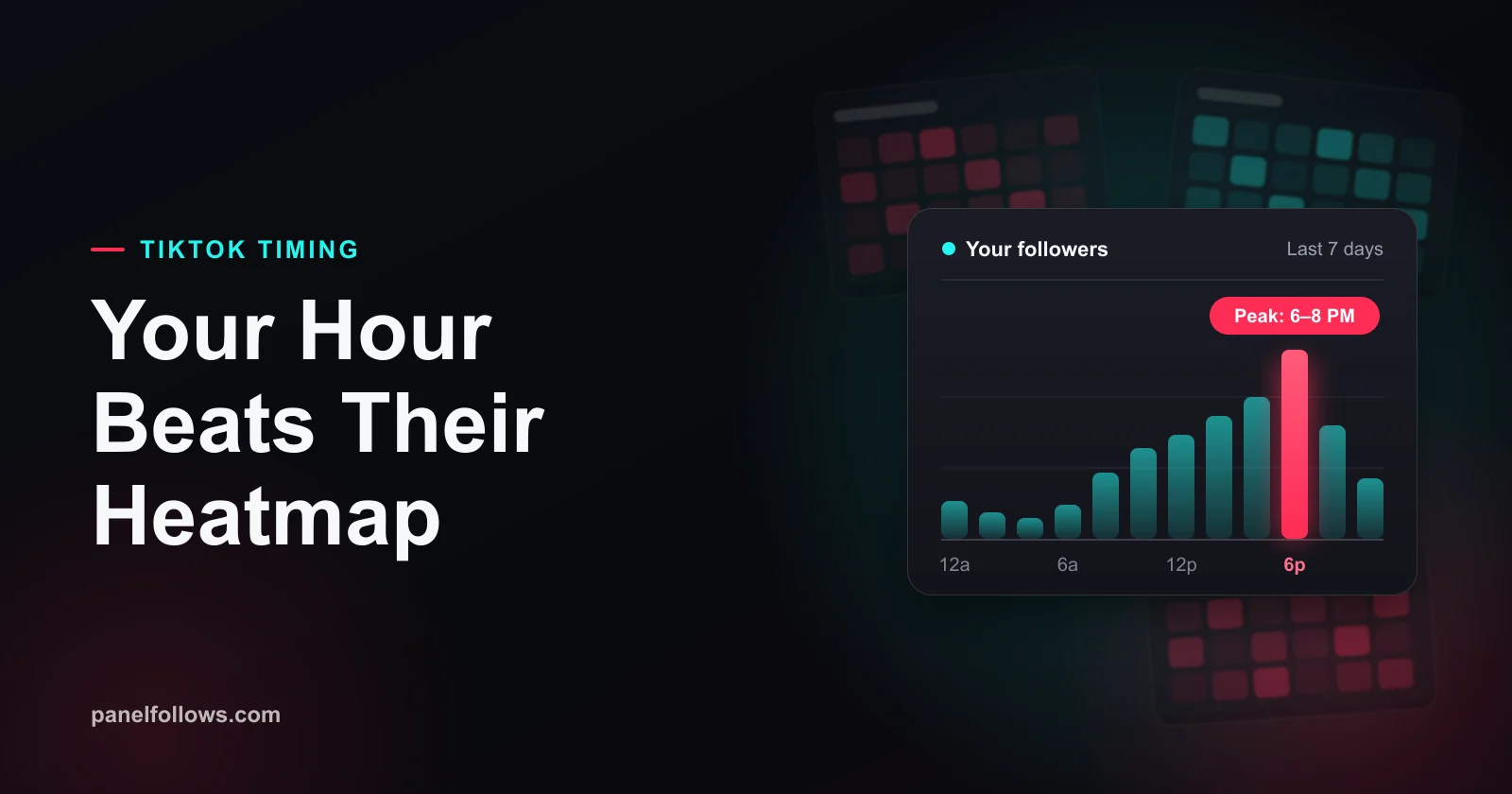
The best time to post on TikTok is when your own followers are active. TikTok Analytics shows this in the Followers tab. For most accounts the hour matters less than published studies suggest. The big vendor datasets contradict each other because the For You feed ranks videos for each viewer and keeps showing them for days. Pick a time from your own data, test it for four weeks, then put your effort into the video itself.
This guide compares what the four most cited timing studies actually measured and why their answers clash. It explains what TikTok itself has said about recommendations and recency, and shows step by step how to find your follower activity in TikTok Analytics. Then it covers a simple four-week test, the best day to post, how often to post, and the cases where timing really does matter, such as trends, launches and LIVE.
Nothing here requires spending money. Facts in this guide were checked in October 2026.
Does posting time matter on TikTok?
Posting time matters on TikTok, but only a little. It shapes the first few hours of a video's life, not how far the video can go. A video that holds attention will keep getting shown after a slow start. A video that does not hold attention won't be saved by a perfect time slot.
When you publish, the first viewers usually include some of your followers plus a first batch of strangers in the For You feed. If your followers are asleep, fewer people see the video early and the views come in slower. So it takes longer to collect the watch and share signals the feed reacts to. That delay is real, and it is the whole case for timing.
Timing does not change how viewers react once they see the video. TikTok's own explanation of the feed, covered below, is built around what viewers do: watch, finish, share, like, comment and follow. A 9 a.m. post with a weak hook loses to a 2 a.m. post with a strong one. Anyone who has run a handful of accounts has seen it.
So the honest answer has two halves. Yes, post when your audience is awake, because it costs nothing. But don't blame the hour for a stalled video until you've checked the video itself. Our guide on why TikTok videos stall and how to fix it covers that diagnosis in depth.
What the big "best time to post" studies say, and why they disagree
The most cited studies give different, sometimes opposite, answers. One says weekday afternoons. One says Thursday mornings and Saturdays. One says Sunday mornings and evenings, and one says evenings every day. All of them are honest analyses of their own data, but none of them measured your audience.
| Study | Data behind it | What it calls the best time | What it says about weekends |
|---|---|---|---|
| Sprout Social (2026 update) | Nearly 2 billion engagements across 307,000 profiles, late 2025 to early 2026 | Tuesday to Thursday, 2-6 p.m. local time | Avoid weekends; Sunday is the worst day |
| Hootsuite ("2025 data", updated 2026) | Over 1 million posts, localized across 118 countries | Thursday 6-9 a.m. and Saturday 10 a.m.-6 p.m. | Saturday is one of its two best windows |
| Buffer (2026, as reported by roundups) | 7.1 million posts | Sunday 9 a.m., Monday 1 p.m., Sunday 1 p.m.; evenings 6-11 p.m. | Summaries disagree on what it found |
| Metricool (as reported by roundups) | 2.3 million posts from 92,000+ accounts | 6-8 p.m., across the week | No weekend penalty reported |
You can read the first two studies yourself: Sprout Social's TikTok timing data and Hootsuite's best time to post on TikTok. The Buffer and Metricool figures above come from several independent roundups. Check the original write-ups before you base a strategy on a single number.
Buffer shows the problem best. Several summaries of its 7.1 million post dataset report Saturday as its best day. At least one widely read roundup reports Saturday as its worst day and names Sunday at 8 p.m. Eastern as the single best slot. If people summarizing the same dataset can't agree, don't plan your calendar around an exact hour copied from a blog post.
There are three structural reasons the studies clash:
- They measure different things. Sprout and Hootsuite rank by engagement, while at least one Metricool figure is about views. A slot can be good for comments and only average for reach.
- They measure different accounts. Every dataset comes from customers of a scheduling or analytics tool. Those customers are mostly brands and agencies, not the creator accounts that make up most of TikTok.
- They measure different periods. Sprout's data covers a few winter months. Seasons, holidays and app changes all shift the results.
The one pattern that shows up in more than one dataset is that late afternoon and evening, local time, are rarely bad. That is a reasonable starting time if you have no data of your own. It is not a law.
Why timing matters less on TikTok than on Instagram
Timing matters less on TikTok because most TikTok views come from strangers through a ranked feed. That feed keeps showing a video for days, not just in the minutes after you upload it. On platforms where most views come from your followers, being early matters more.
TikTok says the For You feed ranks videos separately for each user, so no two feeds are the same. Its newsroom explainer, How TikTok recommends videos #ForYou, describes three kinds of signals:
- user interactions (videos liked or shared, accounts followed, comments)
- video information (captions, sounds, hashtags)
- device and account settings
These are weighted by how strongly they indicate interest. The same explainer says follower count and previous high-performing videos are not direct factors. Nothing in that list is "the hour you posted."
Recency does play a smaller role. TikTok's newsroom post Learn why a video is recommended For You announced the "Why this video" feature. It lists reasons such as your own interactions, accounts you follow, and content posted recently in your region. So freshness counts. "Recently" plus "your region" is TikTok's own basis for posting when your local audience is awake. But it is one reason among several, not the main one.
Hootsuite's guide says videos in the For You feed are usually "no older than a couple of days." That is a vendor observation, not a TikTok statement, but it matches what operators see. A video that works often keeps getting views on day two and day three. A small account sometimes gets its biggest day well after upload.
Instagram works differently. Much of the reach of a typical Instagram photo or carousel comes from the Feed and Stories of existing followers. There a post competes with everything else those followers see in that session, so being fresh when they open the app counts for more. Reels make Instagram behave more like TikTok, which is why Reels and photo posts need different timing advice. Our explainer on how the Instagram algorithm decides reach covers the Instagram side in detail.
This comparison is our reasoning from how the two products are built, not a published test. The practical takeaway still holds: on TikTok, a post at a "bad" hour gets a slower start. It is not a lost video.
Test this on one post before you scale
The cheapest way to check the logic above is a small order on a single post, then compare the outcome against your own Insights data.
What is the best day to post on TikTok?
There is no best day to post on TikTok that works for every account. Sprout's data favors Tuesday through Thursday and says to avoid weekends. Hootsuite rates Saturday among its two best windows, and Buffer, as reported, puts Sunday mornings near the top.
The split comes from who is in each sample. A B2B software brand's followers scroll at their desks midweek and disappear on Saturday. A gaming creator or a local event venue often sees the opposite. Averaging them together gives you a "best day" that fits nobody.
The day of the week matters most when your content follows a real-world schedule. Say you run a bakery account with 2,300 followers, almost all within 20 miles. Your Saturday morning post about the weekend bake is the one that brings people in. So your business decides the right day, not a heatmap.
If you have nothing else to go on, start with weekdays plus one weekend slot, then let the four-week test below decide. Keep the weekend slot in the test even if a study told you to drop it.
How to find your best time to post in TikTok Analytics
You find your best time to post in TikTok Analytics. Open the Followers tab and look at the follower activity chart, which shows when your followers were on the app by hour and by day. It is the only timing data about your own audience rather than someone else's.
Menu names have changed several times, so here is the current path and the older names you may see:
- Open TikTok and go to your profile.
- Tap the menu icon (three lines) in the top right.
- Tap TikTok Studio, then Analytics. Older versions call this area Creator tools or Business Suite.
- Switch to the Followers tab. Some versions split audience data into Viewers and Followers. For timing, you want Followers.
- Scroll to Follower activity or Most active times. You will see activity by hour and by day.
- Check which time zone the chart uses. Guides disagree on whether it shows UTC or your phone's local time, and it has changed between app versions. Read the label rather than assuming.
- Take a screenshot. The chart covers roughly the last seven days, and one week isn't much data.
Repeat step 7 once a week for three or four weeks. A single week can be thrown off by a holiday, a school break, or a viral video that brought in a new crowd. The hours that show high activity in all four screenshots are your real peaks.
A few caveats:
- Third-party tools have their own minimums. Later's help center says its audience analytics need over 100 followers because of API limits.
- Very new accounts may see a sparse or empty follower chart in the app too.
- Older guides say you must switch to a Business or Creator account to see analytics. If you can't find the menu, check your account type in settings first.
How to read the follower activity chart
Look at the overall shape of the chart, not just its single busiest hour. A sharp evening peak means it's worth matching your posting time to it. A flat chart means your audience is spread out and the hour barely matters.
Most charts fall into one of a few patterns, and each calls for a different decision.
| What you see | What it usually means | What to do |
|---|---|---|
| One clear peak block, for example 7-10 p.m. | Followers concentrated in one region | Post at the start of the block or one to two hours before it, and test both |
| Two peaks, morning and evening | Commuters, students, or two regions | Alternate the two windows and compare results |
| Flat activity across most of the day | Global or multi-time-zone audience | Timing barely matters; pick the slot that fits your schedule |
| Empty or sparse chart | Too few followers for useful data | Use the region you are targeting and a study window as a placeholder |
| Peak shifts week to week | Small sample or seasonal audience | Keep collecting; do not optimize yet |
The chart only covers followers, and on TikTok followers are often a minority of viewers. Open the Content tab, pick a few recent videos and look at where their views came from (the traffic source breakdown):
- If most views come from the For You feed, strangers are doing the work and follower timing matters even less.
- If a large share comes from your profile and the Following feed in the first hours, your account depends more on followers, and matching their peak is worth more.
A lot of people advise posting one to two hours before your peak. The logic makes sense, because the video has a head start when the crowd arrives, but TikTok has never confirmed it. Treat it as one of the two times you test, not as a rule.
If you track engagement during the test, calculate it the same way every time. Our guide on how to calculate engagement rate explains why dividing by followers and dividing by views give very different answers.
A four-week posting time test you can run
To settle your best posting time, compare two times on your own account for four weeks. Measure every video at the same points and compare the medians. Every other answer is an average of someone else's accounts.
- Pick two windows. Window A comes from your follower activity chart (the start of your peak or just before it). Window B is a real alternative, such as a different slot from one of the studies, or a weekend morning.
- Keep the content similar. Use the same format, similar length and similar topics in both windows. Alternate between A and B so one window doesn't get all the strong ideas.
- Post at a pace you can keep. At three to five posts a week you will have 12 to 20 videos after four weeks. That's enough for a rough comparison.
- Measure at the same points. For each video, note views at 24 hours and at 7 days, average watch time, the share of viewers who watched to the end, and the share of views from the For You feed.
- Compare medians, not totals. One video that takes off will throw off an average. The median view count for each window is a fairer comparison.
- Decide. If one window wins on both views and watch time, use it. If the gap is smaller than the normal difference between your good and bad videos, timing isn't what's holding you back. Pick whichever slot is easiest for you and move on.
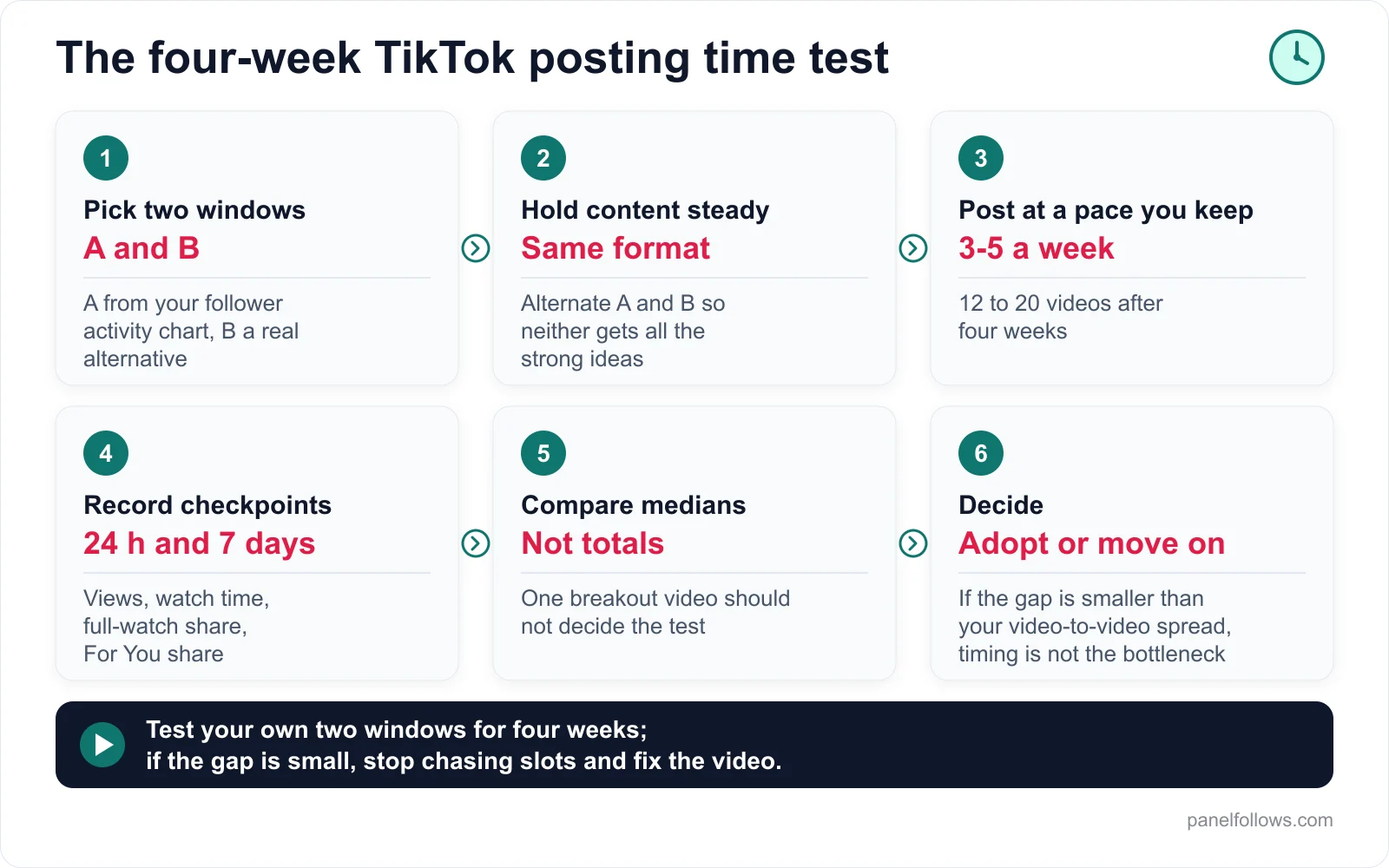
A simple A/B test on your own account settles the posting time question better than any cross-account study.
In our experience running accounts, many tests end up in that last case. That's useful to know, because you can stop chasing time slots. Spend the hours on hooks, keeping viewers watching, and topic choice instead, since that's where the big differences are. Our guide to your first 1,000 TikTok followers covers that work for new accounts.
How often should you post on TikTok?
For most accounts, two to five posts a week that you can keep up beats a daily schedule that falls apart after a month. TikTok's often quoted "1-4 times per day" comes from guidance written for advertisers. Frequency studies based on views point to a much lower number.
Both numbers get repeated side by side without context, so here is where each one comes from.
| Source | Recommendation | What it actually is |
|---|---|---|
| TikTok creative guidance, quoted by Hootsuite | 1-4 posts per day | Advice in an ads creative guide; at least one review dates that guide to 2021 |
| Buffer frequency study (as reported) | Start with 2-5 posts per week | Analysis of 11.4 million posts from 150,000+ accounts, comparing each account with itself |
| TikTok's statement to businesses (as quoted) | No limit on organic posting | A statement that there is no cap, not a target |
| TikTok Direct Post API (as quoted) | Typically around 15 posts per day per account via the API | A technical limit for third-party posting tools, not advice |
According to the reports, Buffer found that going from one post a week to two to five raised views per post by about 17 percent. Higher frequencies were reported to add more (roughly 29 percent at six to ten posts and 34 percent at eleven or more), but each extra post bought a smaller gain. That makes two to five a week the most efficient step, not the ceiling. Because the study compared each account with itself, it answers your question more directly than an average across many accounts.
Frequency is really about how many good videos you can make. Say you are a solo creator who can script and edit eight good videos a week. Posting all eight is fine. Adding twelve reposted clips to reach "three a day" usually lowers average watch time across the account. It also takes hours away from the eight good ones.
Higher frequency does make sense when:
- You have a format that is cheap to produce and reliably holds attention (reactions, quick tips, recurring series).
- You are testing hooks and want more data quickly.
- You are a business with real news, products or events to show every day.
If you're trying to qualify for monetization, the eligibility rules matter more than how often you post. Our breakdown of TikTok Creator Rewards Program requirements covers those rules.
When timing really does matter on TikTok
Timing matters most when content goes stale quickly or when your audience has to be there at the same moment. That covers trends, news, sports, launches with a deadline, and anything LIVE.
Trends and sounds. Many trends peak within days, and few stay fresh for long. Posting your take on day two beats a perfect evening slot on day nine. What matters here is how old the trend is, not the time of day.
News, sports and events. Reaction videos compete for the hours right after the event. If the match ends at 10 p.m., 10:30 p.m. is your best time, whatever the heatmap says.
Product launches and sales. If a product drop goes live at noon, post the teaser early enough to collect views beforehand, and post the "it's live" video right at launch. Business deadlines matter more than engagement windows.
LIVE. A LIVE happens in real time, so the follower activity chart matters directly: people who aren't online can't join. Go live during your peak hours. LIVE has its own eligibility rules, covered in how many followers you need to go live on TikTok.
Being around for comments. Whatever time you choose, make sure you can reply during the first hour. Replies keep conversations going and give you ideas for follow-up videos.
Does scheduling TikTok posts hurt reach?
TikTok has not said that scheduled posts get less reach, and we have seen no evidence that they do. The claim spreads in creator forums, usually based on a single disappointing post.
Scheduling is most useful when your audience's peak is a bad time for you, such as a creator in Europe with a mostly U.S. audience. You can schedule from TikTok Studio on desktop or through third-party tools that use TikTok's posting API. The downside is the one mentioned above: if the video goes out while you sleep, nobody answers the first comments.
One habit helps: check the time zone setting in whatever tool you use. A scheduler set to UTC can quietly shift every post by several hours.
Where paid views fit, and where they do not
Paid views don't change when your audience is online, so they don't fix timing. They raise a number, while the For You feed reacts to what real viewers do after they see the video.
Know the rules first. TikTok's terms prohibit artificially inflating engagement, so buying views carries a risk from the platform, and no seller can honestly promise otherwise. People still choose it in a few narrow cases, such as making a launch video look less empty on day one, or keeping a client's numbers steady while organic growth catches up. Even then, it does nothing for watch time or completion, and those are what the feed weighs. Paid views also muddy your own data. If you are running the four-week test, don't add paid views to any test video, because they change the view counts and traffic sources you are trying to compare.
If you want to see how delivery works before deciding anything, the free TikTok views sample sends a small fixed number of views to a public video link. It needs no password and no sign-up. It is a sample, not a growth method. Full orders are listed under TikTok views. Each service shows its own start time, speed, refill terms and whether it can be cancelled. Some services support drip-feed, which delivers views gradually instead of all at once. For more on how the feed treats likes and views, see our article on how the For You feed decides.
Open your account and order in minutes
Signing up is free and takes two steps. Top up with card, bank transfer or crypto, place your order and track delivery from the dashboard.
Frequently asked questions
What is the best time to post on TikTok for beginners?
If you don't have follower data yet, start with late afternoon or early evening in the time zone where most of your target audience lives. That range is rarely bad in the published studies. Post consistently for a few weeks, then check the follower activity chart in TikTok Analytics and switch to your own peak. At this stage, hooks and topics matter far more than the hour.
Is it better to post on TikTok in the morning or at night?
It depends on your audience. Hootsuite's data favors Thursday mornings. Several roundups of Buffer's data, and Metricool's figures, point to evenings, while Sprout Social favors weekday mid-afternoons. Your follower activity chart settles it for your account. If it shows two peaks, alternate morning and evening posts for four weeks and compare median views at 24 hours and seven days.
What is the worst time to post on TikTok?
For most audiences, the middle of the night in their local time is the weakest slot, because few followers are awake to watch first. Sprout Social's 2026 data also rates weekends as weak, especially Sunday, though other studies disagree. A video posted at a weak hour can still be recommended later if it holds attention. A bad time slows a video down; it doesn't kill it.
What time zone should I use when posting on TikTok?
Use your audience's time zone, not your own. The country breakdown in the Followers tab of TikTok Analytics shows where most followers are. If one region dominates, schedule for its local evening. If your followers are spread across continents, timing matters less and a time that suits you is fine. Also check which time zone your analytics chart and any scheduling tool are using.
How long after posting does a TikTok get most of its views?
TikTok doesn't publish a timeline. Many videos get most of their views in the first day or two, which fits the observation that For You videos are usually recent. But videos that keep people watching often collect views for several days and sometimes take off later. Judge a video after seven days, not after one hour, before deciding it failed.
Is posting three times a day on TikTok too much?
It is too much if your quality drops to hit the number. TikTok has no limit on organic posting, and its ads guidance mentions one to four posts a day. Buffer's research, as reported, found views per post keep rising with frequency, but the biggest gain per extra post comes from moving to two to five posts a week. If you can make three strong videos a day, post them. If not, post fewer, better ones.
Should I delete and repost a TikTok that flopped because of bad timing?
Usually not. The hour is the least likely reason a video underperformed, and deleting it throws away the analytics you need to figure out what went wrong. Check the retention graph first. If most viewers left in the first few seconds, the hook was the problem, and the fix is a new video with a new opening. If viewers kept watching but views were low, give it a few days, since strong videos can pick up later.
Do I need a business account to see when my followers are active?
Older guides say you need a Business or Creator account, but current versions of the app show analytics in TikTok Studio for more account types. The follower activity chart is in the Followers tab under Analytics. Very new accounts with few followers may see little or no data there. Some third-party tools also require at least 100 followers before they show audience data.
Does posting at the best time guarantee more views?
No. Posting when followers are active can speed up a video's first hours, but TikTok ranks videos by how viewers respond, such as whether they watch to the end, share or follow. A video with a weak opening will stall at any hour. Treat timing as a small, free adjustment and spend most of your effort on hooks, keeping viewers watching, and choosing topics.
Sources and further reading
- How TikTok recommends videos #ForYou: TikTok's official explanation of the signals behind the For You feed.
- Learn why a video is recommended For You: TikTok newsroom post on the "Why this video" feature, which lists recent posting and region among the reasons a video is recommended.
- Best times to post on TikTok (Sprout Social): engagement-based timing data from around 307,000 profiles, favoring weekday afternoons.
- The best time to post on TikTok (Hootsuite): timing analysis of over 1 million posts, plus the "1-4 times per day" frequency claim and its source.
- Later's TikTok Analytics (Later help center): how a third-party tool shows hourly follower activity, and its 100-follower minimum for audience data.