
Twitch Viewbots: What They Are, How They're Caught, the Penalties
What a Twitch viewbot is, how Twitch detects and purges fake viewers, the 2026 penalties, and what to do if someone viewbots your channel.
A Twitch viewbot is software or a paid service that makes a live stream show more concurrent viewers than there are real people watching. Twitch classifies this as fake engagement and "viewership tampering," and both are banned in its Community Guidelines. Twitch strips bot traffic from viewer counts, and since 2026 it also caps the viewership of channels found using bots. Enforcement can go as far as indefinite suspension. A viewbot gives you a bigger number, but it doesn't give you an audience.
This guide covers what viewbotting is and how it works at a high level. It sets out what Twitch has actually said about detection and what is only guesswork. You'll see what happened during the 2025 crackdown and the 2026 penalty update, why a view count can drop when you never bought anything, and why a big count with a silent chat hurts a channel. The longest section is for streamers who think someone else is botting them to cause trouble: how to protect the channel and what to put in a report.
Facts in this guide were checked in October 2026.
What is viewbotting on Twitch?
Viewbotting means inflating the live viewer count of a Twitch stream with scripts, tools or services, so the channel looks like it has more people watching right now than it really does. Twitch's help article on handling viewership botting and fake engagement defines it that way. It also separates it from legitimate jumps in viewership, such as a channel being hosted or embedded somewhere else.
The same article puts viewbotting inside a wider category it calls fake engagement: artificially inflating channel statistics like views or follows "through coordination or 3rd party tools." This matters because many streamers who would never pay for bots are still doing something Twitch counts as fake engagement. Twitch names Follow 4 Follow, Lurk 4 Lurk and Host 4 Host exchanges. It also names services that promise visibility in return for lurking in lots of channels, and pages that play several unrelated embedded streams at the same time.
In practice, "viewbotting" covers three different things:
- Pure bots: automated sessions that load the stream player and register as viewers. No person is behind them.
- Chatbots: automated accounts that post generic messages so the bot viewers look less suspicious.
- Human or semi-human exchanges: viewer-for-viewer networks, idle tabs and multi-stream pages. A real device is involved, but nobody is really watching.
Twitch's rules cover all three. A lot of the confusion online comes from people assuming only the first one counts.
What do Twitch's rules actually say?
Twitch bans viewbotting in two places: its Community Guidelines and its help center. The Community Guidelines have an Authenticity section with a subsection on spam, scams and other malicious conduct. One of the things it prohibits is viewership tampering, with artificially inflating follow or live viewer stats given as the example.
The help article goes further on consequences. It says fake engagement and artificial inflation of channel statistics break Twitch's policies, and that taking part in, organizing or running these services leads to enforcement on your account, up to and including indefinite suspension. Pay attention to "participating." The rule isn't only aimed at people who sell bots. Buying them, joining exchange networks and running them all count.
Twitch has also put this into its reporting tools. In early 2025, streaming industry commentator Zach Bussey shared a screenshot of a new report reason, "Viewership Tampering," under the "Spam, Scams, Bots, or Tampering" category. Its description covered tampering with viewer, follower or other channel statistics through artificial inflation. Anyone can now report a channel they suspect.
| Rule source | What it covers | What it says about consequences |
|---|---|---|
| Community Guidelines, Authenticity section | Viewership tampering, such as artificially inflating follow or live viewer stats | Falls under Twitch's general enforcement, which ranges from warnings to suspensions |
| Help article on fake engagement | Viewbotting, follow-botting, F4F, L4L, H4H, lurk services, multi-embed pages | Enforcement up to and including indefinite suspension for participating, organizing or running |
| In-app report form | "Viewership Tampering" report reason | Starts a review; Twitch does not publish timelines |
How do Twitch viewbots work?
At a high level, a viewbot opens many sessions of a stream from many different network addresses, and Twitch's counter registers each session as a viewer. Most bot sessions are logged out, since logged-out viewers are counted too. Sellers usually route the traffic through proxy networks so it doesn't all come from one data center. Pricier services add a pool of accounts that can show up in chat, or chatbots that post short generic messages on a timer.
That's as far into the mechanics as this guide goes, and there's a practical reason as well as a policy one. The sellers who market these tools in detail are describing a cat-and-mouse game they lose on a regular basis. When Twitch announced its 2026 penalty update, CEO Dan Clancy openly said viewbot companies respond quickly to enforcement, as Tubefilter reported. The details change every few months. The structural weakness stays the same: a bot can register a session, but it can't behave like an audience over weeks.
That weakness shows up in every metric that needs a person. Bots don't follow because they liked a moment, they don't come back next Tuesday, they don't subscribe, cheer or clip, and they don't talk to each other in chat. The count goes up and everything else stays where it was.
Does buying Twitch viewers count as viewbotting?
Yes. Paying any service to add live viewers to your own channel is viewership tampering under Twitch's rules, whatever the seller calls it: "real viewers," "organic traffic," "promotion," or "advertising." Twitch's definition depends on whether the viewers are artificial, not on how a seller markets them. If you didn't earn the attention, it's fake engagement in Twitch's terms.
Since Panel Follows sells social media services, here is where we stand. Our catalog does list Twitch live stream viewers, Twitch followers and other Twitch services, the same as most SMM panels, and resellers stock them because people ask for them. Using them on a Twitch channel breaks Twitch's rules. Nothing about how the delivery works makes that "safe" or undetectable, and we won't claim otherwise. If your goal is Affiliate status, a sponsorship or a lasting community, bought live viewers work against all three, for reasons covered further down.
The same honesty applies outside Twitch. Instagram, TikTok and YouTube also prohibit buying engagement in their terms. Any order on any platform carries the risk that the platform removes it or takes action on the account. If you still decide to use a panel elsewhere, read the platform's rules first. Every service page lists its own start time, speed, refill terms and whether it can be cancelled. If you're comparing panels for other platforms, our guide to how drops and refill guarantees really work explains what those terms mean in practice.
See live pricing in the panel
Unit prices for follower, like, view and engagement services are listed live. Registration is free and you can browse the list before adding any balance.
How does Twitch detect viewbots?
Twitch hasn't published how it detects viewbots, and any article claiming to list "the exact signals" is guessing. What Twitch has confirmed is limited. The help article says Twitch is always investigating inflated viewers, chat activity and follower counts, and keeps collecting information on users who use bots. In 2025, Clancy said Twitch had meaningfully improved its ability to identify viewbots and inauthentic viewership, and he admitted the system could filter out some real users by mistake.
Here is how what is known compares with what gets repeated:
| Claim in circulation | Status |
|---|---|
| Twitch actively investigates inflated viewers, chat and follows | Confirmed in Twitch's help article |
| Twitch improved detection in 2025 and removed inauthentic viewers from counts | Confirmed by Twitch's CEO and Twitch's own posts at the time |
| Detection can catch some legitimate viewers too | Acknowledged by Clancy in 2025 |
| Viewbot sellers adapt quickly to enforcement | Acknowledged by Clancy in 2026 |
| Twitch looks at IP reputation, proxies and data-center traffic | Plausible and widely assumed, not confirmed by Twitch |
| A low chat-to-viewer ratio on its own triggers a ban | Not confirmed, and unlikely as a sole signal given how many real lurkers exist |
| Logged-out viewers are ignored entirely | Not confirmed; Twitch has not said it stopped counting logged-out viewers |
| Third-party "viewbot checker" sites see what Twitch sees | False; they only see public data |
The last row matters if you're worried about accusations. Third-party analytics sites estimate from public numbers: viewer count over time, chatter counts and follower changes. A guide from Streamscouter makes the right point: a single quiet hour proves nothing, and only a repeated, unexplained gap between the count and every other signal is worth reporting. Twitch has server-side data no outside site can see, and that's why reporting beats public accusations.
What happened in the 2025 crackdown and the 2026 viewer caps?
Twitch made two big moves in a little over a year. In mid-2025 it purged inauthentic viewers from live counts, and in May 2026 it announced concurrent viewership caps for channels found using viewbots. Together they mean viewbotting no longer just risks an eventual ban. It can also leave a channel with a smaller, capped number than it would have had honestly.
The 2025 rollout started with a July announcement. According to Dexerto, Twitch said it would "meaningfully" improve how it identifies viewbots and inauthentic viewership, and Clancy warned that channels that had been viewbotted would see their counts affected. Sources give slightly different dates for when detection kicked in, from late July to around August 21, 2025. Third-party trackers then recorded sharp platform-wide drops, and Dexerto reported Twitch's lowest monthly viewership in five years. Twitch questioned the accuracy of some third-party figures. That's worth keeping in mind before treating any single percentage as official.
Then suspected channels appeared to recover their numbers, and people asked whether Twitch had quietly backed down. Twitch told Sportskeeda that it had not rolled back any viewbot tools or removal efforts. Counts were going up and down because detection was still running while sellers adjusted.
The 2026 update changed the penalty itself. Tubefilter reported in May 2026 that Clancy announced concurrent viewership caps for streamers found to use viewbots. In his announcement he wrote that viewbotting "is bad for our business" and that fighting it effectively is hard. A cap goes after the reason people buy bots in the first place. If you're caught, the number you were trying to inflate is limited. Twitch hasn't published the full mechanics of how caps are set or lifted in a way we could verify. Read Clancy's announcement and Twitch's help pages directly before relying on any specifics.
| Date | Event | Source type |
|---|---|---|
| June 2016 | Twitch sues seven viewbot makers | Press coverage of the filing |
| January 2018 | Court orders two defendants to pay Twitch about $1.37 million and shut down | Court ruling, reported by gaming press |
| Early 2025 | "Viewership Tampering" report reason appears | Screenshot of Twitch's report form |
| July to August 2025 | Improved detection; inauthentic viewers removed from counts | Twitch CEO statements, press coverage |
| May 2026 | Concurrent viewership caps for channels found viewbotting | Twitch CEO announcement, reported by Tubefilter |
Why did my Twitch view count drop?
Most Twitch view count drops have an ordinary cause: fewer real people tuned in. If the drop was sudden and lined up with an enforcement wave, though, part of what disappeared may have been viewers Twitch no longer counts. That can happen even if you never bought a bot. Separate the possibilities before you assume the worst.
Run through these in order:
- Check the timing. Did the drop happen across many channels in your category at once? A platform-wide shift (enforcement, a big event elsewhere, a holiday) affects everyone, not just you.
- Check your sources. If some of your viewers came from multi-stream pages, lurk exchanges or "support each other" Discord groups, Twitch's help article says these count as fake engagement. Removing them is the rule being applied, not a mistake.
- Compare chat and follows. If chat activity, new follows and returning viewers stayed steady while the count fell, the missing viewers probably weren't taking part in anything. That points toward filtered traffic, not lost fans.
- Look for a raid hangover. A big raid lifts one stream. If you're comparing against that stream, any normal stream afterward will look like a drop.
- Consider a false positive. Clancy acknowledged in 2025 that detection might filter some real users. If your chat is active but the count looks wrong, document it and contact Twitch support. Don't try to "compensate" with outside traffic.
The worst thing you can do after a drop is buy viewers to get the old number back. That turns a measurement problem into a rules violation. For a broader look at which numbers matter, our explainer on engagement rate and social media metrics covers why interaction usually tells you more than raw reach.
Can you get banned for viewbotting on Twitch?
Yes. Twitch's help article says participating in, organizing or running fake engagement services leads to enforcement up to and including indefinite suspension. Since 2026, a channel found viewbotting can also face concurrent viewership caps. Viewer count purges happen whether or not any account action follows, and Twitch has gone to court against bot sellers in the past.
The legal history is real and useful context. In June 2016 Twitch sued seven viewbot makers. In January 2018 a California judge ordered two of them, Michael and Katherine Anjomi, to shut down and pay Twitch a total of $1,371,139, as PC Gamer reported. Claims in the case included trademark violation, unfair competition and breach of contract. That case targeted sellers, not buyers. Some streamers have said Twitch is preparing more aggressive legal action against viewbotters, but Twitch hadn't confirmed that publicly in anything we found.
There's also a regulatory angle beyond Twitch. In 2024 the US Federal Trade Commission finalized a rule on fake reviews that also covers fake indicators of social media influence, such as bot-generated followers or views, when they're bought or sold for commercial purposes. If you stream as a business and use your numbers to win sponsors, this is a real consideration. Read the FTC's own materials or ask a lawyer, because we can't tell you how it applies to your situation.
| Consequence | Who it hits | Confirmed? |
|---|---|---|
| Bot viewers removed from the live count | Any channel receiving bot traffic | Yes, Twitch did this at scale in 2025 |
| Concurrent viewership cap | Channels found to use viewbots | Announced by Twitch's CEO in May 2026 |
| Account enforcement up to indefinite suspension | Anyone participating, organizing or running fake engagement | Yes, in Twitch's help article |
| Civil lawsuit | Viewbot sellers (2016 to 2018 precedent) | Yes, for sellers |
| Lost sponsor or brand deals | Channels whose numbers fail an audit | Not a Twitch rule, but a common outcome |
Why inflated viewers without chat work against a channel
Bot viewers who never chat hurt a channel in three ways: they push away the real visitors they attract, they make your analytics useless, and they leave a pattern that sponsors, rivals and analytics sites can spot. Twitch hasn't said its recommendations penalize low chat ratios, so don't read this as an algorithm claim. These costs are human and practical.
Start with the visitor. Viewer count is a visible signal on browse pages and one of the ways a category can be sorted, so a botted stream can show up higher in its category. A real person clicks in, expecting the energy of a room with 300 people, and finds a chat with two messages in ten minutes. They leave quickly, and a stranger who leaves quickly is the opposite of what you were trying to buy.
Then your data. When half your count is fake, every decision based on it is wrong: which game to play, which time slot works, whether a new format is landing. Here's an example. Say you stream at 7 p.m. and 10 p.m. and the 10 p.m. slot looks stronger, but only because a bot package happens to run then. You'd move your whole schedule to the worse slot.
Then visibility. Many brand managers and talent agencies compare viewer counts with chat activity, follower growth and returning viewers, often with third-party tools. Viewers notice too. Public cases have hurt reputations quickly. On March 18, 2025, for example, a streamer accidentally showed what looked like a viewbotting program window on a live broadcast, a case documented on Wikipedia's viewbot page. A clip like that stays around for years.
Finally, bots don't affect the metrics that earn money. They don't subscribe, cheer or buy merch. If you're working toward monetization, our guide to Twitch Affiliate requirements explains the current thresholds. Reaching them with bot viewers puts the account you're monetizing at risk.
How can you tell if a Twitch channel is viewbotted?
You can't prove viewbotting from outside a channel. The best you can do is notice a persistent, unexplained mismatch between the viewer count and everything else a real audience produces. Before you suspect anything, rule out the many innocent reasons viewers stay silent.
| Pattern you notice | Innocent explanation | When it starts to look like bots |
|---|---|---|
| High count, quiet chat | Lurkers, background listening, non-English viewers, a slow game segment | The gap appears on every stream, regardless of content or time |
| Sudden jump in viewers | Raid, front-page feature, embed on a news site or event page | No raid or embed explains it, and chat does not change at all |
| Very flat viewer line | Small, stable regular audience | A large count that holds almost perfectly flat for hours, then drops all at once when the stream ends |
| Count far above follower base | New channel picked up by an event restream | Repeats for weeks with no follower growth |
| Generic chat messages | New viewers saying hello | Repetitive messages from new accounts on a timer, not responding to the stream |
Real audiences are messy. Counts climb slowly after you go live, rise when something funny happens, and drift away during dead stretches. Fake ones tend to be neater than reality. Even so, if you suspect a rival, use the in-app report and let Twitch look at its own data. Public accusations based on a screenshot have hurt innocent streamers, and they can blow back on you.
Someone is viewbotting my channel: what should you do?
If you think someone is viewbotting your channel to get you in trouble, document it while it's happening, secure your account, moderate chat, and contact Twitch support with specific evidence and a plain statement that you didn't buy the traffic. Commentators have noted that viewbotting is common enough now to be used against rivals. Twitch's help article has a section for streamers who think someone else is botting them. Read the current version, because the wording changes.
The policy facts make this urgent. A channel found viewbotting can face caps and suspension, and none of the Twitch statements we found explain in detail how Twitch tells a streamer who paid for bots from one who was targeted. Your evidence is what makes that distinction.
Here's an example. Say you stream a retro platformer to six to ten regulars. One evening the count jumps to 140 within two minutes, your chat stays at the same three people, and the number stays perfectly flat until you end the stream. Here's what to do, in order:
- Record while it's live. Start a screen recording that shows the viewer count, the chat and your chatter list together. Note the start time, including your time zone. Once the stream ends, the live count is gone, and your recording is the only proof of what it looked like.
- Don't respond to sellers or extortion. Targeted streamers sometimes get messages offering to "remove the bots" for a fee, or threatening more botting. Don't pay. Screenshot the messages, including the sender's username, and save them for your report.
- Secure the account. Turn on two-factor authentication, reset your stream key in your Creator Dashboard settings, and remove any third-party connections you don't recognize. A viewbot doesn't need your login, but if someone is targeting you, close every door anyway.
- Moderate the chat side. If chatbots arrive, ban them, tighten AutoMod, and consider followers-only chat or Shield Mode for that stream. Tell your moderators what's happening so they don't engage with the bots.
- Contact Twitch support. Use the Twitch help portal to explain that your channel is receiving traffic you didn't buy. If you know or strongly suspect who's behind it, report that account through the in-app flow under Viewership Tampering.
- Tell your community once, calmly. A short message like "we're seeing bot traffic we didn't order, and we've reported it" is enough. Don't name a suspect without proof.
- Keep a log. Write down each incident, what you recorded, when you contacted Twitch and any replies. If the botting happens again, a dated log is much stronger than a single complaint.
The order matters because evidence disappears and accounts can be acted on quickly. Record first, secure second, then take your time writing the report.
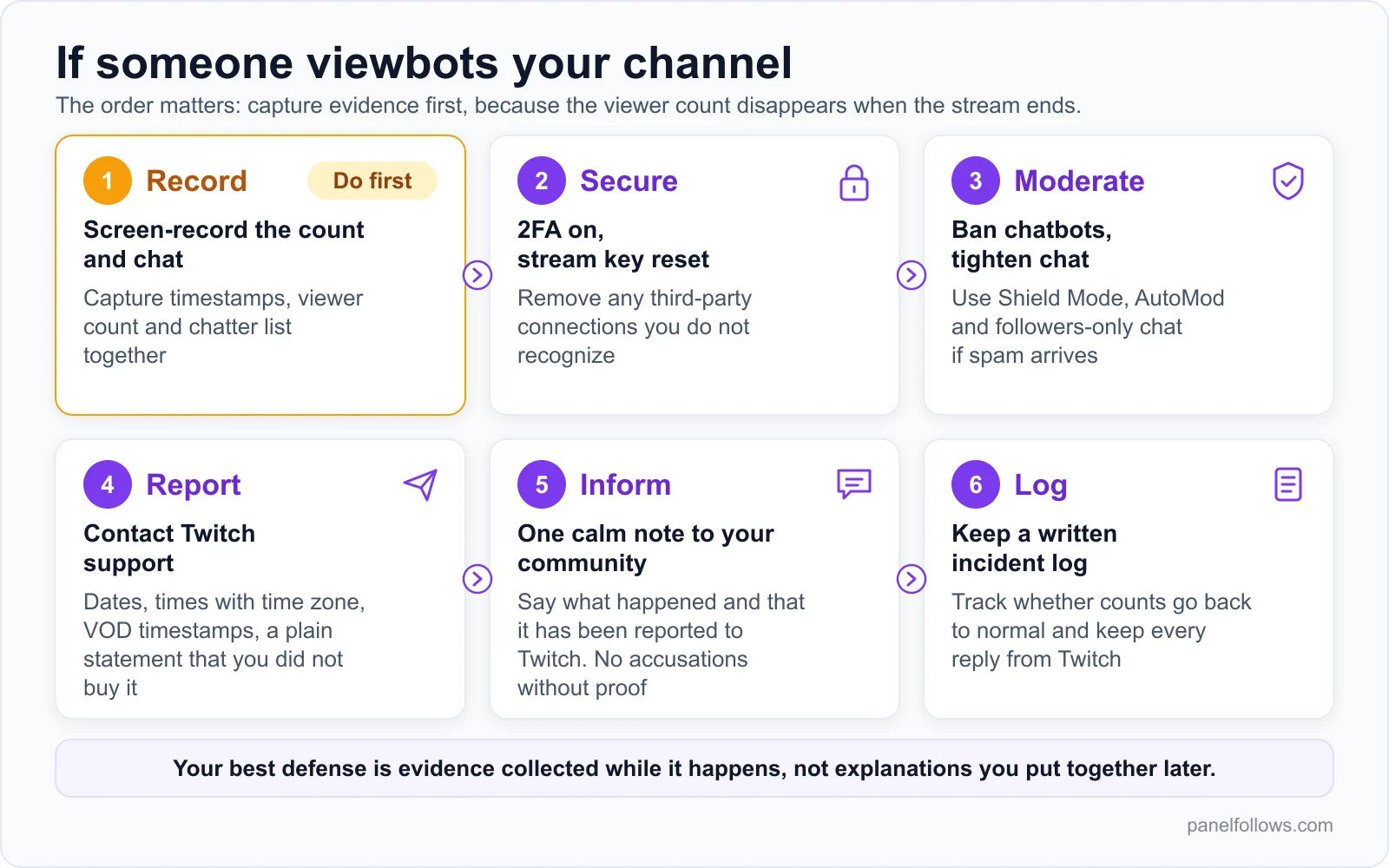
The order matters: capture evidence first, because the viewer count disappears when the stream ends.
A good report is short and specific. Include your channel name and the dates and times of each incident with time zone. Add VOD timestamps if your VODs are saved (turn on saving past broadcasts if they aren't), and attach your screen recordings or screenshots that show the count and chat together. Describe your usual viewer range so the jump is obvious, add any messages from sellers or people making threats, and list what you've already done. End with one sentence saying you haven't purchased or arranged any viewers. Leave out speculation, insults and long backstory. A reviewer should be able to understand the case in under a minute.
What actually grows a Twitch audience instead?
Twitch audiences grow when people find you, stay, and come back, and none of those three things can be faked. On Twitch, discovery mostly happens off the platform or around it. The directory is a hard place for a channel with five viewers to get noticed.
What works for most small streamers comes down to a few unglamorous habits:
- A fixed schedule. Returning viewers need to know when you'll be live. Two consistent slots a week beat seven random ones.
- Clips and short-form video. Cut your best moments into vertical clips for TikTok, YouTube Shorts and Instagram Reels, with a clear on-screen mention of where you stream. This is where most strangers find a small streamer now. Our guide to getting your first 1,000 TikTok followers covers the short-form side in depth.
- A smaller category. Being one of ten streamers in a game you love gets you more visibility than being one of ten thousand in the top category.
- Talking to an empty room. Narrate as if someone is listening, because lurkers are. A new visitor who arrives in the middle of a commentary sentence stays longer than one who arrives to silence.
- Real networking. Raid streamers you actually watch, collaborate with people your size, and join communities as a viewer first. Twitch treats organized lurk and follow exchanges as fake engagement, so the networking has to be real.
- Read your analytics honestly. Average viewers, chat participation and returning viewers tell you what's working. Clean numbers are worth more than impressive ones.
None of this happens fast. But a channel that grows this way keeps its viewers when the next enforcement wave comes, and it never has to explain a flat viewer line to a sponsor.
If you want to understand how SMM panel ordering works in general (keeping in mind that Instagram, TikTok and YouTube also prohibit buying engagement), our walkthrough of how to use Panel Follows explains ordering, refill periods and samples without any pressure to buy.
Open your account and order in minutes
Signing up is free and takes two steps. Top up with card, bank transfer or crypto, place your order and track delivery from the dashboard.
Frequently asked questions
Is viewbotting illegal?
Viewbotting is mainly a violation of Twitch's rules, not something people are generally prosecuted for. Twitch has taken viewbot sellers to civil court and won a 2018 judgment of about $1.37 million against two defendants. In the US, an FTC rule finalized in 2024 targets buying or selling fake social media influence indicators for commercial purposes. If you stream as a business, get advice from a lawyer rather than relying on a blog post.
Can Twitch tell if you use a viewbot?
Twitch says it is always investigating inflated viewers, chat activity and follower counts, and it showed in 2025 that it can remove inauthentic viewers from live counts at scale. It doesn't publish its detection methods, and sellers keep adapting. Twitch's CEO has openly said fighting viewbots is hard, but a hard fight is a long way from going undetected, and the 2026 viewership caps raised the penalty.
Will I get banned if someone else viewbots my channel?
Twitch's help article includes guidance for streamers who believe they're being botted by someone else, but no public statement we found guarantees that targeted channels are never affected. Protect yourself with evidence: screen recordings while it's happening, timestamps with time zone, saved VODs, and a support ticket clearly saying you didn't buy the traffic. A documented, early report is far stronger than an explanation you put together afterward.
Why don't viewbots show up in chat?
Most viewbot sessions are logged out, and logged-out viewers can't chat or appear in the chatter list, even though they still count toward the live viewer number. That's why botted streams often show a large count with a nearly empty chat. Some sellers add chatbots that post short generic messages to hide the gap, but these usually don't respond to anything happening on stream.
Are lurkers the same as viewbots?
No. Lurkers are real people watching without chatting, and they're normal on every channel. Some are at work, some are shy, and some have the stream on in the background. Twitch's help article separates legitimate viewership, including hosts and embeds, from viewbotting. Organized "Lurk 4 Lurk" exchanges are different, though: Twitch classifies them as fake engagement, even when real devices are involved.
How long does it take Twitch to remove viewbots from a count?
Twitch doesn't publish a timeline. During the 2025 rollout, counts on some suspected channels fell and then appeared to recover, and Twitch told the press it hadn't reversed its removal efforts. That suggests detection runs continuously rather than on a fixed schedule. If you're tracking a specific incident, keep your own log, because nothing tells you when filtering has finished.
Do viewbots help you reach Twitch Affiliate or Partner?
They can push the number toward a threshold, but using them puts the same account you're trying to monetize at risk of caps or suspension. Bots also don't subscribe, cheer or buy anything, so even a channel that gets through ends up with monetization tools and nobody to use them. Real average viewers and a returning audience are what make Affiliate status pay.
Does a raid count as viewbotting?
No. A raid sends real viewers from another channel. Twitch's help article lists hosting and embedding as legitimate causes of higher concurrent viewership. Host mode itself was retired in 2022, so raids are now the main way one channel sends its audience to another. A raid often brings a big jump with quiet chat at first, because the new viewers are getting their bearings. What matters is that the spike has a visible cause and fades naturally as some raiders leave.
Is follow for follow allowed on Twitch?
No. Twitch's help article names Follow 4 Follow, Lurk 4 Lurk and Host 4 Host as forms of fake engagement when they're done in a coordinated way. They fall under the same policy as viewbotting, which allows enforcement up to indefinite suspension. Following channels you actually enjoy is fine. The problem is organized exchanges meant to inflate statistics for both sides.
Sources and further reading
- Twitch Help: How to Handle Viewership Botting and Fake Engagement: Twitch's definitions of fake engagement and viewbotting, the forms it prohibits, and enforcement up to indefinite suspension.
- Twitch Community Guidelines: the Authenticity section that bans viewership tampering.
- Tubefilter: Twitch caps concurrent viewership for viewbotters (May 2026): coverage of Dan Clancy's announcement of viewership caps.
- Dexerto: Twitch viewership drops amid viewbot crackdown (September 2025): the 2025 detection announcement and its effect on platform viewership.
- Sportskeeda: Twitch says it did not undo its viewbot crackdown (August 2025): Twitch's statement that removal efforts were not rolled back.
- PC Gamer: Twitch viewbot makers ordered to pay nearly $1.4 million (2018): the outcome of Twitch's lawsuit against bot sellers.
- Zach Bussey on Threads: the "Viewership Tampering" report reason (2025): a screenshot of Twitch's report form showing the new category.
- Streamscouter: How to Spot View-Botting on Twitch: a careful outside view of the signals and the innocent explanations to rule out first.
- Wikipedia: Viewbot: a background overview with links to coverage of notable incidents.