
Instagram Trial Reels: How to Test Ideas on Non-Followers
Instagram trial reels show a Reel to non-followers first. Learn how they work, what to test, how to read results and why the toggle may be missing.
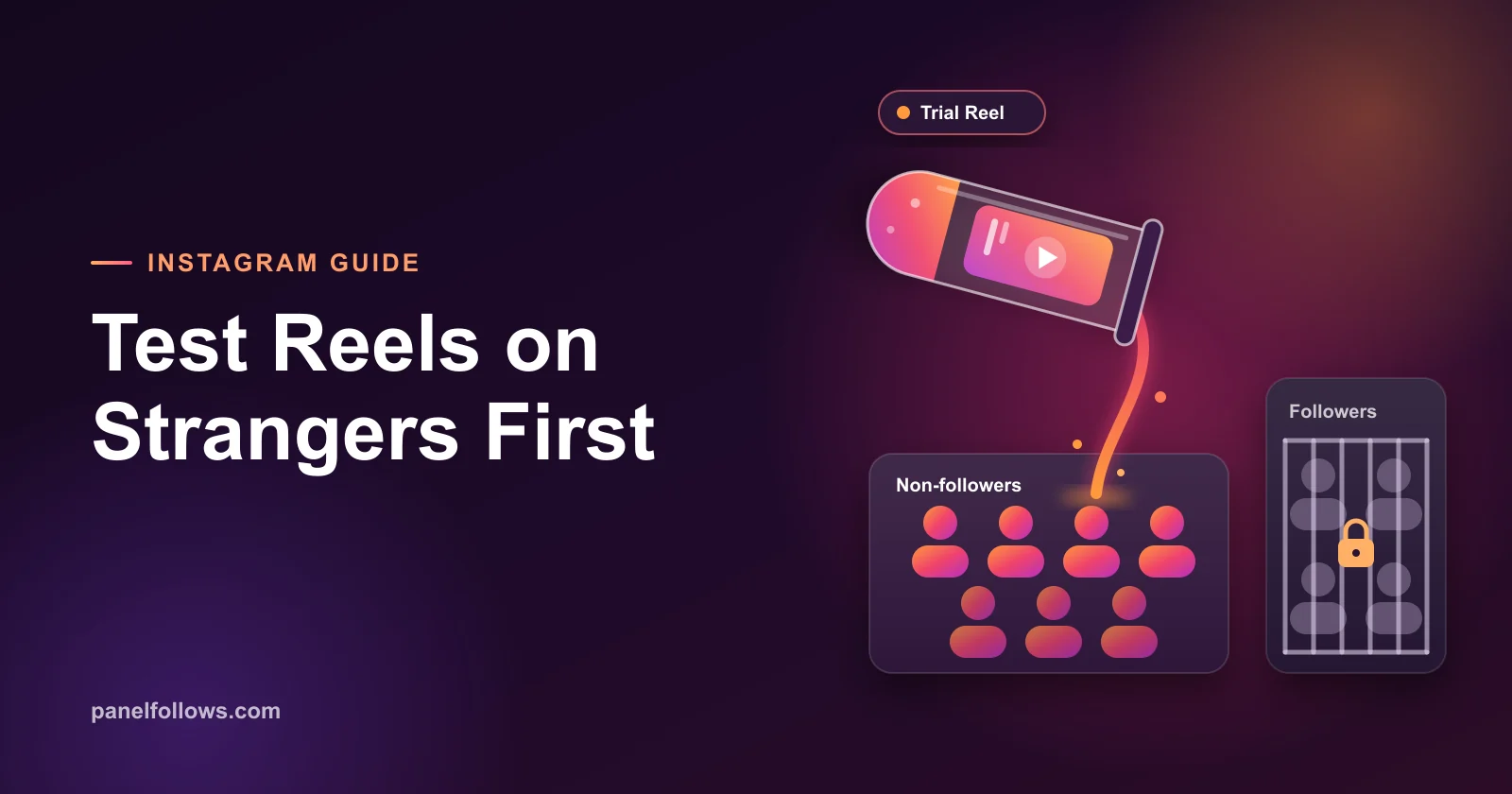
Instagram trial reels are Reels that are shown to people who don't follow you before your followers see them. They stay off your profile grid and out of your followers' Feed and Reels tab. About 24 hours after posting you can see views, likes, comments and shares. Then you can share the Reel with everyone yourself, or let Instagram share it automatically if it does well on views in the first 72 hours.
Most articles about this feature were written when it launched, and they stop at "flip the toggle." This guide treats trial reels as a testing tool. It covers what Instagram has officially said, which updates have arrived since launch, what is worth testing (hooks, length, formats, topics), how many trials it takes to get a usable answer, how to read the numbers before you share to followers, and why the Trial toggle doesn't show up on some accounts.
Nothing here requires buying anything. One section explains why paid engagement and trial reels don't mix, even though Panel Follows sells engagement services. Facts in this guide were checked in October 2026.
How do trial reels work, step by step?
You create a trial reel the same way as any other Reel, and you turn on the Trial toggle on the share screen before posting. Here is the official sequence, based on Instagram's launch announcement on the Creators blog:
- Create a Reel as usual and go to the final share screen.
- Turn on the toggle labeled "Trial."
- When you create it, choose whether Instagram should share it with followers automatically if it performs well, or whether you will decide yourself. Instagram says you can change this setting at any time.
- Post. The Reel goes to non-followers first. Your followers won't see it in Feed or the Reels tab, and it won't appear on your profile grid or your profile's Reels tab.
- After about 24 hours, open the Reel to see views, likes, comments and shares in the Reels viewer, plus a comparison with your previous trials.
- If you like the result, tap "Share to everyone." The Reel then appears on your grid and can be shown to followers on all Instagram surfaces.
There is one caveat that many guides leave out. Instagram's own note says some followers may still come across a trial reel: someone could send it to them in a DM, or it could show up on a page that collects Reels with the same audio, location or filter. "Non-followers first" means followers aren't shown it on purpose. It doesn't mean followers can never see it. Don't use trials for anything you need to keep private.
The automatic option has one stated condition. Instagram says it shares the trial with followers if it decides the Reel is doing well "based on the views it receives within the first 72 hours." Instagram hasn't published a view threshold, so nobody outside Instagram knows what "performing well" means in numbers. Any figure you see for it is a guess.
What Instagram has officially said, and what has changed since launch
Trial reels launched on December 10, 2024, and the feature has been extended several times since then. If you last read about it at launch, the timeline below shows what has changed. Primary sources come first. Secondary coverage is labeled.
| Date | What changed | Source and status |
|---|---|---|
| December 10, 2024 | Trial reels start rolling out, with global availability "to all eligible creators in the coming weeks" | Instagram Creators blog (official) |
| June 2025 | Instagram says trial reels have helped creators increase reach; trial reels are part of a set of updates that also adds grid editing | Coverage by Social Media Today and The Week (secondary, reporting Instagram statements) |
| July 2025 | Access expands to more creators | Social Media Today (secondary) |
| December 2025 | The Content Publishing API reportedly accepts trial settings, so scheduling tools can publish Reels as trials with manual or performance-based sharing | Developer and agency coverage (secondary, check your tool's docs) |
| April 2026 | Adam Mosseri says trial reels can be scheduled in the app | Social Media Today (secondary, reporting Mosseri) |
| September 2026 | Mosseri says posting the same trial reel repeatedly may limit its reach | Coverage of Mosseri's comments (secondary) |
The last row matters most for testing, and we come back to it below. Some creators read trial reels as a free retry button: post the clip, and if it flops, post it again as a new trial. Instagram's head has now said plainly that this habit can backfire.
Eligibility is the one area where official and unofficial sources don't line up. The launch post sends readers to the trial reels page in the Instagram Help Center for eligibility. Third-party guides disagree about follower thresholds, which is covered in the "not showing" section.
Should I use trial reels?
Yes, if you already post Reels regularly and want to try ideas without spending your followers' attention on them. No, if the Reel only makes sense to people who already know you. A trial measures one specific thing: whether a Reel holds up with strangers who have no reason to give you the benefit of the doubt. That's very useful for some content and a poor fit for others.
| Situation | Use a trial? | Why |
|---|---|---|
| Trying a new topic outside your usual niche | Yes | This is the use case Instagram built it for, and followers won't be confused if it misses |
| Testing a new hook style or editing style | Yes | Strangers react to the hook without any loyalty bias |
| Posting more often than your followers want | Yes | Extra experiments don't land in followers' feeds |
| Product launch, sale or event date | No | Followers and customers are the audience, and the clock matters |
| Reply to a follower question or community in-joke | No | Strangers lack the context, so a weak trial result tells you nothing |
| Brand content that needs approval before going wide | Often yes | A trial gives a low-visibility read before the Reel goes on the grid |
| A Reel you have already posted and it flopped | No, rework it first | Posting identical content again is the behavior Mosseri warned about |
There's one trade-off that launch coverage rarely mentions. A normal Reel gets early views from followers who already like your work. A trial doesn't. Trial view counts are often lower than your regular Reels, and that's expected, not a sign you've been penalized. Compare trials with other trials. If you want the bigger picture of how Reels get recommended to non-followers, our guide to how the Instagram algorithm decides reach covers the ranking signals in more depth.
Test this on one post before you scale
The cheapest way to check the logic above is a small order on a single post, then compare the outcome against your own Insights data.
What should you test with trial reels?
Test one thing at a time, and test things that affect the first few seconds or how the Reel holds attention, because that's what strangers react to. The useful variables fall into four groups.
Hooks. The opening line, the first visual and the on-screen text in the first two seconds. Examples of hook styles worth comparing: showing the result first versus asking a question first, starting mid-action versus a talking-head intro, and bold text overlay versus no text. Strangers decide in moments, so hooks are where trials teach you the most.
Length. The same type of idea cut to roughly 10 to 15 seconds versus 30 to 45 seconds versus over a minute. Instagram hasn't published an ideal length. Your audience's patience is something you can measure, and trials let you measure it without your followers seeing three versions of similar content in a week.
Format. Voiceover versus on-camera speaking, single take versus fast cuts, tutorial versus story, screen recording versus filmed footage, carousel-style "slides" turned into video versus live action. Format tests often shift results more than hook tests do, but they also take more effort per variant.
Topic. The original purpose of the feature. A fitness creator trying meal prep, a bakery account trying behind-the-scenes staff stories, a software tutor trying career advice. Topic tests answer a different question: "will strangers care about this subject from me?" A good result doesn't promise your followers will care too.
One rule makes these tests much more reliable. Test a pattern across different videos, not one video in two versions. It's tempting to film one clip, give it two hooks and post both as trials. That gives you one data point per version, and it also creates near-duplicate content, which is the repeated-posting pattern Instagram has said may limit reach. A better design is "question-first hook on three different recipes" versus "result-first hook on three other recipes." The winner is then a style you can use again, not a one-time accident.
Things not worth testing with trials: captions and hashtags on their own (the effect is usually too small to see at trial sample sizes), posting time to the minute, and filters. Before you test the minor details, make sure the major ones are working.
A trial reel testing workflow you can start this week
A trial is worth running only if you decide beforehand what result would change what you do. The workflow below fits around a normal posting schedule and takes about two weeks per round.
- Write down the question. For example: "Do result-first hooks get more shares per view than question-first hooks on my tutorials?" One question per round.
- Set your baseline. If you have run trials before, note the median views and the median shares per 1,000 views of your last five to ten trials. If you haven't, your first round is the baseline round.
- Make at least three videos per variant. Different subjects, same treatment. Keep length, audio approach and editing style the same except for the variable you're testing.
- Post them as trials in the same time window. Same days of the week and a similar time of day, spread over the round so one bad day doesn't decide the result. Scheduling trials (available since April 2026, per Mosseri) makes this easier.
- Read each trial at about 24 hours, when Instagram makes the metrics available, and record the four numbers plus Instagram's comparison with your previous trials.
- Decide by 72 hours. That's the window Instagram uses for auto-share, so it's a reasonable point to make your manual decision too.
- Repeat the round once before changing your strategy. If the same variant wins twice, act on it. If the winner switches, the difference was probably noise.
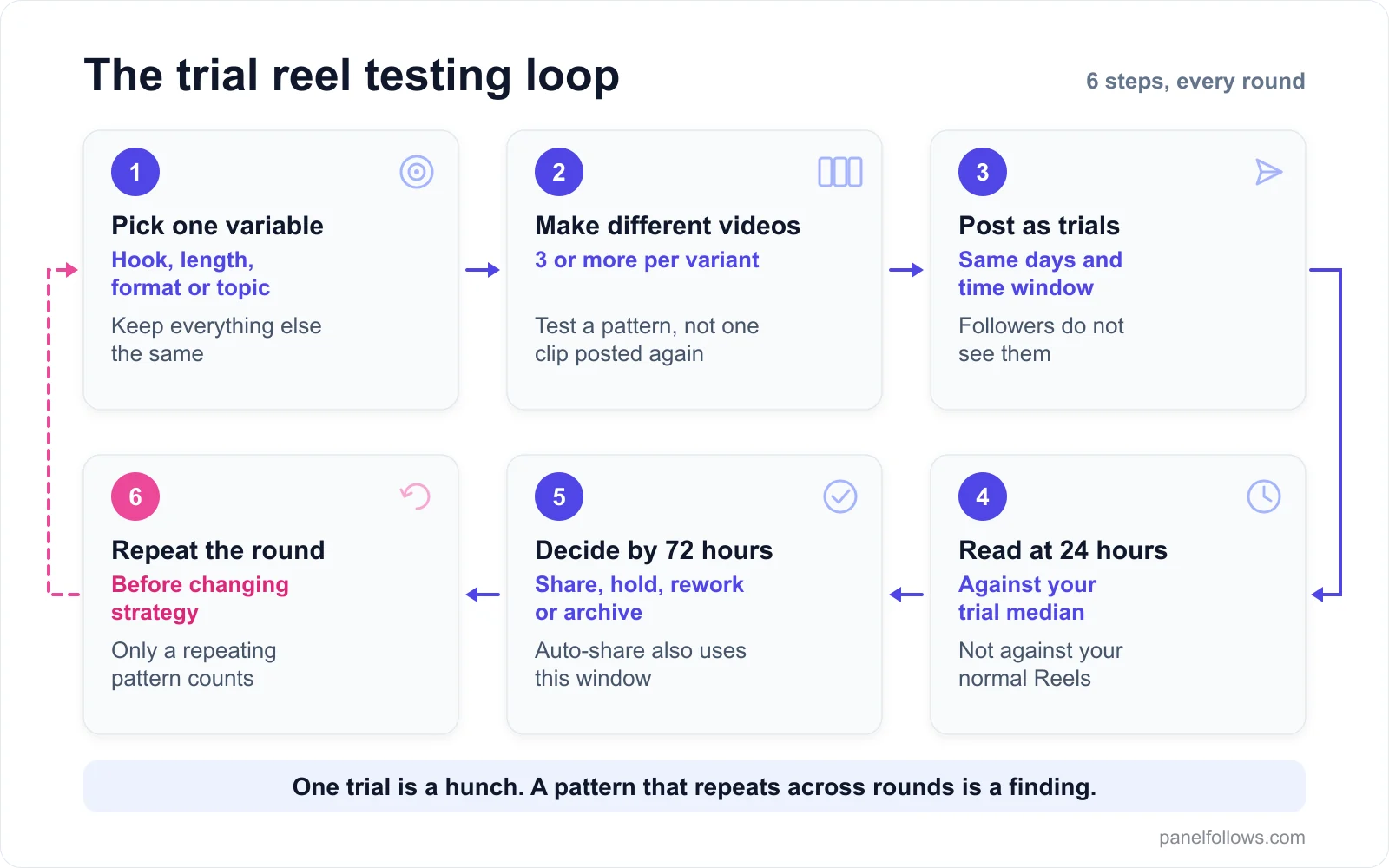
A repeatable loop turns trial reels from one-off experiments into evidence you can act on.
Keep a simple log: date, variable, variant, views, likes, comments, shares, Instagram's comparison label, and your decision. A spreadsheet is enough. After a month, the log is more useful than any single trial, because it turns a run of hunches into a record of what actually works with strangers for your account.
How many trial reels should you run?
Run enough to compare patterns rather than single posts: at least three trials per variant, and two rounds before you trust a result. In practice that means about six to twelve trials per question, which is two to four weeks for most creators. Instagram doesn't recommend a number. This rule of thumb comes from basic sampling logic, not from the platform.
The reason is variance. Two Reels with the same treatment can get very different reach for reasons that have nothing to do with your variable: what else was trending that day, which first viewers happened to be shown it, whether the subject matched a passing interest. With one trial per variant, you can't tell your hook apart from luck. With three, the median starts to mean something. With two rounds, you can see whether the result holds.
How many trials to run per week depends on how much you can produce well. Here is a rough guide, framed as examples rather than rules:
| Your current output | Suggested trial load | What it gets you |
|---|---|---|
| 1 to 2 Reels per week | 1 trial per week | One question answered roughly every 6 to 8 weeks; enough for topic tests |
| 3 to 5 Reels per week | 2 to 3 trials per week | One question roughly every 2 to 4 weeks; hook and format tests become realistic |
| Daily Reels | 3 to 5 trials per week | A steady testing program that can run alongside the main feed |
Don't let trials replace your regular posting. Trials don't reach your followers, so a week of trials only is a week your followers see nothing new from you. Treat trials as an extra layer on top of your normal schedule, not a substitute for it.
How do you read trial reel results before sharing to followers?
Read a trial against your other trials, using ratios per view rather than raw totals, and only trust differences that repeat. The four metrics Instagram shows at about 24 hours (views, likes, comments, shares) are enough if you read them correctly.
Views tell you how far the Reel spread. On a trial, views are close to a direct measure of how well the Reel did in the first rounds of non-follower distribution. Compare them with your trial median, not your regular Reels. Instagram's built-in comparison with your previous trials is the most useful single signal, because it's already like-for-like.
Shares per 1,000 views tell you whether strangers found it worth passing on. Shares usually happen less often than likes, but they mean more: someone chose to put your Reel in front of another person. Our guide to Instagram saves and shares explains why sends per reach has become a metric that serious accounts watch.
Likes and comments per 1,000 views tell you whether it landed emotionally. A Reel with high views but very few likes per view got watched but didn't win people over. That's typical of a strong hook on weak content.
Here's how a round might look. Say you run a home-cooking account with about 8,000 followers and test result-first hooks against question-first hooks, three different recipes each. The numbers below are invented to show the method, not real benchmarks.
| Trial (hypothetical) | Hook style | Views | Likes per 1,000 views | Shares per 1,000 views |
|---|---|---|---|---|
| Recipe A | Result first | 2,900 | 41 | 9.0 |
| Recipe B | Result first | 1,700 | 38 | 7.6 |
| Recipe C | Result first | 4,200 | 45 | 11.4 |
| Recipe D | Question first | 1,100 | 52 | 4.5 |
| Recipe E | Question first | 2,300 | 36 | 5.2 |
| Recipe F | Question first | 900 | 49 | 3.3 |
Medians: result-first hooks get about 2,900 views and 9.0 shares per 1,000. Question-first hooks get about 1,100 views and 4.5 shares per 1,000. Likes per view are close (medians of 41 versus 49, slightly higher for question-first hooks), so both styles please the people who watch, but result-first hooks get more people watching and sharing. If a second round shows the same gap, this account has a hook style worth using as its default. If the second round flips, the account has learned that hook style isn't what holds it back.
Watch out for small numbers. A trial with 400 views and 3 shares versus one with 400 views and 2 shares is a difference of one person. Below a few hundred views per trial, look only at very large gaps. If you want a refresher on calculating rates properly, see how engagement rate is calculated. For how Instagram defines a "view" since it moved to views as the main metric, see our breakdown of Instagram views, reach and impressions.
Then use a simple decision grid:
| Views vs. your trial median | Shares and likes per view | Action |
|---|---|---|
| Above | Above | Share to everyone |
| Above | Below | Hook works, content doesn't; rework the middle before reusing the idea |
| Below | Above | Content works, hook doesn't; reshoot the opening with a new treatment |
| Below | Below | Leave it as a trial and log what you learned |
What happens when you share a trial reel to followers?
When you tap "Share to everyone," the trial becomes a normal Reel: it appears on your profile grid and can be shown to followers on all Instagram surfaces, according to Instagram's launch post. It's the same Reel, now with your follower audience added on top of the non-follower distribution it already had.
You have two ways to get there, and the choice is about control rather than reach:
| Manual sharing | Automatic sharing | |
|---|---|---|
| Who decides | You, after reading the metrics | Instagram, based on views in the first 72 hours |
| Threshold | Your own decision rule | Not published |
| Best for | Brand accounts, off-niche topics, anything that needs a fit check | Creators running many trials who trust views as the main signal |
| Risk | You forget to check and a strong trial never reaches followers | A Reel that strangers liked but your followers won't goes on your grid anyway |
The second risk deserves a moment. A trial tells you that strangers responded. It doesn't tell you your followers will. Say a craft account tries a trending comedy format and it does very well with non-followers. Auto-share would put it in front of 20,000 people who followed for knitting patterns, and some of them may react with a quiet unfollow. For off-niche topic tests, manual sharing is usually the better choice. For hook and length tests within your normal niche, auto-share is fine, because a better hook on familiar content rarely puts followers off.
Instagram hasn't published guidance on whether sharing early or late affects follower distribution. A sensible habit is to decide within the 72-hour window while the Reel is still being distributed, rather than graduating a week-old trial.
Also remember what happens on your profile while a trial is running. A stranger who likes the trial and taps through to your profile won't see that Reel on your grid. Your grid has to convince them by itself. If you get profile visits from trials but few follows, the problem is on your profile, and our guide to turning an Instagram business account's visitors into customers covers the bio, highlights and grid side of that.
Why are trial reels not showing on my account?
If the Trial toggle is missing, the usual cause is eligibility: the account type, account visibility, follower count, app version or posting surface. It's rarely a penalty. Work through these checks in order before you assume anything worse.
| Check | How to verify | Fix |
|---|---|---|
| Professional account | Settings, account type | Switch to a Creator or Business account (free) |
| Public account | Settings, account privacy | Private accounts can't reach non-followers by definition |
| Follower threshold | Compare with Instagram's Help Center page in your app | Disputed; see below |
| App version | App store, check for updates | Update the Instagram app and restart it |
| Posting surface | Toggle sits on the final share screen of a new Reel in the mobile app | Post from the mobile app rather than a desktop browser |
| Account Status | Settings, Account Status | Resolve any restriction or recommendation-eligibility issue first |
| Third-party scheduler | Check whether your tool supports trial publishing | Post natively, or use a tool that has added trial support |
The follower threshold is the confusing part. Many third-party guides say trial reels need 1,000 followers. At least one says the bar is lower, just above 200. Instagram's launch post doesn't give a number and points to the Help Center for eligibility. Our honest summary: we couldn't confirm a current official follower number, and the rules seem to have loosened as the feature expanded in mid-2025. Check the Help Center page from inside your own app, because it reflects your account. If you're near whatever threshold applies, organic growth is the way through it, and our Instagram Reels and Explore guide is the most direct help.
If everything above checks out and the toggle is still missing, Instagram rolls out features in stages, and an app update or simply waiting sometimes fixes it. Reporting the problem in the app (Settings, Help, Report a problem) with a screenshot of the share screen is the standard official support route for an individual account.
Why did my trial reel get almost no views?
A trial with very few views usually didn't make it past the first small group of non-followers. Most often that's because of the content. Sometimes the Reel or the account isn't eligible for recommendations. Occasionally it's the duplicate-posting pattern. These have different fixes, so tell them apart first.
Start with Account Status. Trials depend entirely on recommendations, since there's no follower audience to fall back on. If your account or a recent post has been flagged as not eligible to be recommended, trials will barely move. Normal Reels can hide this problem because followers still see them. A trial makes it obvious. Our guide to detecting and recovering from an Instagram shadowban walks through Account Status and the recommendation guidelines in detail.
Next, look at originality. Instagram's recommendation and originality rules apply to trials like any other Reel. Content reposted from other creators, clips with another app's watermark, and low-quality reuploads are poor candidates for showing to strangers, and trials are shown only to strangers.
Then check whether you've been reposting. If the trial is the second or third upload of the same video, Mosseri's warning about repeated trial reels applies. Edit it properly: a new opening, a new structure, new footage where you can.
If none of these apply, the honest answer is that strangers didn't stop scrolling. That's a result, not a failure. The trial did its job by telling you before your followers saw it.
Can you boost a trial reel with bought views or likes?
You can, but it ruins the only thing a trial measures, and Instagram's rules prohibit artificially inflating engagement. A trial is useful because its numbers come from strangers' real reactions. Add purchased views and the Reel's view count no longer tells you anything about your hook, your format or your topic. You've paid to make your own test meaningless.
Panel Follows sells social media services, so here is the plain position. Platform terms on Instagram, TikTok and YouTube prohibit buying engagement, and no paid service is risk-free in that respect. Even where people decide to accept that risk, for example social proof on an older Reel that's already finished its distribution, there's no good reason to point paid engagement at a trial or at any Reel whose results you're trying to measure. If you run a business account that uses paid services anywhere, keep them away from your testing pipeline and away from the 72-hour window of anything you plan to judge. That's the only way the numbers in your log stay honest.
The same principle applies to engagement pods and comment-for-comment groups. They aren't purchases, but they distort trials in the same way. Strangers' real behavior is the whole point.
Open your account and order in minutes
Signing up is free and takes two steps. Top up with card, bank transfer or crypto, place your order and track delivery from the dashboard.
Frequently asked questions
Do my followers ever see trial reels?
Not on purpose. Instagram keeps trials out of followers' Feed and Reels tab and off your profile grid until you share to everyone. A follower can still come across one if someone sends it to them in a direct message, or if it appears on a page showing Reels with the same audio, location or filter. Treat trials as low-visibility, not private, and don't use them for anything you'd be uncomfortable with a follower seeing.
How long does a trial reel stay a trial?
Instagram's metrics become available about 24 hours after posting, and the automatic sharing option judges performance on views within the first 72 hours. Instagram hasn't published an expiry date for a trial. The Reel stays off your grid unless you share it to everyone or it graduates automatically. A practical habit is to decide within 72 hours, while the Reel is still being distributed and the result is fresh.
Why do my trial reels get fewer views than my normal reels?
A normal Reel gets early views from followers who already like your content. A trial has to earn every view from strangers, so lower counts are normal and don't mean a penalty. That's why trials should be compared with your other trials and not with your regular posts. Instagram's built-in comparison with your previous trials is designed for exactly that like-for-like reading.
Can I post the same video as a trial reel more than once?
You can, but Instagram's head Adam Mosseri has said that posting the same trial reel repeatedly may limit its reach. If a trial didn't do well, rework it before trying again: a new opening, a new structure or new footage. Better still, test the idea behind it on a different video, so you learn whether the style works rather than whether one clip got lucky.
How many followers do you need for trial reels?
There's no single confirmed number in public sources. Instagram's launch post says eligibility is set out in its Help Center and doesn't give a figure. Third-party guides variously cite 1,000 followers or just over 200. What's consistent is that you need a public professional account. The most reliable check is the Help Center page opened from your own app, alongside whether the Trial toggle appears on your share screen.
Can I schedule trial reels?
Yes. According to reporting on Adam Mosseri's announcement, trial reels can be scheduled in the Instagram app since April 2026. Developer coverage also says Meta's Content Publishing API accepts trial settings, so some third-party schedulers can publish Reels as trials with manual or performance-based sharing. Check your own tool's documentation, because support varies and some schedulers still publish everything as a normal Reel.
Should I use auto-share or share trial reels manually?
Use auto-share for hook and length tests within your usual niche, where a trial that strangers like will almost certainly suit your followers too. Share manually for off-niche topic tests and brand content, because strangers liking a Reel doesn't mean your followers will. Instagram doesn't publish the view threshold it uses for auto-share, so manual sharing is also the only way to apply your own decision rule.
Do trial reels work for business accounts?
Yes. Trial reels are available to professional accounts, which include both Creator and Business accounts, as long as the account is public and meets Instagram's current eligibility rules. Brands get extra value from them because a trial gives a low-visibility read on new creative before it goes on the grid. Launches, sales and time-sensitive announcements still belong in normal posts, since followers and customers are the audience for those.
Sources and further reading
- Trial reels: Try content with non-followers first (Instagram Creators blog): the official launch announcement from December 10, 2024, covering the toggle, visibility rules, the 24-hour metrics and the 72-hour auto-share window.
- About Trial Reels on Instagram (Instagram Help Center): the official page Instagram points to for eligibility; open it from your own app for the version that applies to your account.
- Instagram Trial Reels Are Now Available to More Creators (Social Media Today): coverage of the July 2025 access expansion.
- Trial reels, quiet posting and grid control (The Week): June 2025 coverage of trial reels alongside grid editing and other profile updates.
- Instagram allows creators to schedule Trial Reels (Social Media Today): reporting on Mosseri's 2026 scheduling announcement.
- Adam Mosseri reveals Instagram trial reels rule that could limit your reach (The Reel Stars): coverage of Mosseri's comments on posting the same trial reel repeatedly.