
Is an SMM Panel Legal? The FTC Fake Followers Rule Explained
Is an SMM panel legal? How the FTC fake followers rule (16 CFR 465), platform terms and payment rules affect panel owners, plus a reseller checklist.
Running an SMM panel is not a crime in itself in the United States, but "totally legal" isn't accurate either. Since October 21, 2024, the FTC's Consumer Reviews and Testimonials Rule (16 CFR Part 465) has made it unlawful to sell or buy fake followers, likes, views or comments when you knew or should have known they were fake and they can misrepresent someone's influence for a commercial purpose. Platform terms ban bought engagement regardless of the law.
Most search results on this question come from two kinds of pages. Panel sales pages say "yes, 100% legal" because they want your order. Short creator explainers say "it's against the rules" without saying whose rules. This guide splits the question into the three layers a panel owner actually deals with. The first is US federal law, the second is platform terms, and the third is payment processors and consumer protection. It ends with a checklist for resellers on how to word a store so you aren't adding a second problem to the first.
This is an operator's map, not legal advice. It's written by people who run a panel, not by a law firm, and if you have a real decision to make you need a lawyer licensed in your jurisdiction. Facts in this guide were checked in November 2026.
Is an SMM panel legal? It depends which layer you mean
An SMM panel is legal to operate as a business in most places. Whether a given sale is lawful, allowed or bankable depends on three separate rule sets, each enforced by a different party. Mixing them up causes most of the confusion. A panel owner can be fine on one layer and exposed on the other two.
| Layer | Who enforces it | What triggers it | Typical consequence |
|---|---|---|---|
| US federal law (16 CFR 465.8) | The FTC, through federal courts | Selling or buying fake indicators of social media influence, with knowledge, for commercial misrepresentation | Civil penalties per violation, injunctions, bans from the business |
| Platform terms | Instagram, TikTok, YouTube and others | Any artificial boosting of engagement, legal or not | Removed followers and likes, restrictions, account bans, occasional lawsuits against sellers |
| Payments and consumer protection | Payment processors, card networks, state attorneys general | Selling follower products through a processor that restricts them, or making false claims to your own customers | Frozen merchant accounts, chargebacks, deception claims |
The rest of this guide takes the layers one at a time. The federal rule gets the most space because it's the newest and the most misquoted. The other two catch far more panels in practice.
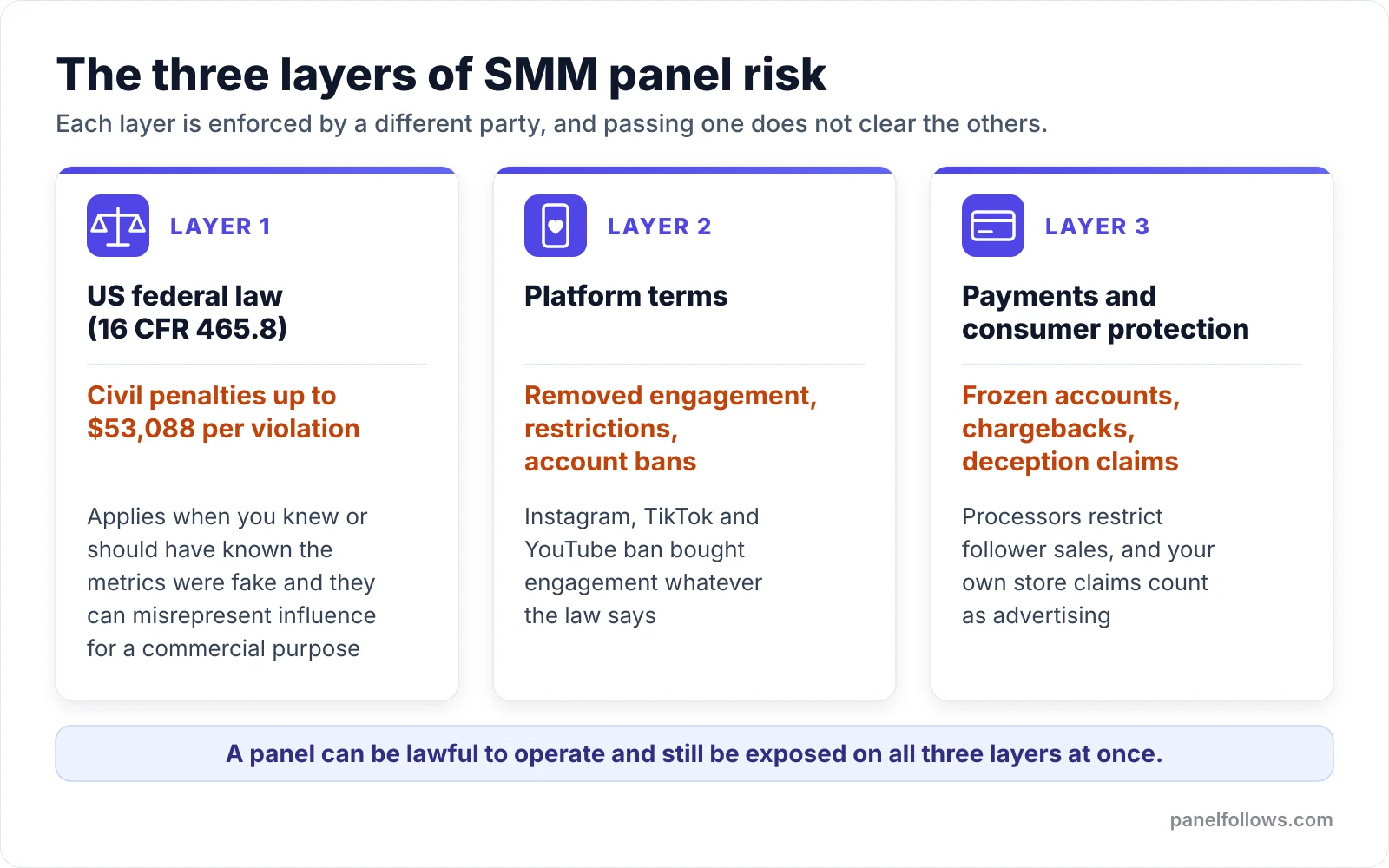
Each layer is enforced by a different party, and passing one does not clear the others.
What does 16 CFR Part 465 actually ban?
16 CFR Part 465 is the FTC's Rule on the Use of Consumer Reviews and Testimonials. Section 465.8 bans selling, distributing, buying or procuring fake indicators of social media influence under specific conditions. The rule was announced in August 2024 and took effect on October 21, 2024. Most of it deals with fake reviews: invented reviews, reviews bought with a required sentiment, undisclosed insider reviews, fake "independent" review sites and review suppression. Section 465.8 is the part that matters for panels, and it applies to anyone, not only to businesses selling their own products.
The definitions are where the detail lives, and they're short enough to read in full in the eCFR text of Part 465. In plain terms:
- Indicators of social media influence (465.1(j)) are any metrics the public uses to judge influence. The rule lists followers, friends, connections, subscribers, views, plays, likes, saves, shares, reposts and comments. Almost every product category on a panel menu is on that list.
- Fake indicators (465.1(h)) are those generated by bots, by accounts not tied to a real person, by accounts made with someone's personal information without consent, or by hijacked accounts. A catch-all also covers anything that otherwise doesn't reflect a real person's or entity's activities, opinions, findings or experiences.
- Distribute (465.1(g)) means giving fake indicators to people or businesses who could use them to misrepresent their influence.
Two limits are worth knowing. According to the commentary that came with the final rule, the FTC chose not to extend the definition to metrics that aren't public but are used to gain an algorithmic advantage. The FTC's questions and answers on the rule also say that a business which hires an influencer who happens to have fake followers isn't procuring fake indicators itself. The rule targets the people who knowingly sell and buy fake metrics, not everyone downstream of them.
Section 465.8 has two halves, and they aren't mirror images:
| Element | Seller side, 465.8(a) | Buyer side, 465.8(b) |
|---|---|---|
| Conduct | Sell or distribute | Purchase or procure |
| Knowledge | Knew or should have known the indicators were fake | Knew or should have known the indicators were fake |
| Effect | Indicators can be used by individuals or businesses to materially misrepresent influence or importance | Indicators materially misrepresent the buyer's influence or importance |
| Purpose | For a commercial purpose | For a commercial purpose |
That difference in the "effect" row is the most important detail in the rule for anyone running a store, and we'll come back to it.
What does "knew or should have known" mean for a panel owner?
"Knew or should have known" means you can be responsible both for what you actually knew and for what a reasonable operator in your position would have figured out from the information in front of them. It's a familiar standard in US consumer protection law. For a panel, the evidence of what you knew mostly sits in your own admin area.
Think about what an investigator, or a judge, would see if they opened your store and your supplier dashboard:
- Your own service names. Plenty of panels copy upstream labels word for word, including tags like "bots", "fake", "no profile picture" or "mixed quality". That label is a written admission.
- Supplier descriptions. If your provider's catalog says a service comes from bot accounts, you can't easily claim you didn't know just because you renamed it.
- Price. When 1,000 followers cost less than a cup of coffee at wholesale, a reasonable operator might ask how real people could be behind that. Price on its own proves nothing, but it feeds into the "should have known" part.
- Drop rates and support tickets. A service that loses half its count within days, with customers writing in to say the followers have no posts and no photos, tells you something about where it comes from.
Here's a hypothetical. Say you run a small panel and import a service your provider labels "Instagram Followers, Bots, No Refill". You rename it "Instagram Followers, Premium Quality" and add "real active users" to the description. You've now done two things. The supplier label shows that you knew, so the 465.8 issue is still there. You've also made a false statement to your own customer, which is a separate deception issue covered further down. Renaming the service made things worse on both counts.
The uncomfortable conclusion is that wording can't fix a sourcing problem. The only complete answer to 465.8 exposure is to stop selling services you know or should know are fake. What wording can do is keep you from stacking a second violation on top of the first. No panel, including this one, can honestly promise that every unit in a wholesale catalog comes from a real person acting on their own opinion. Panel Follows is a provider layer. It doesn't own bot farms or device pools and isn't the original source of every service, so it doesn't make that promise. Your store shouldn't either.
Resell the same services at your own price
Send orders from your own site through the reseller API and set your own margin. You can also run a child panel under your own brand.
Is buying followers illegal?
Buying followers isn't a crime in the US. Under 16 CFR 465.8(b), though, it's an unlawful practice when the buyer knew or should have known the followers were fake and they materially misrepresent the buyer's influence or importance for a commercial purpose. All three conditions have to be met. A business or creator using the account commercially, for example to win clients or brand deals, can meet them without much difficulty.
The "commercial purpose" condition is where buyers differ. An influencer who buys followers before pitching brands, a consultant who inflates a LinkedIn following to win clients, or a shop that pads its Instagram so it looks established is squarely the target. When the FTC announced the final rule, it described the ban as reaching followers or views generated by a bot or hijacked account, limited to cases where the buyer knew or should have known they were fake and they misrepresent the buyer's influence or importance for a commercial purpose. A teenager buying a few hundred followers for fun is a much weaker fit, although platform terms still apply to them in full.
We found no public FTC action against individual buyers of fake followers. Seller cases still matter to buyers, though. In the 2019 Devumi case (covered below), the FTC's complaint described the kinds of customers who bought from the company, which shows that a seller's order records can end up in front of a regulator.
If you're a brand vetting creators, you aren't liable under the rule just because a creator you hired has fake followers. You can still lose money on them, and our manual audit for fake followers shows how to check before you pay.
Is selling followers illegal?
Selling followers isn't a crime in the US either. Under 16 CFR 465.8(a), selling or distributing fake indicators of social media influence is an unlawful practice when the seller knew or should have known they were fake and they can be used to materially misrepresent influence for a commercial purpose. That wording is broader than the buyer side, and it's the main legal point for panel owners.
On the buyer side, the fake metrics have to actually misrepresent the buyer's influence. On the seller side, they only have to be capable of being used that way. Our reading (and it is a reading, not a ruling) is that an enforcer wouldn't need to prove what each individual customer did with an order. Selling bot followers to the general public, where any business could buy them, would arguably be enough. "My customers are just hobbyists" is a weak defense when your store is open to anyone.
The FTC had come after sellers before the rule existed. In October 2019 it announced what it called its first-ever complaint challenging the sale of fake indicators of social media influence, against Devumi and its CEO. The FTC's Devumi case page has the documents. The theory back then was that by selling fake followers, Devumi gave its customers the means to deceive. According to press coverage, the CEO agreed to a $2.5 million judgment, all but $250,000 of it suspended, and the order banned the defendants from selling social media influence to users of third-party platforms. Devumi had already paid $50,000 each to settle with the New York and Florida attorneys general.
What the rule adds is a direct route to money. In 2021 the Supreme Court held in AMG Capital Management v. FTC that the FTC couldn't win monetary relief under Section 13(b) of the FTC Act, which made rule violations much more valuable to the agency. A trade regulation rule allows civil penalties for knowing violations, even for a first offense.
The rule also doesn't stop at the original source. Resellers and child panel owners sell to the public, so they're sellers and distributors too. Your upstream provider's knowledge doesn't replace yours, and your ignorance of the provider's sources isn't a shield if the signs were there. Our explainer on how the SMM supply chain actually works shows how many hands a typical order passes through.
What are the penalties, and can a customer sue you under the rule?
Violations of 16 CFR Part 465 can bring civil penalties of up to $53,088 per violation, as stated in the FTC's December 2025 warning letters. The figure comes from the January 2025 inflation adjustment, which set that amount for knowing violations of a trade regulation rule under Section 5(m)(1)(A) of the FTC Act. Several legal summaries report that a September 2026 Federal Register notice kept the 2025 levels in place rather than raising them for 2026. We saw that notice only through secondary sources, so treat the "no 2026 increase" detail as reported, not confirmed.
"Per violation" is what turns that number into a business-ending risk. How violations get counted in a particular case is up to the agency and the courts. A store that has processed thousands of orders could face a theoretical maximum far larger than any panel's revenue. Courts weigh things like good faith, ability to pay and how serious the conduct was, so the maximum is rarely the result. Still, the starting point of a settlement negotiation shapes everything after it.
Who can bring a case matters as much as the amount:
- The FTC, either on its own or through the Department of Justice.
- State attorneys general, under their own consumer protection laws, as New York and Florida did with Devumi.
- Not your customers, under this rule. The FTC Act doesn't give private individuals a right to sue for its violations. That said, many state consumer protection statutes do allow private lawsuits over deceptive practices, so an unhappy customer may have other routes.
- Platforms, which can sue under contract and other theories that have nothing to do with the FTC rule.
The rule is civil, not criminal. Prison isn't a remedy under 465.8. Some of the conduct the rule describes can be criminal on its own, though, such as using hijacked accounts or accounts built from someone's stolen personal information, and that's a different and much worse problem.
Has the FTC enforced the fake followers rule yet?
As of November 2026, we found no public FTC case built on the fake social media indicators section, 465.8. Enforcement of the rule so far has focused on fake and incentivized reviews, and has mostly appeared as extra counts added to cases about other deceptive conduct. Here's the timeline from the sources we reviewed.
| Date | Event | Relevance to panels |
|---|---|---|
| October 2019 | FTC v. Devumi settled, the first complaint over sales of fake social media influence | Pre-rule precedent aimed squarely at a follower seller |
| October 21, 2024 | 16 CFR Part 465 takes effect | Section 465.8 creates civil penalty exposure for sellers and buyers |
| December 22, 2025 | FTC staff send warning letters to 10 unnamed companies | Review-focused; the letters cite penalties of up to $53,088 per violation |
| 2026 | FTC posts the warning letters; recipients reported as property managers, personal injury law firms and an accounting firm | Shows the FTC names recipients after the fact |
| April 2026 | TruHeight complaint and settlement | Rule counts alongside other claims; reported as the only basis for the money award |
| May 11, 2026 | DOJ, for the FTC, and the Illinois attorney general sue Premium Home Service | Fake listings plus fake five-star reviews; motion to dismiss filed July 17, 2026 |
| October 2026 | GovAssist and Digital Forensics actions | Fake reviews used to support scams; the complaints rely on Section 5, not the rule |
The FTC's December 2025 press release says the letters were based on consumer complaints and information from the companies, and that they aren't formal findings of violation. DLA Piper's July 2026 analysis describes the agency alleging rule violations in matters centered on other deceptive conduct. It also notes that the FTC hadn't brought a case focused mainly on reviews since a November 2024 action against Sitejabber. Its November 2026 follow-up on the GovAssist and Digital Forensics cases points out that those complaints didn't allege rule violations at all.
The lesson isn't that sellers are safe because nobody has been charged under 465.8. The pattern so far is warning letters first, then rule counts added to bigger cases. A panel whose customers include scam operators, fake local businesses or people faking influence for brand deals is exactly the kind of supplier that turns up in those bigger cases. The first time a regulator reads your store may be as evidence in someone else's file.
Why legal is not the same as allowed: platform terms
Instagram, TikTok and YouTube all prohibit artificially inflating engagement in their terms and community guidelines, whether or not the engagement breaks any law. Platform terms are a contract between the platform and each account holder. Every customer of every panel has agreed to them, and enforcement doesn't need a court.
In practice, platform enforcement is the layer that touches panel customers most often:
- Removal. Platforms periodically purge accounts they consider inauthentic, and those followers disappear from the customers who bought them. That's the main reason counts drop, as our guide on why followers drop and how refills work explains.
- Restrictions. Unusual activity patterns can lead to temporary limits, and our article on Instagram action blocks covers what those look like and how long they last.
- Distribution and account penalties. Platforms can limit reach or, for repeated or serious cases, remove accounts.
- Lawsuits against sellers. Meta, among others, has sued sellers of fake engagement in the past, under contract and other theories that don't depend on the FTC rule.
For a panel owner the practical point is simple. You can't promise a customer that a platform won't act. "Safe", "undetectable" and "no ban risk" are claims about another company's enforcement decisions, which you neither control nor see. That's why Panel Follows doesn't make those claims and why your store shouldn't. Panel Follows never asks for a password and never logs into a customer's account, so at least credential theft and account takeover aren't added to the risk. It's worth requiring the same of any provider you use.
Payment processors and consumer-protection exposure
Payment processors are often the first layer to shut a panel down, well before any regulator shows up. Mainstream processors treat follower and engagement sales as prohibited or high-risk. Separately, every claim you make about your services is an advertising claim to your own customers.
Stripe is the clearest example. Its Atlas restricted categories page lists "digital promotion products", described as selling traffic or followers to websites or social media accounts, among the categories that may not be supported on Stripe Payments because they appear on Stripe's general prohibited list. Older versions of Stripe's list named selling social media activity explicitly. A panel that opens a merchant account anyway, by describing itself as "digital marketing software", risks a frozen balance once the processor works out what it sells.
That's why a large share of the industry runs on cryptocurrency and bank transfers. Panel Follows takes cryptocurrency (USDT and other coins through crypto gateways) and international bank transfer from international customers. Our payment gateway guide for SMM panels covers the options for your own store, and the chargeback prevention playbook covers the fraud that comes with card payments in this niche.
The consumer-protection side is quieter and gets underestimated. Separately from 465.8, Section 5 of the FTC Act and state consumer protection laws prohibit deceptive claims to your customers. If your store says "lifetime non-drop" and the service drops in a week with no refill, that's a false claim to the person who paid you. "Real active users", "guaranteed", "instant" and "100% refund" are all statements you may one day have to back up. The good news is that this layer is fully under your control. It depends only on your wording and your refund practice.
Is an SMM panel legal in India and other countries?
We found no Indian statute that names the sale of followers specifically, so "is SMM panel legal in India" has no one-line answer. The relevant layer there, as in most countries, is general consumer protection and advertising law. In India that means the Consumer Protection Act, 2019 and the rules on misleading advertising made under it. Platform terms apply in India exactly as they do in the US.
Some practical points for operators outside the US:
- The FTC rule is US law. It covers conduct that affects US commerce and US consumers. If your panel sells to US customers, or your customers use your services to mislead US buyers, assuming you're out of reach because you're based elsewhere is a gamble a lawyer should assess, not a blog post.
- Other countries regulate fake reviews and endorsements in their own ways. Rules on fake reviews, influencer disclosure and misleading advertising differ widely, and some are newer than the FTC rule. We haven't verified each jurisdiction's treatment of follower sales, so we won't summarize them here.
- Payments travel with you. Processor restrictions on follower sales are generally applied worldwide, regardless of local law.
If you're starting a panel in India, Turkey, Indonesia, Nigeria or anywhere else, the honest advice is the same: have a local lawyer review your terms of service, your refund policy and your service descriptions before you take your first payment. Our guide to starting an SMM reseller business from scratch covers the business side of that setup.
Is an SMM panel safe to use?
No SMM panel is "safe" in the sense of carrying no risk to the account you order for, because platform terms prohibit bought engagement and any panel that tells you otherwise is making a claim it can't back up. Whether a panel is safe also has two other meanings: whether your money is safe and whether your data is safe.
Here's how to separate the three:
- Account risk sits with the platform. It depends on the platform's detection and enforcement, which no seller controls. Lower quantities and slower delivery change how an order looks, but they don't make it permitted.
- Money risk sits with the panel. Scam panels take deposits and don't deliver, or promise refills they never honor. A trustworthy panel shows the start time, speed, minimum and maximum, refill period and cancellation status for every service before you pay. Panel Follows lists all of these. Refills on eligible services can be requested once every 24 hours per order during the stated refill period, and services without refill require you to confirm a warning before you order.
- Data risk depends on what you hand over. A legitimate order needs only a public link or username. Any service that asks for your password is asking for your account.
If you're judging a provider for your own store, the questions are the same, plus API stability and margins. Our guide on how to find and vet an SMM provider gives a scoring method.
A compliance checklist for SMM resellers
The goal of this checklist is to keep your store from making things worse. It's not a way to make selling fake metrics lawful, because nothing in your wording can do that. Work through it before you launch, and again whenever you import new services from a provider.
- Audit your catalog for sourcing labels. Read every service name and description you imported. If a provider label says bots, fake accounts or anything similar, decide whether you want to sell that service at all, since 465.8 exposure comes from the service, not the name.
- Strip every guarantee about platform behavior. Remove "safe", "no ban", "undetectable", "algorithm-friendly" and "won't get flagged". You can't make those promises.
- Remove "real" claims you can't verify. "Real active users", "100% real" and "high-quality humans" are factual claims. If you can't prove them, they're deceptive.
- Describe mechanics, not outcomes. State start time, speed, quantity limits, refill period and cancellation rules. Don't promise viral reach, sales or brand deals.
- Make refills match the label. If a service says 30-day refill, honor it within 30 days. If there's no refill, say so prominently.
- Write terms of service a customer will actually read. Cover refunds, refills, cancellation (only before delivery starts, if that's your rule) and the fact that platform terms prohibit bought engagement.
- Watch who your customers are. Orders for fake reviews of local businesses, large follower orders for accounts selling financial products, or bulk orders for impersonation accounts are the patterns most likely to put your store into someone else's enforcement case.
- Keep records. Keep supplier descriptions, change logs of your own descriptions, and refund decisions. If you're ever asked what you knew, records help an honest operator.
- Get a lawyer before scale, not after. Have someone licensed in your jurisdiction review your store at launch and when your volume or market changes.
The wording part of the checklist in table form:
| Risky claim on a panel store | Why it's a problem | Better wording |
|---|---|---|
| "100% real active users" | Unverifiable factual claim; a false one deceives your customer | Describe start time, speed, refill period and drop expectations |
| "Safe, no ban risk" | A promise about another company's enforcement | "Platform terms prohibit bought engagement. See our terms." |
| "Lifetime non-drop" | Hard to honor; a false guarantee | State the actual refill period, or "no refill" |
| "Guaranteed viral" | An outcome no seller controls | Don't make outcome claims |
| Upstream label "Bots" kept in the name | Written evidence of knowledge under 465.8 | Reconsider selling the service rather than renaming it |
| Renamed "Premium Quality" with no basis | Adds deception on top of the 465.8 issue | Describe only what you can verify |
If you'd rather not source and vet every service yourself, a white-label child panel runs on the Panel Follows catalog, but you're still the seller to your own customers and the checklist applies to you. Our honest build guide to becoming an SMM provider covers the operations side if you plan to go further up the chain.
Open your account and order in minutes
Signing up is free and takes two steps. Top up with card, bank transfer or crypto, place your order and track delivery from the dashboard.
Frequently asked questions
Is it illegal to buy Instagram followers?
Buying Instagram followers isn't a crime in the US. Under the FTC rule in 16 CFR 465.8(b), it's an unlawful practice if you knew or should have known they were fake and they materially misrepresent your influence for a commercial purpose, such as pitching brands or attracting clients. Separately, Instagram's terms prohibit artificially boosting followers, so the platform can remove them or restrict your account no matter what the law says.
Can you go to jail for selling followers?
Not under the FTC rule. 16 CFR Part 465 is a civil rule, and its remedies are civil penalties, injunctions and court orders, not prison. Some conduct around fake engagement can be criminal on its own, though, such as using hijacked accounts, stolen personal data or stolen payment cards. Those are separate offenses with separate consequences, and they're a good reason to avoid any supplier that works with compromised accounts.
Does the FTC rule apply if my panel is outside the United States?
The FTC rule is US law aimed at conduct affecting US commerce and US consumers. A panel based elsewhere that sells to US customers, or whose services are used to mislead US buyers, can't safely assume it's out of reach. How far US enforcement reaches a foreign operator in practice depends on facts a lawyer has to assess. Your own country's consumer protection and advertising laws apply in addition.
What is an SMM panel?
An SMM panel is a self-serve web store where customers order social media marketing services, such as followers, likes, views, comments or subscribers, by pasting a link or username. SMM stands for social media marketing. Many panels also sell wholesale to resellers through an API, and some let others open white-label stores on their own domains.
Does 16 CFR 465 cover views and likes, or only followers?
It covers far more than followers. The rule defines indicators of social media influence as any public metrics used to judge influence and lists followers, friends, connections, subscribers, views, plays, likes, saves, shares, reposts and comments. Almost every product category on a typical panel menu falls under that definition. The FTC chose not to extend it to non-public metrics used only for algorithmic advantage.
Does the rule still apply if the followers come from real people?
Possibly. The definition of fake indicators includes a catch-all for metrics that otherwise don't reflect a real person's or entity's activities, opinions, findings or experiences. Our reading (not a ruling) is that a follow or like from a real person who was paid or rewarded to give it, with no genuine interest in the account, could fall under that catch-all. The FTC hasn't tested this point in a public case under 465.8 that we found. Platform terms prohibit paid or incentivized engagement either way, so a service labeled "real" doesn't make an order permitted.
Can a customer sue my panel under the FTC rule?
Not directly. The FTC Act doesn't give private individuals a right to sue for violations, so enforcement of the rule falls to the FTC and the Department of Justice. A customer still has other options. Many state consumer protection laws allow private lawsuits over deceptive claims, state attorneys general can act, and your payment processor can respond to complaints by freezing your account.
Is a cheap SMM panel riskier than an expensive one?
Price alone doesn't decide legality, but very low wholesale prices can count toward what a seller should have known about where a service comes from. The cheapest panels also tend to have higher drop rates, weaker refill practices and less transparent sourcing, which raises both customer complaints and deception risk. Judge a panel on its stated refill periods, cancellation rules and refund behavior, not on price per thousand.
Is using an SMM panel against Instagram's or TikTok's rules?
Yes. Instagram, TikTok and YouTube all prohibit artificially inflating engagement in their terms and guidelines, whatever the source or quality of the engagement. That's separate from the law, and enforcement needs no court: platforms can remove the engagement, limit reach, restrict actions or remove accounts. Any seller claiming its services are "safe" or "undetectable" is promising something it doesn't control.
Does a child panel owner carry the same legal risk as the main provider?
Largely, yes. Section 465.8 applies to anyone who sells or distributes fake indicators of social media influence, and a child panel owner sells to the public under their own brand. Your upstream provider's knowledge doesn't replace your own, and the claims on your storefront are your advertising. Running on someone else's catalog changes your operations, not your responsibility to your customers.
Sources and further reading
- eCFR: 16 CFR Part 465, Rule on the Use of Consumer Reviews and Testimonials: the current rule text, including definitions in 465.1 and the fake social media indicators ban in 465.8.
- FTC: The Consumer Reviews and Testimonials Rule, Questions and Answers: the FTC's own business guidance, including what does and doesn't count as procuring fake indicators.
- FTC: Final rule announcement, August 2024: the agency's summary of the rule's prohibitions, including the knowledge and commercial purpose limits.
- FTC: Warning letters to 10 companies, December 22, 2025: the FTC's warning letters citing the rule and the $53,088 per-violation figure.
- FTC: Devumi, LLC case page: documents from the first FTC complaint against a seller of fake followers, subscribers and views.
- Federal Register: FTC civil penalty adjustments, January 2025: the inflation adjustment setting the maximum penalty for knowing rule violations.
- DLA Piper: FTC's 2026 enforcement approach to fake reviews takes shape (July 2026) and FTC's actions against fake reviews in GovAssist and Digital Forensics (November 2026): law firm analysis of how the rule has been used in 2026 cases.
- Stripe: Atlas restricted business categories: Stripe's statement that selling followers or traffic may not be supported on Stripe Payments.