
YouTube Reused Content Policy After the 2026 Shorts Update
The YouTube reused content policy now affects Shorts reach, revenue sharing and monetization. See what counts as original and how to audit your channel.
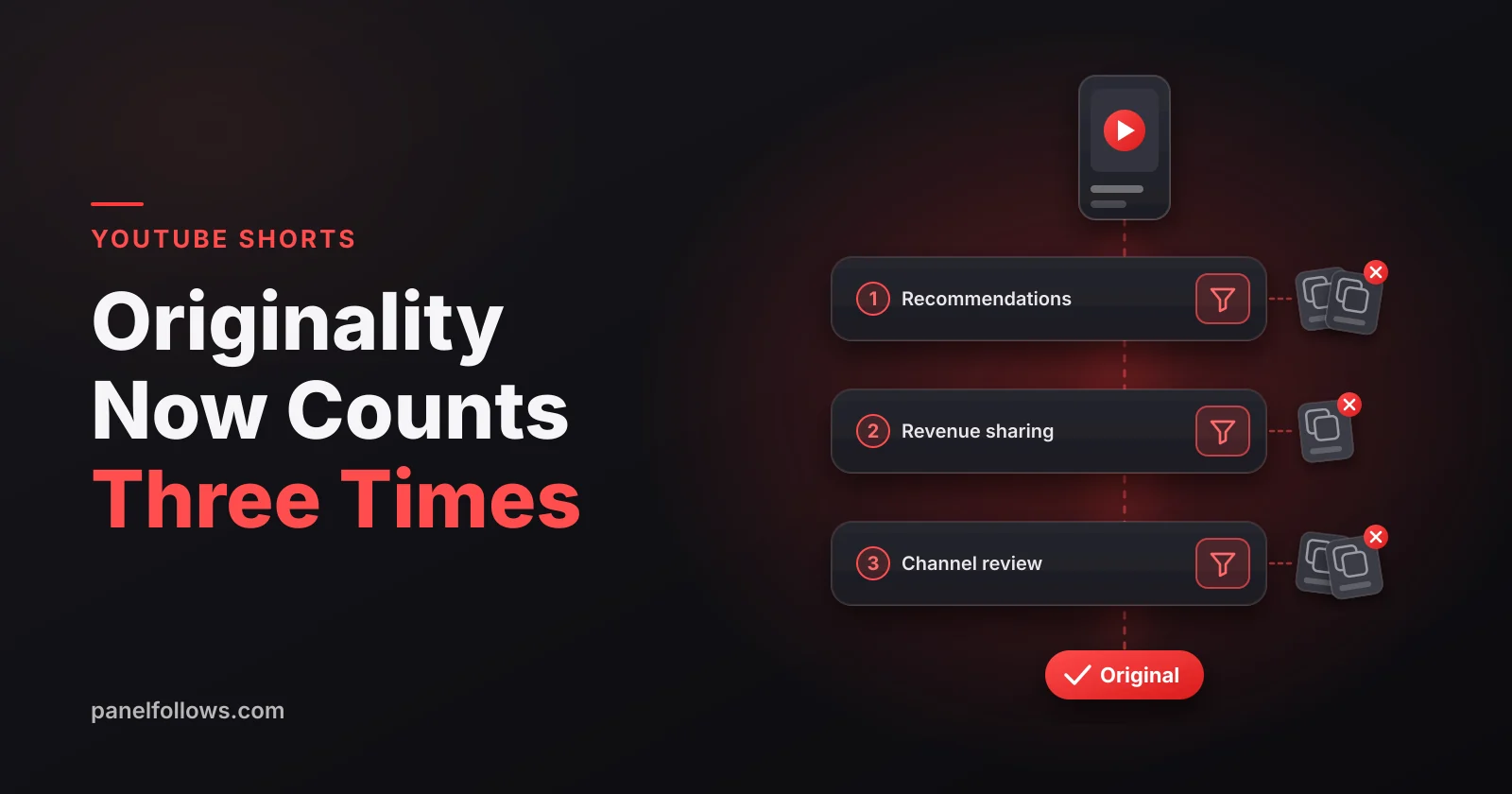
The YouTube reused content policy is a monetization rule. If a channel repurposes material from YouTube or other sites without adding significant commentary, real edits, or educational or entertainment value, it can lose monetization on the whole channel. On October 1, 2026, YouTube announced that the same originality test now affects Shorts reach: recommendations will likely show less of channels that mostly re-upload other creators' clips. YouTube already excluded non-original Shorts views from revenue sharing.
Most coverage either repeats the old policy page or summarizes the October announcement. This guide puts all of it on one page. It covers the three places originality now counts, what YouTube has said does and does not make a clip original, a self-audit for clip, reaction, compilation and faceless channels, a way to check a reach drop when YouTube gives you no dashboard, and why buying views cannot undo a recommendation demotion. Facts in this guide were checked in October 2026.
Nothing here requires buying anything. If you run a Shorts channel built partly on other people's footage, you can do every step with YouTube Studio and a spreadsheet.
What is the YouTube reused content policy?
The reused content policy is one of the YouTube channel monetization policies. It decides whether a channel that uses other people's material can stay in the YouTube Partner Program (YPP). YouTube defines reused content as channels that repurpose content already on YouTube or another online source without adding significant original commentary, substantive modifications, or educational or entertainment value. It treats duplicated and scraped content (taking material from elsewhere and publishing it as your own) as the same thing.
Three details on the official page matter more than the definition.
First, the policy is judged channel-wide. YouTube says that if some videos break the guidelines, or if it cannot clearly tell that you made the content, "monetization may be removed from your entire channel." A few bad uploads can cost you monetization on all of them.
Second, reviewers do not watch everything. The page says they may focus on your channel's main theme, most viewed videos, newest videos, the videos with the biggest share of watch time, video metadata (titles, thumbnails, descriptions) and the About section. Your biggest hit and your latest uploads count for the most.
Third, it is not a copyright rule. YouTube says the policy is separate from copyright enforcement, does not depend on permission or fair use, and applies even if the original creator gave you permission. A channel can go months without a single Content ID claim and still fail a reused content review.
The policy has a history worth knowing because search results mix up the versions. On July 15, 2025, YouTube renamed its "repetitious content" policy to "inauthentic content" to make clear it covers mass-produced and repetitive content. The changelog on the help page says the reused content policy did not change at that time. Rene Ritchie, YouTube's Creator Liaison, made the same point in a quote reported by Search Engine Journal: no changes to clips, compilations or reaction content. Today the policy page lists reused content alongside sections on generic or repetitive content, unsatisfying or off-putting content, and AI personas on sensitive topics. A faceless channel can fail any one of them.
What changed for YouTube Shorts on October 1, 2026?
On October 1, 2026, YouTube said its Shorts recommendation systems would further prioritize original content. In YouTube's words, quoted by Music Ally, the update aims to "reduce the reach of content re-uploaded from other creators without adding anything of your own." The announcement came as a TeamYouTube post in the YouTube Help Community and a Creator Insider video presented by Rene Ritchie.
The key sentence from the TeamYouTube post, as quoted by PPC Land, is: "Channels identified as primarily aggregating or re-uploading other creators' videos without significant changes will likely see less distribution." Three words in it do most of the work:
- Channels: the classification applies to an account, not to a single Short.
- Primarily: a channel that sometimes posts a borrowed clip is not described as the target.
- Likely: this is a hedge, not a promised penalty.
Ritchie added two practical points on X. If you just want your audience to see another creator's video, share it in your channel's Posts tab so viewers watch the original. And if a channel moves from aggregating to original content, "the recommendation system will re-evaluate reach."
Just as important is what YouTube left out. Search Engine Journal found no start date, no timeline for re-evaluation, and no place in Studio to check whether your reach was cut. It also noted that the video does not discuss creators who cut Shorts from their own long-form videos. YouTube also published no ratio, lookback window or definition of "significant." If a blog post gives you a threshold such as "under 30 percent re-uploads is fine," that number came from the author, not from YouTube.
The change affects recommendations. The monetization rules have not changed, so the reused content policy above still governs YPP.
The three places originality counts on YouTube now
After the October update, a non-original Short is judged in three places, plus a fourth if it crosses into spam. Each one works differently, and creators often confuse them.
| Layer | What happens to reused clips | What is judged | Are you notified? | Official basis |
|---|---|---|---|---|
| Shorts recommendations | Less distribution in the Shorts feed | The channel's overall pattern | No notice, no dashboard | October 1, 2026 TeamYouTube post |
| Shorts revenue sharing | Views of non-original Shorts are not counted when payouts are calculated | Each Short's views | No per-Short flag in the policy | Shorts monetization policies |
| Channel monetization review | YPP removed or application rejected | The channel as a whole | Yes, through a monetization decision | Channel monetization policies |
| Spam policy (Community Guidelines) | Removal, warnings, strikes, possible termination | Individual content and behavior | Yes, by email | Spam, deceptive practices and scams policy |
These layers add up. A straight re-upload was already excluded from the Creator Pool and already put the channel at risk in a YPP review. Now it also gets shown to fewer people. Losing reach is the newest penalty, but for monetized channels it is not the most expensive one.
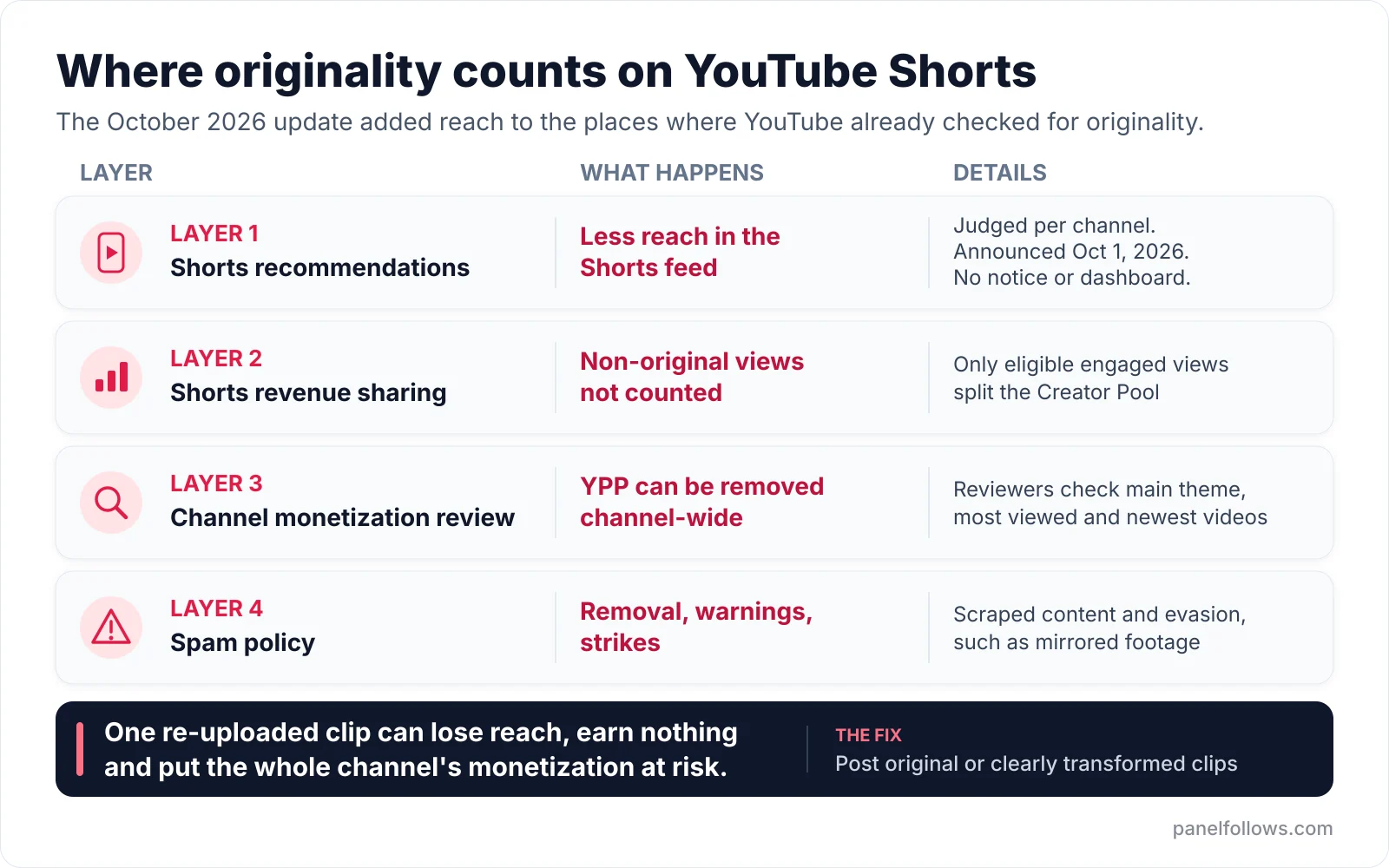
The October 2026 update added reach to the places where YouTube already checked for originality.
The spam layer gets less attention but matters for the tricks people use to dodge detection. The spam policy (summarized in detail by PPC Land) has a scraped content category: reposting material from other sites or videos with nothing of your own added. It also has a detection evasion category for technical changes such as sped-up audio, heavy filters or cropping meant to get past detection, and its example is a mirrored TV episode. So flipping a clip does not make it original. It can move the upload from "not monetizable" to "possible strike."
What does not make a reused clip original?
The simplest answer comes from Ritchie. As reported by Search Engine Journal, he said a remix must add your own value, "not just VO descriptions of what's happening on screen, minor technical edits, or template-based bulk changes." He told creators to bring commentary, analysis and storytelling instead. The monetization policy page adds its own list of things that do not monetize. Here they are together, with the edits that clip channels actually use:
| Common edit or habit | Does it make the clip original? | Why |
|---|---|---|
| Mirroring or flipping the video | No, and it can be worse | The spam policy uses a mirrored TV episode as its detection evasion example |
| Changing speed or pitch | No | The policy page lists songs changed only in pitch or speed as not monetizable |
| Crop, zoom, border, filter, color grade | No | These are "minor technical edits" in Ritchie's wording |
| Text-to-speech voice-over describing what is on screen | No | Ritchie named voice-over descriptions of on-screen action specifically |
| The same caption template applied to 50 clips | No | Template-based bulk changes, and also a generic or repetitive content risk |
| Silent face cam in the corner | No | Mostly non-verbal reactions without voice commentary are listed as not monetizable |
| Reading a Reddit thread or news article aloud | No | Content made only of readings of material you did not create is listed |
| Getting the creator's permission | No effect on this policy | The reused content policy applies even with permission |
| "Credit: @originalcreator" in the caption | No | Promoting other people's content is listed as not monetizable, even with permission |
What the right-hand column has in common: none of these changes give a viewer a reason to watch your version instead of the original. That is the question every one of these rules comes back to.
Test this on one post before you scale
The cheapest way to check the logic above is a small order on a single post, then compare the outcome against your own Insights data.
What counts as original? Do's and don'ts with examples
YouTube's monetization page says reused content is allowed when viewers can tell there is a meaningful difference between the original and your video. Its examples of what can monetize include clips used in a critical review, a movie scene with rewritten dialog and a new voice-over, sports replays where you explain how a competitor succeeded, reaction videos where you comment on the original, edited footage where you add a storyline and commentary, and content that mainly features you, the uploader.
The short version as do's and don'ts:
| Do | Don't |
|---|---|
| Put your own analysis, argument or joke at the center of the Short | Let the borrowed clip carry the whole Short while you add a caption |
| Use the clip as evidence for a point you are making | Use the clip as the content and your voice as background |
| Appear on screen or speak in your own voice with your own view | Rely on a generic text-to-speech narrator describing the action |
| Vary structure, story and focus from Short to Short | Run every clip through the same template |
| Share clips you love through the Posts tab | Re-upload them to your Shorts shelf "for the fans" |
The examples below are hypothetical, to show where the line sits.
Say you run a basketball Shorts channel. The old version: a 40-second highlight with "INSANE" in bold text and a music track. The original version: 12 seconds of the play, then a freeze frame where you circle the defender who missed the switch and explain, in your own voice, why the pass was open. The borrowed footage is the same. In the second version it is supporting material, and your explanation is the reason to watch.
Say you clip a long-form interview podcast. The old version: the funniest 50 seconds, with auto captions. The original version: a 15-second setup where you explain what the guest is reacting to and why it matters, the clip, then your own counterpoint. This version is defensible. Whether it clears the bar depends on how much of the Short is you and how much is them, and YouTube gives no ratio.
Say you run a faceless history channel that layers AI narration over stock footage and other creators' documentary clips. The weak spot is not AI use, which the policy page allows when it supports a well-researched or creative narrative of your own. The weak spot is sameness. If every video uses the same voice, the same music and the same structure on a different topic, you are in generic or repetitive territory even with no borrowed clips.
Here are two quick tests we use when auditing clip channels. They are our own rules of thumb, not YouTube's:
- The removal test: delete the borrowed footage in your head. If almost nothing is left, the Short is a re-upload with decoration.
- The mute test: turn off your audio track. If the Short is just as good, your contribution was not the point.
Clip, reaction, compilation and faceless channels: where does each stand?
The risk depends on what the channel adds to the footage, not on what format it uses. Reaction channels are explicitly allowed when the reaction is commentary. Compilation channels are explicitly listed as a problem when nothing is added. Here is how common Shorts formats map to the three layers.
| Channel type | Reach risk after Oct 2026 | Monetization risk | What to change first |
|---|---|---|---|
| Viral clip compilations pulled from TikTok or Instagram | High | High: short videos compiled from other social sites are listed as not monetizable | Change the format, or move the channel to original footage |
| Movie and TV scene channels with captions | High | High: unedited clips from movies or TV are listed as ineligible Shorts views | Rewrite into review, analysis or parody with your own voice |
| Reactions with a silent face cam | High | High | Talk: give an opinion, a correction, a prediction |
| Reactions with real spoken commentary | Lower | Allowed by the policy page | Keep the reaction as the focus, not the clip |
| Podcast and streamer clippers | Medium to high | Permission does not help with this policy | Add context and a point of view, or clip only your own shows |
| Faceless narration reading posts or news | Medium | High: readings of material you did not create are listed | Write original scripts and add your own research |
| Sports breakdowns with analysis | Lower | Allowed when you explain the moves | Make the explanation longer than the replay |
| Your own long-form cut into Shorts | Not addressed by YouTube | Content mainly featuring you is allowed | Usually fine, see the edge cases section |
If you manage several of these channels for clients, the audit below works across a whole roster. Our playbook on scaling a social media agency covers how to build checks like this into a multi-client workflow.
How do you audit a Shorts channel for reused content?
A self-audit means sorting your recent Shorts by how much of each is yours, then weighting the result by what reviewers and the recommendation system are most likely to see. It takes about an hour for a channel with 50 to 100 Shorts.
- Pull your recent Shorts. In YouTube Studio, open Content, filter to Shorts, and list the last 90 days of uploads (or the last 50 if you post daily) in a spreadsheet with views and publish date.
- Label each Short with one of four tags. O for original (your footage, your idea). T for transformed (others' footage, but your commentary or analysis is the core). L for light edit (others' footage with captions, music, zoom or a template). R for straight re-upload.
- Run the removal and mute tests on anything you hesitate over. If it fails either one, tag it L or R.
- Weight by visibility. Mark your 10 most viewed Shorts and your 10 newest. Those match the places YouTube says reviewers look first. Ten L or R clips among your top 10 is a much bigger risk than ten buried in the middle of the list.
- Check the metadata. Titles that name another creator, descriptions that say "all rights to the owner," and an About section that calls the channel a fan page all tell a reviewer the content is not yours.
- Calculate your share. Count L plus R as a percentage of recent uploads. YouTube gives no threshold. If L and R make up most of what you post, you fit "primarily aggregating," and that is the pattern the announcement describes.
- Decide what to do with each bucket. Keep O and T. Turn L into T where you can (record commentary, rebuild the edit). Stop making new R uploads. YouTube has not said whether privating or deleting old re-uploads speeds up re-evaluation, so do not delete your catalog in a panic. Mass deletion can also take down L Shorts you could still upgrade into T, along with their view history.
- Write a rule for future uploads. For example: "Every Short that uses outside footage must have at least one spoken point of view from us, and the clip itself is never more than half the runtime." That half-the-runtime figure is a house rule, not a YouTube rule. It just makes the standard easy to check.
Did the October update cut my Shorts reach? How to diagnose a drop
You cannot confirm it directly, because YouTube offers no notice or Studio indicator for this change. What you can do is compare groups of Shorts. YouTube gave no start date, so October 1 (the announcement date) is only the most practical dividing line. If your re-upload Shorts lost Shorts feed views after it while your original Shorts held steady, the update is the most likely cause. If everything dropped together, look for another explanation first.
- In YouTube Studio Analytics, open Advanced mode and filter to Shorts.
- Break down views by traffic source and isolate Shorts feed, which is where the recommendation change would show up. Views from your channel page, search and subscriptions tell a different story.
- Compare two windows of the same length, for example the 28 days before October 1 and the first 28 days after it (or two equal shorter windows if less time has passed). Compare views per Short rather than totals, because you may have published a different number of Shorts in each window.
- Split the comparison using the O/T/L/R tags from your audit.
- Check viewed versus swiped away for each group. A rising swipe-away rate is a hook and content problem that existed before any policy change.
| What you see | What it likely means | What to do |
|---|---|---|
| L and R Shorts fell, O and T held | Fits the originality update | Shift output toward T and O, then measure for several weeks |
| Every group fell at the same time | Probably not this update | Check upload gaps, topic fatigue, seasonality and swipe-away rate |
| Swipe-away rose across the board | Viewers are leaving early | Fix the first two seconds before anything else |
| Shorts feed fell, search and channel page held | Recommendation problem, cause still uncertain | Look again at what share of recent uploads are L and R |
| Views held, but revenue fell | Possibly ineligible views, or Creator Pool changes | Compare engaged views with revenue per Short |
A hypothetical example: say a channel posts 60 Shorts in September, 35 of them podcast clips with captions only (L) and 25 with the host's spoken commentary (T). In the first two weeks of October, Shorts feed views on the L group fall by more than half while the T group barely moves. That pattern points at the update. If both groups had fallen by the same amount, the update would be a weak explanation and the channel should look at topic fatigue or posting volume.
On recovery, the only official statement is Ritchie's: reach will be re-evaluated if a channel moves toward original content. YouTube gave no timeline. Plan for weeks of consistently original uploads, not days. Since the classification is about patterns, one good Short in a feed of re-uploads probably does not change anything. If you want to track progress the same way each week, our guide to social media metrics and engagement rate explains how to set up a consistent baseline.
How does Shorts revenue sharing treat non-original views?
Non-original Shorts views do not earn. The Shorts monetization policies say payments are calculated from eligible engaged views. Ineligible examples include unedited clips from others' movies or TV shows, re-uploads of other creators' content from YouTube or other platforms, and compilations with no original content added. Artificial views, such as those from click or scroll bots, are excluded on the same list.
The mechanics explain why this matters even before reach falls. Shorts Feed ad revenue is pooled each month, partly allocated to a Creator Pool (with a split for music licensing when a Short uses tracks), divided among monetizing creators by their share of eligible engaged views in each country, and creators keep 45 percent of their allocation. Ineligible views are taken out before that split, so a re-upload's views never become money.
Two changes in 2027 raise the stakes:
- Staying in the pool: from February 1, 2027, the Shorts policy page says a channel needs at least 10 million qualified Shorts views in the last 90 days to earn Shorts ad and Premium revenue for a given month.
- Getting in: according to PPC Land's report on the August 2026 announcement, new applicants from February 1, 2027 will need 1,000 subscribers plus either 8,000 qualified watch hours in 365 days or 20 million qualified Shorts views in 90 days, double the old bars.
Here is how it adds up in a hypothetical case. Say 40 percent of a channel's Shorts views come from captioned re-uploads. Those views were never counted for payouts. After October, those same Shorts get less reach. Then in February the channel must reach 10 million qualified views per 90 days without them. A channel that looked comfortably above the line can end up well below it. Our YouTube monetization requirements guide covers the current entry thresholds in detail. Read it with the February 2027 changes in mind.
Why bought views cannot reverse a recommendation demotion
Buying views does not fix a reach cut caused by the originality update. The classification depends on what your channel uploads, not on how many views it has. A higher counter does not make a re-uploaded clip original, and YouTube says the recommendation re-evaluation follows a shift toward original content, not a recovery in numbers.
There are three more reasons. First, the Shorts policy page lists artificial views as ineligible, so they add nothing to revenue. Second, according to the TeamYouTube post as summarized by PPC Land, the recommendation system looks at viewer signals such as watch history, topic interest and interactions. Views from people who do not watch and engage do not supply those signals. Third, YouTube's terms prohibit buying engagement, and fake engagement has its own policy. Paying for views on a channel that is already flagged as low-originality adds a second problem.
As an SMM panel we sell YouTube services, and we will still tell you this is the wrong tool for this problem. Our YouTube services hub lists what exists, with start time, speed and refill terms on each service. None of them can change how YouTube classifies a channel's content. If you are curious what a panel delivery looks like, the small samples on our free services page need only a public link and no password, but they are a sample, not a growth method or a fix for reach. For the wider picture of what view offers can and cannot do, see our guide to free YouTube views and fake view traps, and for the subscriber side, free YouTube subscribers: what works.
Edge cases: your own clips, permission, Content ID and the Posts tab
Most confusion about the reused content policy comes from a few edge cases. Here is how each one looks based on what YouTube has published, with gaps marked as gaps.
Cutting Shorts from your own long-form videos. The October announcement does not cover this, as Search Engine Journal pointed out. The monetization policy allows content that mainly features the uploading creator, so clips of your own show, voice or face fit the allowed side. The exception: if the long-form video was itself built on reused material, its Shorts carry the same problem.
Permission and licensing. A written license from a creator can settle a copyright question, but it does not settle the reused content question. The policy page says plainly that it applies even with permission, and that promoting other people's content is not monetizable even when they agree.
No Content ID claims. No claim does not mean the content is original. The reused content policy works independently of Content ID, and YouTube notes that you may receive no claims while still violating it.
Sharing a video you love. Ritchie's advice is to use the Posts tab, which sends viewers to the original upload and does not add a re-upload to your Shorts shelf.
Fan pages reposting your clips. If other channels re-upload your Shorts word for word, they are now the pattern YouTube says it is demoting. Your originals are the content the update is meant to favor. That is a reason to keep your best clips on your own channel instead of encouraging repost pages.
Other platforms. Instagram has a similar originality system, and according to PPC Land it publishes a 30-day window and an Account Status screen, which YouTube does not offer. If you cross-post, our Instagram Reels growth and Explore guide covers how originality affects Reels distribution.
Reading translated policy pages. PPC Land noted that a translated YouTube Help Center page carried a notice that it may contain AI-translated text. If a word like "significant" decides your case, check the English version.
Open your account and order in minutes
Signing up is free and takes two steps. Top up with card, bank transfer or crypto, place your order and track delivery from the dashboard.
Frequently asked questions
What is the YouTube reused content policy in simple terms?
It is a YouTube Partner Program rule that says you cannot earn money from other people's content unless you change it enough to make it your own. That means adding real commentary, analysis, storytelling or substantive editing so viewers can see a meaningful difference from the original. The policy is applied to the whole channel, so a pattern of re-uploads can remove monetization from all your videos, including the original ones.
Is there a new YouTube reused content policy in 2026?
No. The monetization policy itself was not rewritten in 2026. What changed on October 1, 2026 is that Shorts recommendations began favoring original content and reducing reach for channels that mostly re-upload others' clips. The July 2025 update renamed the repetitious content policy to inauthentic content and, according to YouTube, did not change the reused content rules for clips, compilations and reactions.
Will the October 2026 Shorts update demonetize my channel?
Not directly. The October change affects recommendations, meaning how often your Shorts are shown in the feed. Monetization is still decided by the existing channel monetization policies and by human review. The two are related: a channel that mostly re-uploads clips was already at risk of losing YPP, and the reach cut also makes it harder to meet the qualified view thresholds that apply from February 2027.
Can I still post compilations on YouTube Shorts?
You can post them, but compilations of clips from other social sites with nothing original added are listed as not monetizable, their views are excluded from Shorts revenue sharing, and a channel built on them now risks reduced reach. A compilation with a real storyline, ranking logic or spoken analysis in your own voice is a different case. YouTube allows edited footage where you add a storyline and commentary.
Does giving credit or getting permission make reused content okay?
No. Credit lines and permission help with copyright and courtesy, but YouTube says the reused content policy applies even if you have the original creator's permission. Promoting other people's content is listed as not monetizable even with their consent. The only thing that changes the result is what you add: your commentary, analysis, story or substantive edit has to be the reason someone watches.
Is AI voice-over narration enough to make a clip original?
Not if it only describes what is happening on screen. Rene Ritchie named voice-over descriptions of on-screen action as something that does not make another creator's clip original. AI tools are allowed when they support your own research, script or creative idea. The problem is narration that adds nothing, plus the generic, templated sameness that the repetitive content rules target.
How long does it take for Shorts reach to recover after the update?
YouTube has not said. Rene Ritchie stated that the recommendation system will re-evaluate reach when a channel shifts toward original content, but no timeline was given. Because the classification is about the channel's overall pattern, plan for several weeks of consistently original uploads and measure Shorts feed views on those uploads separately from older re-uploads.
Can I reuse my own long-form videos as Shorts?
YouTube's October announcement did not address this. The monetization policy treats content that mainly features the uploading creator as allowed, so clips from your own show, with your face or voice, fall on the allowed side. The risk only appears if your long-form videos are themselves built on other people's footage without significant changes, because the Shorts carry the same problem.
What should I do if my channel was demonetized for reused content?
Fix the channel before you appeal or reapply. YouTube Studio's Earn section shows the monetization decision and any appeal option. YouTube's Help Center sets the deadlines for appealing and reapplying, so check them there rather than relying on figures from other blogs. A reviewer will look at the same places described above: your main theme, your most viewed and newest videos, and your metadata. Run the audit, rework the L and R uploads reviewers are most likely to see first, stop new re-uploads, and build up a run of original Shorts before you ask for another review.
Where can I read the reused content policy in Hindi or another language?
The official policy is on YouTube's channel monetization policies page in the Help Center, which you can switch to other languages, including Hindi, with the language selector. Translated editions can include AI-translated text, and at least one translated YouTube page carried a notice saying so. If a specific word decides whether your channel complies, compare the translation with the English page.
Sources and further reading
- YouTube channel monetization policies (YouTube Help): the official reused content definition, the allowed and not-allowed examples, what reviewers check, and the July 2025 changelog.
- YouTube Shorts monetization policies (YouTube Help): ineligible Shorts views, how the Creator Pool works, the 45 percent share and the February 2027 view requirement.
- YouTube To Cut Reach Of Channels Reposting Barely Changed Clips (Search Engine Journal): Rene Ritchie's Creator Insider comments and what the announcement left out.
- Rene Ritchie on X: the Creator Liaison's summary, including the Posts tab advice and the re-evaluation statement.
- Re-uploaded Shorts lose reach as YouTube favours original clips (PPC Land): close reading of the TeamYouTube post and the spam policy categories behind it.
- New YouTube creators face 8,000-hour bar for ad revenue from February 2027 (PPC Land): the doubled YPP entry thresholds announced in August 2026.
- YouTube Shorts algorithm will now prioritise original content (Music Ally): the announcement wording as published by YouTube.
- YouTube Clarifies Monetization Update (Search Engine Journal): the July 2025 rename to inauthentic content and confirmation that reused content rules did not change.