
Spotify Discovery Mode: How It Works and When It Pays Off
Spotify Discovery Mode trades a 30% commission on Radio, Autoplay and Mix streams for algorithmic reach. See the break-even math and how to measure lift.
Spotify Discovery Mode is an opt-in tool in Spotify for Artists that adds a "priority" signal to selected songs in Radio, Autoplay and algorithmic Mixes. You pay nothing upfront. Instead, Spotify takes a 30% commission on the recording royalties from that song's streams in those contexts. It pays off only when the lift in streams, new listeners and saves is larger than the discount on listening you would have had anyway.
This guide works through that trade in numbers. It covers where Discovery Mode streams actually happen, who can access it, the break-even lift you need, how to read the performance report (including the Campaign Lift estimate Spotify added in July 2026), how it compares with Marquee and Showcase, and the payola lawsuit that put the tool in the news. It ends with a 60-day test plan you can run on one catalog track. Facts in this guide were checked in October 2026.
A quick disclosure: Panel Follows sells social media services, including some for Spotify. Nothing here depends on buying anything, and the mistakes section explains why paid stream services should stay far away from any track you test in Discovery Mode.
What is Spotify Discovery Mode, exactly?
Discovery Mode is a marketing switch, not an ad. When you turn it on for a song, Spotify's recommendation system receives an extra input that says this song is a priority for the artist team. According to the Discovery Mode page on Spotify for Artists, that signal makes a recommendation more likely but does not guarantee it, and the system still watches whether listeners skip or engage.
That last point matters. Discovery Mode does not buy plays; it nudges the odds that your song is picked when Spotify is already choosing what to play next. If listeners skip it, the push fades.
Spotify pitches it for moments like a song going viral off-platform, the run-up to a new release or a legacy act's reunion tour. In each case you amplify pull a song already has; you do not manufacture it.
Where Discovery Mode streams happen: the Radio and Autoplay boost
Discovery Mode only works in a limited set of surfaces that Spotify calls Discovery Mode contexts: Radio, Autoplay and Spotify's algorithmic Mixes. Distributor guides list the Mixes as Daily, Artist, Decade and Genre mixes. Everything outside those contexts (on-demand plays, search, your profile, the listener's library, user playlists and editorial playlists) is untouched by the tool and stays commission-free.
These are lean-back surfaces: Radio is the station a listener starts from a song or artist, Autoplay keeps playing when an album or playlist ends, and Mixes are personalized collections Spotify refreshes. In all three Spotify picks the music, which is where strangers first hear artists they never searched for.
There is one point of disagreement worth knowing. When Spotify was sued over the tool in November 2025, the company told reporters that Discovery Mode is not used in flagship playlists such as Discover Weekly or its AI DJ, as Resident Advisor reported. At least one major distributor's guide still lists Discover Weekly among the places the tool works. Spotify's own statement is the better source, so plan as if Discover Weekly is not part of the deal.
| Surface | Discovery Mode applies? | Commission on these streams? |
|---|---|---|
| Radio (song or artist stations) | Yes | Yes, 30% of recording royalties while the song is enrolled |
| Autoplay (after an album or playlist ends) | Yes | Yes |
| Algorithmic Mixes (Daily, Artist, Decade, Genre) | Yes | Yes |
| Discover Weekly, AI DJ | Not according to Spotify's November 2025 statement | No |
| Editorial playlists | No | No |
| Search, profile, library, user playlists | No | No |
How much does Discovery Mode cost? The 30% commission
Discovery Mode costs 30% of the recording royalties generated by the enrolled song's streams in Discovery Mode contexts, and nothing elsewhere. Spotify's help page on using Discovery Mode in Spotify for Artists states the figure directly and adds a detail many guides miss: the commission covers the selected songs and their related track URIs, so if you release a new version of a song during an active campaign, that version is opted in too.
Three mechanics shape what you actually pay:
- It applies to all context streams, not just the extra ones. If your song already got Radio and Autoplay plays before you enrolled, those plays are now discounted as well. The commission does not distinguish between streams the tool created and streams you would have had anyway.
- It is deducted later, not paid now. Spotify takes the commission from future statements. Distributors pass it through on their own schedule; one distributor's help page shows it as a negative wallet adjustment each month, another notes a roughly two-month reporting delay.
- It only names recording royalties. Spotify's wording targets the recording side. If you are on a label, how that cost reaches your statement depends on your contract, so ask before a label opts your catalog in.
How much lift do you need to break even?
You need roughly a 43% increase in Discovery Mode context streams just to earn the same from those contexts as you did before enrolling. The math is simple: each context stream now pays 70% of what it did, and 1 divided by 0.7 is about 1.43. Anything below a 43% lift means you are paying for exposure out of royalties; anything above means the context streams alone more than cover the commission.
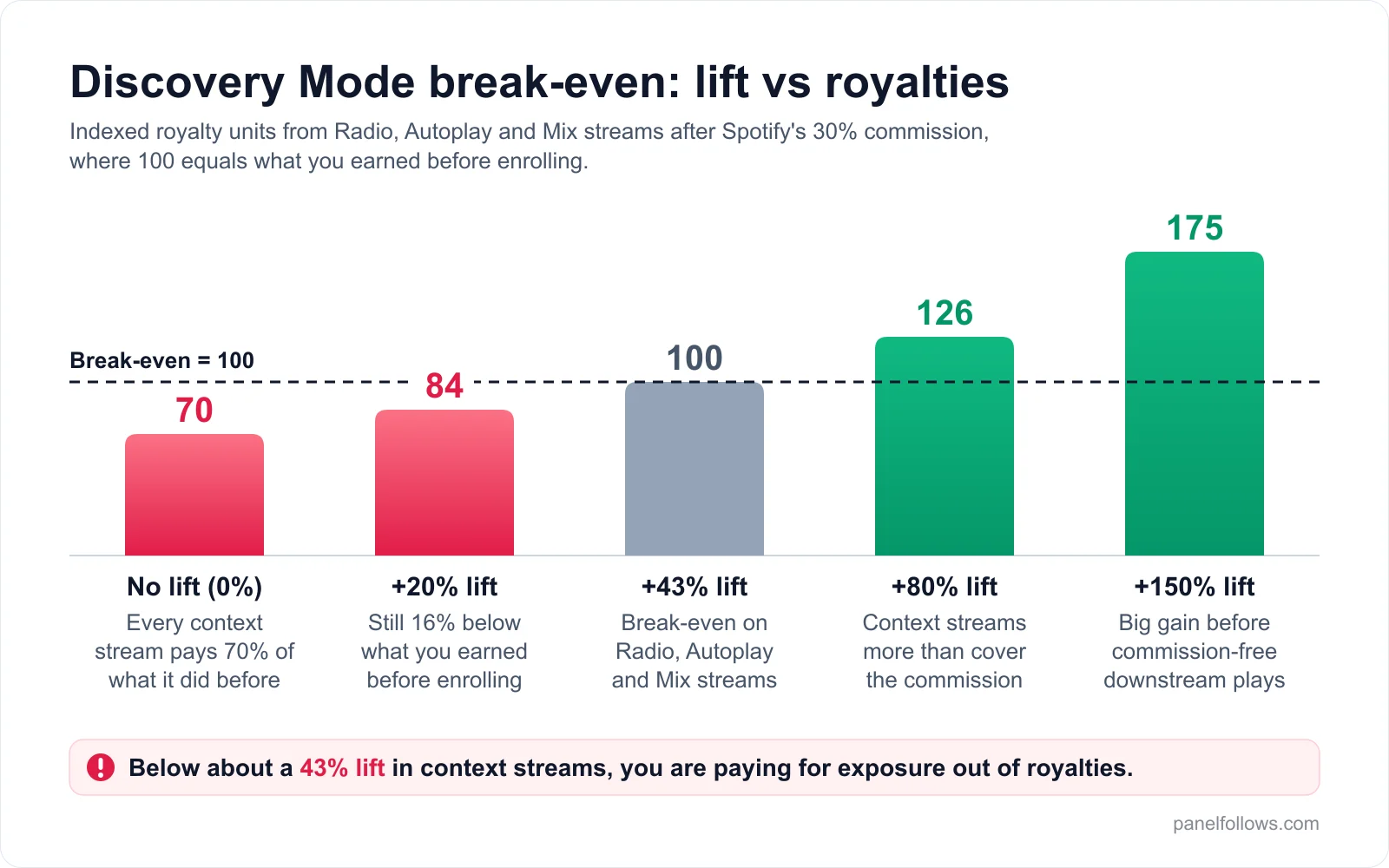
Indexed royalty units from Radio, Autoplay and Mix streams after Spotify's 30% commission, where 100 equals what you earned before enrolling.
Say your 2023 single gets 4,000 streams a month from Radio, Autoplay and Mixes. Treat each stream as one royalty unit, because Spotify pays from a revenue pool and there is no fixed per-stream rate. Here is how different lifts play out on those contexts alone.
| Lift in context streams | Context streams | Royalty units after 30% commission | Versus 4,000 before |
|---|---|---|---|
| 0% (no effect) | 4,000 | 2,800 | 30% lower |
| +20% | 4,800 | 3,360 | 16% lower |
| +43% | 5,720 | 4,004 | Break-even |
| +80% | 7,200 | 5,040 | 26% higher |
| +150% | 10,000 | 7,000 | 75% higher |
The table misses one upside and one downside. Listeners who save the song after hearing it on Radio later stream it from their library, commission-free, and Spotify says its testing shows this downstream effect. But if the tool brings plays without saves or follows, a sub-break-even month is a pure loss that does not compound.
This is why the size of your existing context base matters so much. A song that already lives on Radio and Autoplay pays the commission on a large base and needs a big absolute lift to come out ahead. A catalog track with a small but engaged context audience pays the commission on very little and has the most room to gain.
Who has access to Spotify Discovery Mode?
Discovery Mode is available directly in Spotify for Artists to eligible artists whose songs go through participating distributors, and labels access it through Spotify's partnerships team. Spotify says it is available in over 90 markets, and your Spotify for Artists team must have its billing country set to one of them.
Each song is checked separately. Spotify's help page lists four conditions, all of which must be true:
| Requirement | What it means in practice |
|---|---|
| Released on Spotify at least 30 days ago | New releases cannot enroll. If there are several versions, the earliest release date counts |
| At least 20 streams in Discovery Mode contexts in the last 28 days | The algorithm must already be playing the song a little on Radio, Autoplay or Mixes |
| Met Spotify's monetization eligibility criteria last month | Songs below Spotify's royalty threshold are excluded |
| Distributed by a participating licensor | Your distributor must be in the program; Spotify lists them on its help page |
Two consequences follow. Discovery Mode is a catalog tool, not a launch tool, because a song only becomes eligible after a month. And a song with zero algorithmic life cannot be switched on at all.
If you are not eligible yet, the route in is real listeners: short-form clips that send people to your song, playlist outreach and repeat listening from existing fans. Our guide on how to get more monthly listeners on Spotify covers the organic side in detail. Many artists use TikTok as the top of that funnel, and the mechanics in why TikTok videos stall apply to music clips too.
If you also consider paid promotion for your clips on social platforms, know that Instagram, TikTok and YouTube terms prohibit buying engagement, and organic clips are the more honest test of whether a song connects. If you still choose to use it, the Panel Follows services catalog lists the start time, speed, refill period and cancellation terms for each service so you know what you are ordering. Keep it on the social side, and keep it away from Spotify streams on any song you plan to enroll or measure.
See live pricing in the panel
Unit prices for follower, like, view and engagement services are listed live. Registration is free and you can browse the list before adding any balance.
How to set up a Discovery Mode campaign
Campaigns run by calendar month, and Spotify's help page says you can set one up between the 11th of the month and 12 AM UTC on the last day of the month. Spotify also documents a choice of campaign duration, so check the current options in your dashboard.
- Log in to Spotify for Artists and open the Campaigns tab, then Discovery Mode.
- Click the option to set up the campaign for the coming month. If you see no Discovery Mode section, your account or distributor is not eligible yet.
- Review the eligible songs. Spotify may highlight songs it recommends for Discovery Mode; treat those as suggestions, not instructions.
- Select the songs you want to prioritize. Fewer, stronger choices make the results easier to read.
- Choose the campaign duration where that option is offered and confirm.
- Write down the date, the songs and anything else planned that month (a release, a tour announcement, ads). You will need it when you read the report.
Some distributors run managed programs instead: you opt in once and they pick and remove tracks using their own rules, sometimes with their own terms and with reporting in their dashboard rather than Spotify for Artists. Read your distributor's page as well as Spotify's.
How do you measure the lift in Spotify for Artists?
You measure Discovery Mode in the performance report under the Campaigns tab, which Spotify starts filling from the 11th day of a campaign. Spotify's page on understanding your Discovery Mode performance report groups the metrics into audience growth, long-term engagement and streams, and updates them daily.
The metrics worth knowing by name:
- Listeners and new listeners. New listeners are people who had not streamed your music anywhere on Spotify in the last two years. This is the cleanest measure of discovery.
- Saves and playlist adds. Counted when a listener saves or playlists the song after hearing it in a Discovery Mode context, using a 14-day attribution window from first exposure. These keep updating for 14 days after the campaign ends.
- Intent rate. The share of listeners who saved or playlisted at least one song from a Discovery Mode context. This is the closest thing the report has to a quality score.
- Historical stream and listener lift. The change since the 28 days before the song's first campaign. Spotify notes that this baseline stays fixed across consecutive campaigns and resets when you remove the song.
- Campaign stream and listener lift. Added in July 2026, as Music Ally reported. A machine learning model estimates what your context streams would have been without Discovery Mode and compares that with what happened. It only appears for songs with at least 500 context streams in the previous month.
Read the two lift figures differently. Historical lift is a plain before-and-after comparison, so a viral clip, a new single or the season all get credited to Discovery Mode. Campaign lift tries to control for that, but it is Spotify's estimate of the value of a product Spotify charges for, and Spotify says it can vary. Use it as one input, not proof.
Spotify itself cautions that organic trends and other marketing affect results. The best measurement is boring: one song at a time, nothing else changed that month, and the report checked against the song's source-of-streams history.
For a broader framework on ratios like saves per listener, our guide to engagement rate and social media metrics explains why the denominator matters as much as the headline number.
Is Spotify Discovery Mode worth it?
Discovery Mode is worth it for a catalog song that already shows engagement (saves, repeat listens, playlist adds) but has a small Radio and Autoplay base, because the commission is charged on little and the room for lift is large. It is usually not worth it for a song already carried by Radio and Autoplay, or when you need every royalty dollar this month.
Spotify's marketing figures are strong: its landing page reports average gains for enrolled songs of +106% in monthly listeners, +186% in monthly playlist adds and +181% in monthly saves, and says artists who paired Discovery Mode with display campaigns saw twice the growth in monthly active listeners. Treat these as best-case averages: teams pick the songs they expect to work, and Spotify publishes no medians or loss rates.
| Your situation | Likely verdict | Why |
|---|---|---|
| Catalog song with high saves per listener, small context base | Strong candidate | Commission applies to few streams, engagement suggests the algorithm can find fans |
| Song suddenly trending off-platform (a TikTok sound, a sync) | Good candidate | Spotify itself pitches this use; listeners arriving from outside are primed to save |
| Older catalog ahead of a tour or new album | Reasonable test | Rediscovery can feed new release attention; watch new listeners specifically |
| Song already getting most of its streams from Radio and Autoplay | Weak candidate | You discount a large base and need a big absolute lift |
| Release under 30 days old | Not possible | Not eligible yet; use pitching and your own promotion |
| You depend on this month's royalties for cash flow | Skip for now | The commission lands on your next statements |
| Song with low intent rate in past campaigns | Turn it off | Plays without saves are discounted plays that do not compound |
The one-line test: if the strangers in your report save the song, keep going. If they do not, stop.
Spotify Marquee vs Discovery Mode vs Showcase
Marquee and Showcase are paid display placements with a cash budget, while Discovery Mode is an algorithmic weighting paid for through royalties. All three sit in Spotify's Campaign Kit inside the Campaigns tab, alongside free editorial pitching. As Symphonic's Campaign Kit guide explains, Marquee and Showcase are now grouped as display campaigns that promote music on Spotify Home and in the mobile app.
| Discovery Mode | Marquee | Showcase | Editorial pitching | |
|---|---|---|---|---|
| Format | Priority signal in Radio, Autoplay, Mixes | Full-screen sponsored recommendation on mobile | Sponsored banner on Spotify Home | Submission to Spotify's editors |
| Best for | Catalog songs with engagement | New releases | New or catalog releases | Unreleased music |
| Cost | 30% commission on context recording royalties, deducted later | Cash budget, set upfront | Cash budget, set upfront | Free |
| Timing | Song must be 30+ days old | Around release | Any time | Submit at least 7 days before release |
| Eligibility | Song-level rules plus participating distributor | Market-based, varies by country | Market-based, varies by country | Unreleased music in Spotify for Artists |
The tools are sequential rather than competing: pitch the single before release, use Marquee in release week, use Showcase later for the release or older songs, and switch on Discovery Mode once the song is past 30 days and showing saves. At least one of Spotify's published case studies sequences Marquee before Discovery Mode, and Spotify's claim that pairing Discovery Mode with display campaigns doubles listener growth is the reason it pushes the combination.
The cost logic differs too. With Marquee and Showcase you know your maximum spend upfront. With Discovery Mode the cost scales with success and with your existing context streams, and a song that does nothing still costs you the discount on its baseline.
Is Discovery Mode payola? The 2025 lawsuit
Critics have called Discovery Mode a modern form of payola since it launched, and in November 2025 a Spotify subscriber, Genevieve Capolongo, filed a proposed class action in federal court in Manhattan making that argument. Billboard's report on the lawsuit describes the core claim: that Spotify presents recommendations as personalized while letting labels and artists pay, through lower royalties, for better placement.
Spotify called the allegations "nonsense" and said Discovery Mode "doesn't buy plays, it doesn't affect editorial playlists, and it's clearly disclosed in the app." In 2026, according to Billboard's follow-up, Judge Koeltl ruled that the claims could not proceed as a federal class action because the user agreement the plaintiff accepted sends such disputes to arbitration. That is a procedural ruling, not a finding that the tool is or is not deceptive.
For an artist, the debate is about disclosure to listeners, while your decision is about economics. No court has found the tool unlawful, it is widely used by labels and independents, and Spotify documents it openly. Whether you are comfortable with it is a values question; the United Musicians and Allied Workers union, for example, publicly welcomed the lawsuit and called for an end to payola.
Mistakes that waste the Discovery Mode commission
Most Discovery Mode losses come from enrolling the wrong song or misreading the report, not from the tool itself:
- Enrolling your biggest Radio song by default. It pays the commission on the largest base and is the hardest to lift by 43%.
- Enrolling the whole catalog. You dilute the signal, make the report unreadable and discount streams on songs that were never going to move.
- Judging by streams alone. A stream lift with flat saves and new listeners means the algorithm found placements, not fans.
- Stacking tests. Running Discovery Mode, a Marquee, a new single and a TikTok push in the same month makes it impossible to say what worked.
- Leaving it on forever. If the intent rate has been low for two campaigns, the commission is buying discounted plays. Turn it off and let the baseline reset.
- Adding artificial streams. Spotify's help center warns against artificial streaming and paid third-party services that guarantee streams, and the company has a long record of removing streams it flags as artificial. Inorganic plays also poison every metric in your Discovery Mode report, because the algorithm learns from listener behavior that is not real. Panel Follows sells some Spotify services, and we still say plainly: never mix paid plays with a song you are enrolling or measuring.
The same applies on other platforms: Instagram, TikTok and YouTube terms also prohibit buying engagement. Our Instagram Reels and Explore guide and first 1,000 TikTok followers guide cover organic routes that also feed Spotify.
A 60-day Discovery Mode test you can run
The cleanest way to decide is to test one song for one campaign and judge it on what remains after you switch it off. This protocol takes about two months including the follow-up window.
- Pick the song. Choose an eligible catalog track with a good saves-to-listeners ratio and a modest share of streams from Radio, Autoplay and Mixes. Avoid your biggest algorithmic song.
- Record the baseline. Before the campaign starts, note the song's last 28 days: total streams, context streams, listeners, saves and playlist adds. Screenshot the source-of-streams view.
- Freeze everything else. No new release, no Marquee or Showcase, no new ad campaign on this song during the test month. If something unplanned happens (a viral clip), write it down.
- Enroll for one campaign. Set it up between the 11th and the last day of the prior month, as Spotify requires.
- Read the report from day 11. Watch new listeners and intent rate first, context stream lift second. If the song qualifies for Campaign Lift, note it alongside Historical Lift.
- Do the break-even math at month end. Compare context streams to baseline. Below +43% means you paid for exposure; decide if the new listeners and saves were worth that price.
- Switch off and wait 30 days. Long-term engagement metrics keep updating for 14 days. Then check whether total streams settled above the old baseline, which is the real return.
- Decide. Keep the song in, swap it for another candidate, or drop the tool. Repeat with a different song before drawing conclusions about Discovery Mode in general.
A hypothetical example: your song had 3,000 context streams in its baseline month and 6,300 in the campaign month (+110%), with steady intent rate. After the commission those streams are worth 4,410 units against 3,000 before, and if total streams sit above the old baseline a month after switching off, the song earned its place. If instead you saw 3,600 context streams and flat saves, those streams are worth 2,520 units after the commission. You ended the month 480 units below baseline in exchange for 600 extra plays that did not stick.
Open your account and order in minutes
Signing up is free and takes two steps. Top up with card, bank transfer or crypto, place your order and track delivery from the dashboard.
Frequently asked questions
Is Spotify Discovery Mode free?
There is no upfront fee, but it is not free. Spotify charges a 30% commission on the recording royalties from enrolled songs' streams in Radio, Autoplay and algorithmic Mixes, deducted from future statements, while streams in every other context stay commission-free. It is a marketing cost paid out of royalties rather than cash.
What percentage does Spotify take with Discovery Mode?
Spotify takes 30% of the recording royalties generated by an enrolled song's streams in Discovery Mode contexts. The commission covers the song's related track URIs too, so a new version released during an active campaign is included. Some distributors run managed programs with their own terms on top of Spotify's, so check your distributor's help page before opting in.
Does Discovery Mode affect Discover Weekly or editorial playlists?
According to Spotify's statement in November 2025, Discovery Mode does not affect editorial playlists and is not used in Discover Weekly or the AI DJ. It works in Radio, Autoplay and algorithmic Mixes. A few distributor guides still mention Discover Weekly, but Spotify's own statement is the more reliable source, so do not plan a campaign around a Discover Weekly placement.
Why don't I see Discovery Mode in Spotify for Artists?
The most common reasons are that your distributor does not participate, your team's billing country is not one of the supported markets, or none of your songs meet the song-level rules. A song must be at least 30 days old, have at least 20 streams in Discovery Mode contexts in the last 28 days, and have met Spotify's monetization criteria the previous month.
Can I use Discovery Mode on a new release?
No. A song must have been on Spotify for at least 30 days before it can be enrolled, and if several versions exist, the earliest release date counts. That makes Discovery Mode a catalog tool. For the first month, use editorial pitching (at least seven days before release), Release Radar, Marquee if you have access, and your own promotion off Spotify.
How long does it take to see Discovery Mode results?
Spotify starts showing performance metrics from the 11th day of a campaign and updates them daily. Saves and playlist adds use a 14-day attribution window and keep updating for 14 days after the campaign ends. The full picture, including whether streams stay above your old baseline after you switch off, takes roughly 30 days beyond the campaign month.
Can I turn Discovery Mode off?
Yes. You choose which songs are in each campaign and can drop them in later periods. The commission only applies while a song is enrolled. Spotify's report measures historical lift against the 28 days before a song's first campaign, and that comparison baseline resets when you remove the song, so a later re-enrollment is measured against fresh numbers.
Is Spotify Discovery Mode payola?
Critics and a 2025 class action argued it is pay-for-play, because placement is exchanged for lower royalties. Spotify rejects that, saying the tool is disclosed and does not buy plays. In 2026 a federal judge ruled the claims could not proceed as a federal class action because of Spotify's user agreement. No court has ruled the tool unlawful, and it remains widely used.
Sources and further reading
- Discovery Mode, Spotify for Artists: how the priority signal works, commission basics and Spotify's average results.
- Using Discovery Mode in Spotify for Artists, Spotify Support: commission, eligibility rules and the setup window.
- Understanding your Discovery Mode performance report, Spotify Support: metric definitions and how both lift figures are calculated.
- Spotify adds a Campaign Lift metric for its Discovery Mode, Music Ally: the July 2026 lift estimate.
- Spotify Campaign Kit guide, Symphonic: how Discovery Mode, Marquee, Showcase and pitching fit together.
- Spotify sued over Discovery Mode, Billboard: the November 2025 class action.
- Spotify users can't sue over Discovery Mode, Billboard: the 2026 ruling on the case.
- Spotify faces fresh lawsuit over Discovery Mode tool, Resident Advisor: Spotify's statement on Discover Weekly and AI DJ.